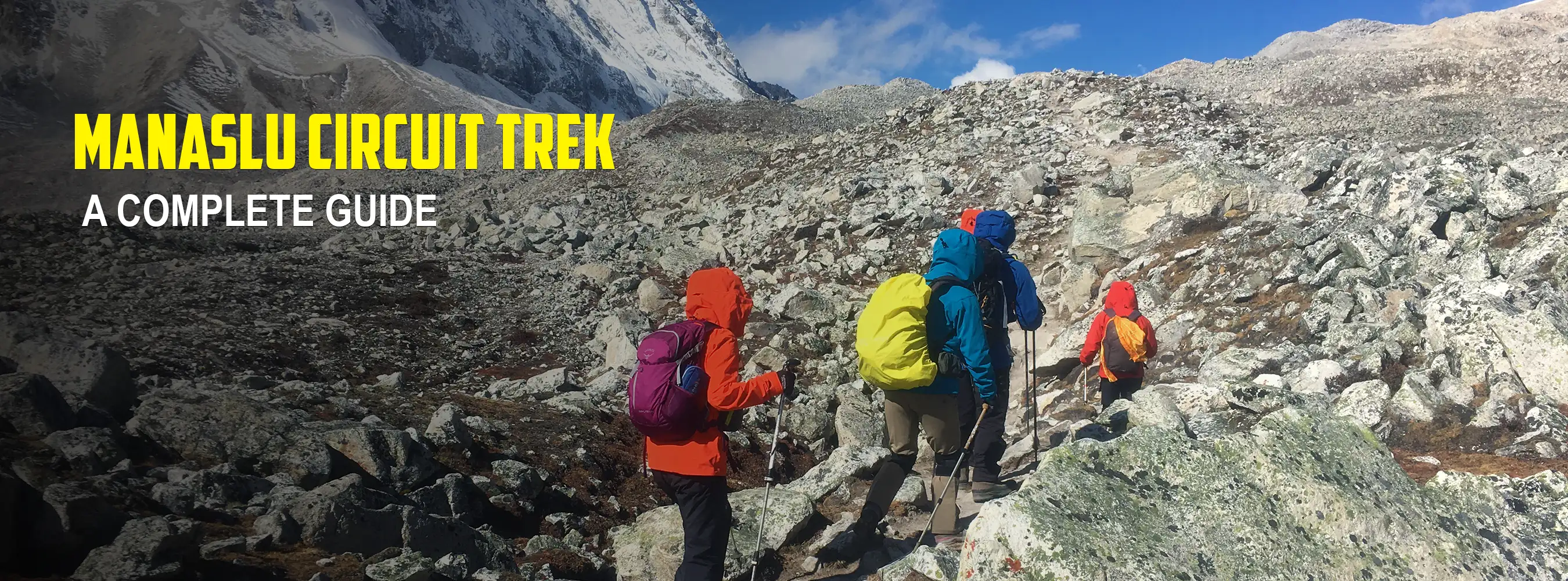
Manaslu Circuit Trek Guide 2026
Everything you need know for the Manaslu Circuit Trek in this Manaslu Circuit trek guide blog from distance, day-by-day itinerary, permit costs, booking steps, difficulty compared to Annapurna, the best season to go, and honest answers to the questions real trekkers are asking on Reddit and other forums.
What Is the Manaslu Circuit Trek?
The Manaslu Circuit Trek loops around Mount Manaslu (8,163 m), the eighth-highest mountain on Earth, through the Gorkha and Manang districts of west-central Nepal. Rather than heading to a single viewpoint or base camp, the route forms a full circuit: it follows the Budhi Gandaki River north through subtropical forest and Gurung villages, climbs into the high, Tibetan-influenced settlements of Nubri, crosses the 5,160 m Larkya La Pass, and descends into the Marsyangdi Valley on the Annapurna side, finishing near Dharapani.
Because the route sits inside a government-controlled Restricted Area, trekker numbers are capped compared with the Everest and Annapurna trails — most estimates put annual traffic in the 15,000–20,000 range, a fraction of the crowds on the classic circuits. That combination of dramatic scenery, mandatory guiding, and relatively light foot traffic is exactly why the Manaslu Circuit has become one of the most searched-for “next adventure” treks for people who have already done Everest Base Camp or the Annapurna Circuit.
Good to know: Since teahouses (small family-run lodges) now line the entire route, camping gear is no longer required. You’ll sleep and eat in teahouses every night, similar to Everest Base Camp or the
Manaslu Circuit Map & Which Districts It Crosses?
The trek starts with a road journey from Kathmandu into Gorkha District, the ancestral home of Nepal’s Shah dynasty and the district that gives the Manaslu Conservation Area its name. From the trailhead (Machha Khola or Soti Khola), the trail stays inside Gorkha District all the way to Samdo and the approach to Larkya La. Once you cross the pass and descend to Bimthang and Dharapani, you leave the Manaslu Conservation Area and enter Manang District, part of the Annapurna Conservation Area — the same district the Annapurna Circuit passes through. That is also why the trek legally requires both an MCAP and an ACAP permit: you genuinely cross two separate conservation areas and two districts in one trip.
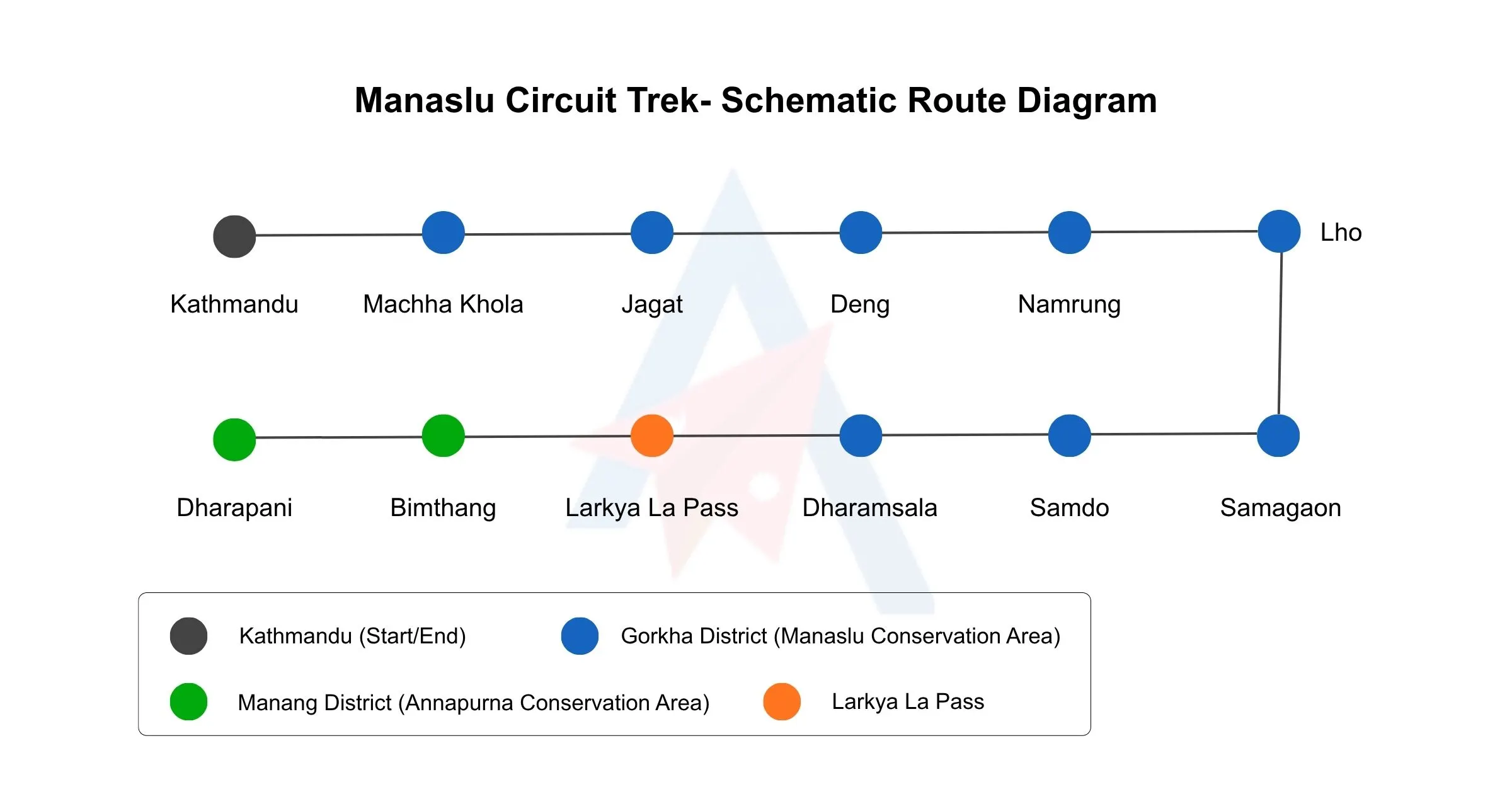
Simplified route diagram not to geographic scale. Always trek with a licensed guide who carries an official map and GPS.
How Long Is the Manaslu Circuit? Distance & Elevation Profile
The total trekking distance during the Manaslu Circuit trek is usually quoted between 150 km and 177 km (93–110 miles). The range exists because operators measure from different starting points. Some itineraries begin with a long drive all the way to Machha Khola or even Jagat, cutting out a full day of walking, while others start the classic way from Soti Khola or Arughat.
Whichever start point you use, you’ll average 10–15 km per day, walking 5 to 7 hours daily, with the Larkya La Pass day being by far the longest and hardest at up to 20–22 km.
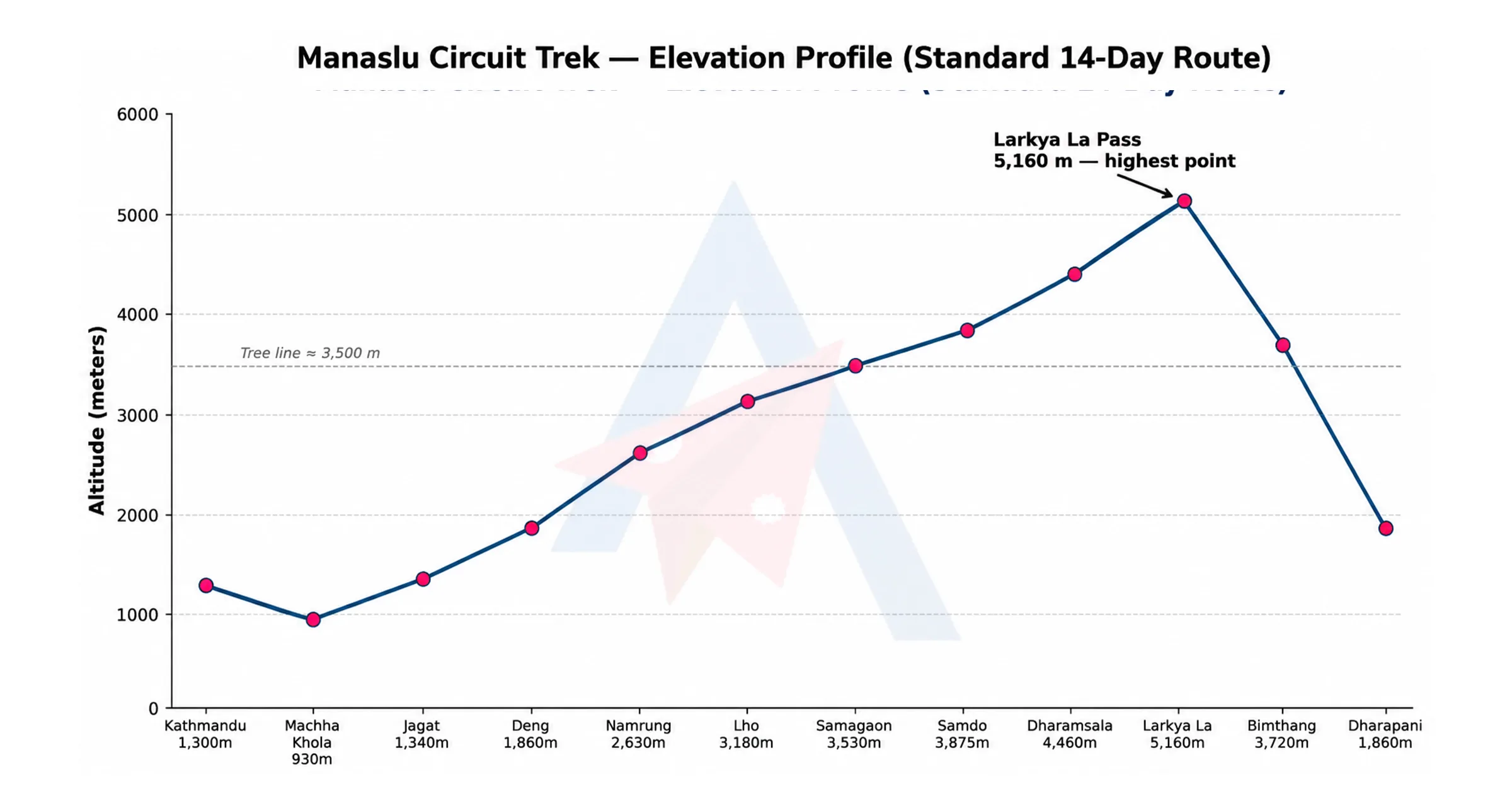
Elevation profile of the standard 14-day Manaslu Circuit itinerary
The gain is gradual by design — you climb from around 600–900 m at the trailhead to 5,160 m at the pass over roughly 10 walking days, which is what makes acclimatization manageable if you follow a sensible itinerary rather than a rushed one.
How many days is the Manaslu Circuit Trek Itinerary?
The standard Manaslu Circuit is 14 days itinerary from (Kathmandu to Kathmandu). How many days do you actually need? Most licensed agencies run a, which includes one built-in acclimatization day at Samagaon. Faster, fitter groups sometimes compress this to 11–12 days by driving further before starting to walk; more relaxed itineraries stretch to 16–18 days to add a second acclimatization day, a Manaslu Base Camp side trip, or the Tsum Valley extension.
Related Packages

Manaslu Circuit Trek - 14 Days
 5,160 m/16,952 feet
 Moderate to Challenging
 All
Inclusive Plan
All
Inclusive Plan
A spare day is strongly recommended in case of weather delays at the pass or road closures.
Tip: Always ask your agency whether their “12-day” or “13-day” itinerary counts arrival/departure days in Kathmandu. Two packages advertised at different lengths can involve the exact same number of walking days once you compare like for like.
Is a 7-Day Manaslu Circuit Itinerary Possible?
Honestly — not the full circuit. With around 150–177 km of trail and a 5,160 m pass that demands proper acclimatization, compressing the complete Manaslu Circuit into 7 days is not something any reputable agency will sell you, and attempting it sharply raises your risk of altitude sickness. If you see a “7-day Manaslu trek” advertised, check carefully what it actually includes; it is usually one of the following, not the full circuit over Larkya La:
A partial trek as far as Samagaon or Manaslu Base Camp and back the same way, skipping the Larkya La Pass and the Annapurna side entirely.
A trek-plus-helicopter package, where you walk in for 4–5 days and fly out from Samagaon rather than crossing the pass on foot.
Marketing shorthand that only counts walking days and excludes the Kathmandu drive-in/drive-out days.
If your schedule genuinely only allows a week, a partial Manaslu trek to Samagaon and Manaslu Base Camp with a helicopter return is the realistic way to see the mountain up close without cutting corners on safety.
Manaslu Circuit Trek Cost in 2026
Expect a standard guided package to land between USD 1,200 and USD 2,000 per person for a 12–15 day trip, including permits, a licensed guide, teahouse accommodation and three meals a day on the trail. Budget bare-bones setups (shared transport, no porter) can come in lower; private or luxury departures with a helicopter return can exceed USD 2,500–3,000. What’s usually not included: your Nepal tourist visa, international flights, travel insurance, tips, and personal spending on snacks, hot showers, and Wi-Fi at teahouses.
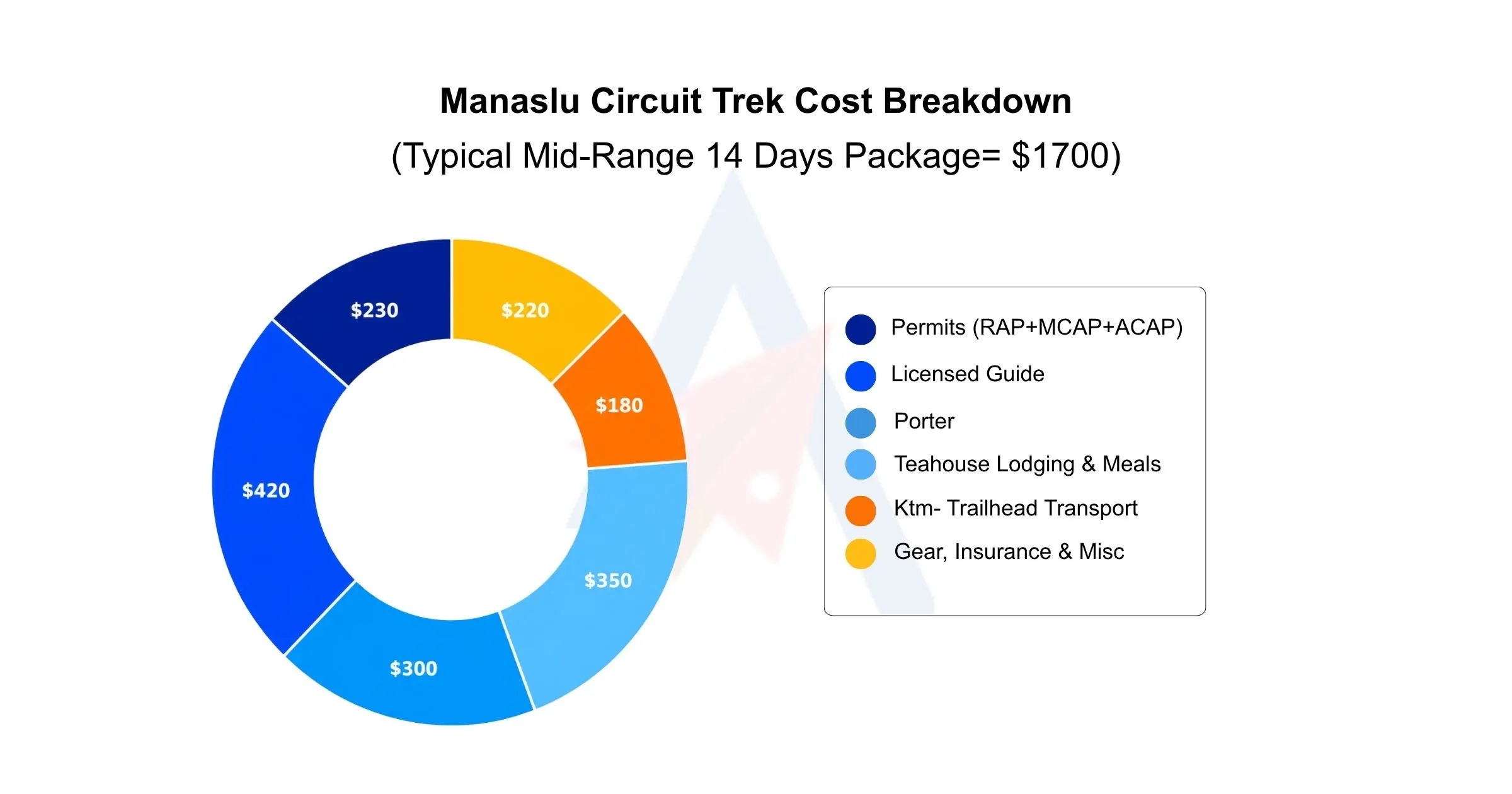
Illustrative cost breakdown for a mid-range 14-day guided package. Your actual split will vary by operator and group size.
| Cost Item | Typical range (USD) | Notes |
| Permits (RAP + MCAP + ACAP + local fee) | $150–$280 | Higher in autumn (Sep–Nov) |
| Licensed guide | $25–$35 / day | Mandatory by law in the restricted area |
| Porter | $20–$25 / day | Usually 1 porter shared between 2 trekkers |
| Teahouse lodging & meals | $25–$40 / day | Rises with altitude; basic rooms, shared bathroom |
| Kathmandu ↔ trailhead transport | $150–$250 | Jeep is faster and more comfortable than local bus |
| Insurance, gear rental, tips, extras | $150–$300 | High-altitude emergency evacuation cover is essential |
How to Book the Manaslu Circuit Trek?
Because the route lies inside a restricted area, you cannot simply show up and start walking — and as of March 2026, the process changed in one important way.
New in 2026: On 22 March 2026, Nepal’s Department of Immigration removed the old rule that forced solo travellers to be grouped with a second “ghost” trekker just to obtain a Restricted Area Permit. Solo trekkers can now apply individually.
What hasn’t changed: A licensed guide from a government-registered trekking agency is still legally required for every trekker on the Manaslu Circuit — fully independent, guideless trekking remains prohibited.
In practice, booking looks like this:
- Choose a registered agency (look for TAAN Trekking Agencies’ Association of Nepal) registration) and pick a fixed group departure or a private/custom date.
- Send your documents in advance: a passport scan valid for 6+ months, passport-size photos, and travel insurance details covering high-altitude trekking and helicopter evacuation up to at least 6,000 m.
- Arrive in Kathmandu with a buffer day before your trek start date — permits are processed with your original passport, and government offices close weekends and public holidays.
- Let the agency handle the paperwork. RAP, MCAP and ACAP are all arranged through the agency in Kathmandu; they cannot be issued at the trailhead.
Book at least a few weeks ahead in peak season (September–November) since permit processing and popular guide availability both get tighter as the season approaches.
Manaslu Circuit Trek Permits You’ll Need
A standard Manaslu Circuit Trek requires four permits to cover the standard circuit (a fifth is needed only if you add the Tsum Valley extension):
| Permit | Covers | Cost (Foreigners) |
| Restricted Area Permit (RAP) | Jagat → Dharapani | $75–$100 for the first 7 days (higher Sep–Nov), + $10–$15/day after |
| Manaslu Conservation Area Permit (MCAP) | Manaslu Conservation Area | ~$30 (NPR 3,000) flat, one-time |
| Annapurna Conservation Area Permit (ACAP) | Post-Larkya La descent to Dharapani | ~$30 (NPR 3,000) flat, one-time |
| Chumnubri Rural Municipality fee | Local trail & bridge maintenance | ~$15 (NPR 2,000) |
| Tsum Valley Permit (optional add-on) | Tsum Valley side trip | $30–$40 for the first week |
A TIMS card is not required for the Manaslu Circuit itself. The Restricted Area Permit (RAP)already tracks trekkers through checkpoints at Jagat, Namrung, Samdo and Larkya Phedi. You’d only need TIMS if you continue past Besisahar onto the wider Annapurna Circuit network.
Manaslu Circuit Trek Difficulty (and How It Compares)
Based on altitude, walking days, and terrain, Manaslu Circuit is graded moderate to challenging. The altitude (topping out at 5,160 m, well into the range where altitude sickness is a real risk without proper acclimatization), the length (14–18 days of sustained daily walking), and the terrain (rough, undulating trail with several long, steep days, especially the Larkya La crossing itself).
Bar chart comparing the Manaslu Circuit Trek to Poon Hill, Annapurna Circuit, Everest Base Camp, Everest Three Passes, and Upper Dolpo by maximum altitude, distance, and typical duration
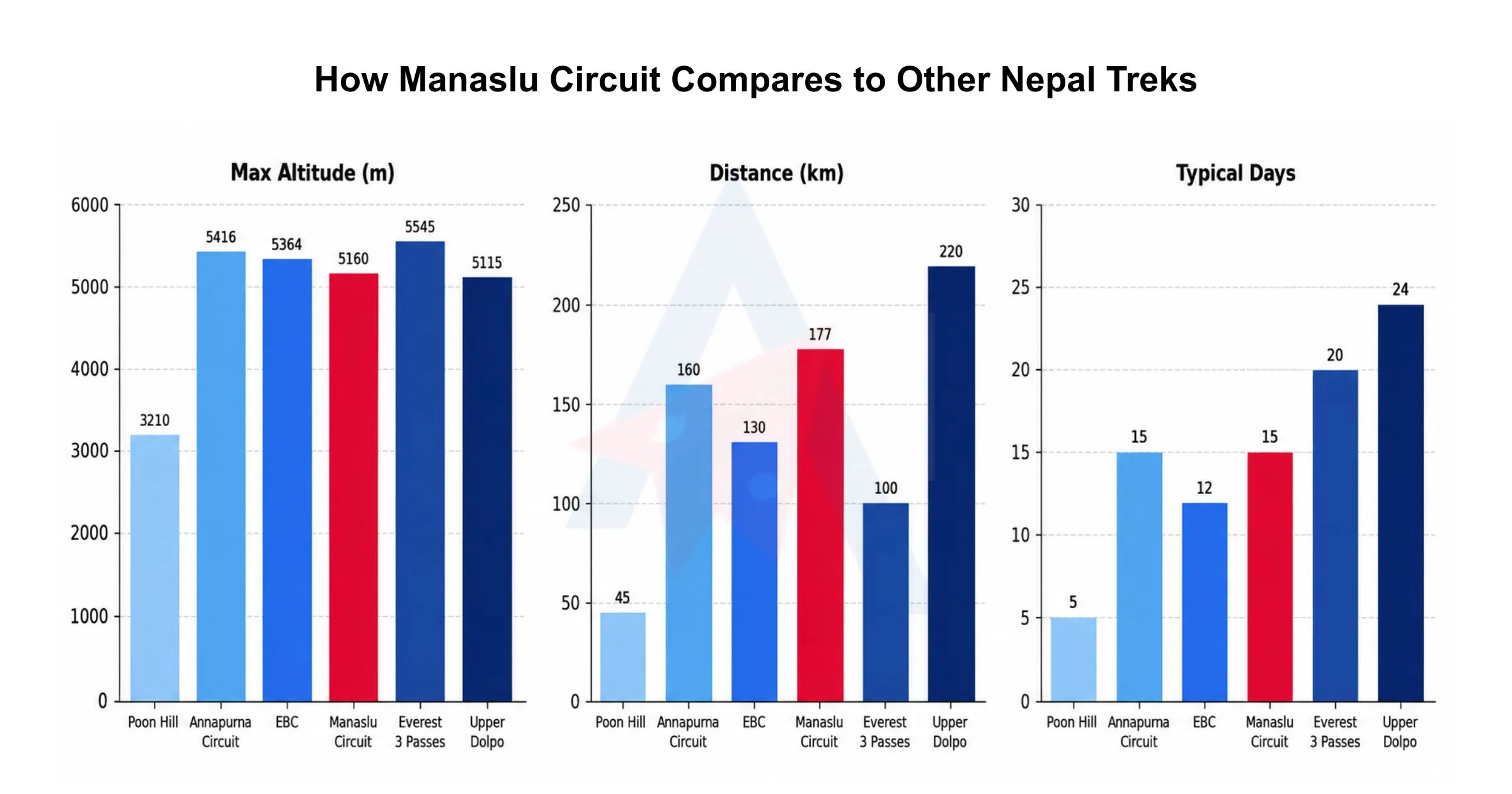
How Manaslu stacks up against other well-known Nepal treks.
Can a beginner do the Manaslu trek?
Yes, with real caveats. Trekkers with no prior high-altitude experience complete the Manaslu Circuit successfully every season, but it works best for a fit beginner: someone who has trained with regular cardio for a couple of months beforehand, walks with a licensed guide (mandatory anyway), builds in the acclimatization day rather than skipping it, and is prepared for basic teahouse facilities with no pharmacies or clinics along the route. It is not the trek to pick for a first-ever multi-day hike with zero physical preparation.
Is Manaslu harder than Annapurna?
Generally, yes, by a modest margin. The Annapurna Circuit’s Thorong La Pass (5,416 m) is actually higher than Manaslu’s Larkya La (5,160 m), so altitude alone doesn’t settle it. What tips the difficulty toward Manaslu is everything around the walking: fewer teahouses and rescue options, a mandatory guide and restricted-area logistics, rougher trail conditions in the lower valley, and a more remote, less-supported overall experience. Trekkers who’ve done both routes commonly describe Manaslu as the wilder, more physically demanding of the two, even though the two passes are broadly comparable in altitude.
Which is the toughest trek in Nepal?
There’s no single official ranking, but the treks most often cited as Nepal’s toughest are the Everest Three Passes Trek (three passes above 5,300 m in one trip), Upper Dolpo (extremely remote, 20+ days), and Kanchenjunga Base Camp (long approach, minimal infrastructure). The Manaslu Circuit sits a notch below these in most guides’ difficulty tables — genuinely challenging, but not usually ranked as the single hardest trek in the country.
Which is the cheapest trek in Nepal?
Short, non-restricted routes near Pokhara — especially the Ghorepani Poon Hill Trek (4–5 days, no special permits, no mandatory guide) — are typically the cheapest teahouse treks in Nepal, often completed for a few hundred dollars all-in. Restricted routes like Manaslu cost more by design, since the guide and multiple permits are non-negotiable.
Which is the best time to visit Manaslu Circuit Trek?
The diagram below is the bar chart showing month-by-month trekking suitability for the Manaslu Circuit, with spring (March to May) and autumn (late September to November) rated best.
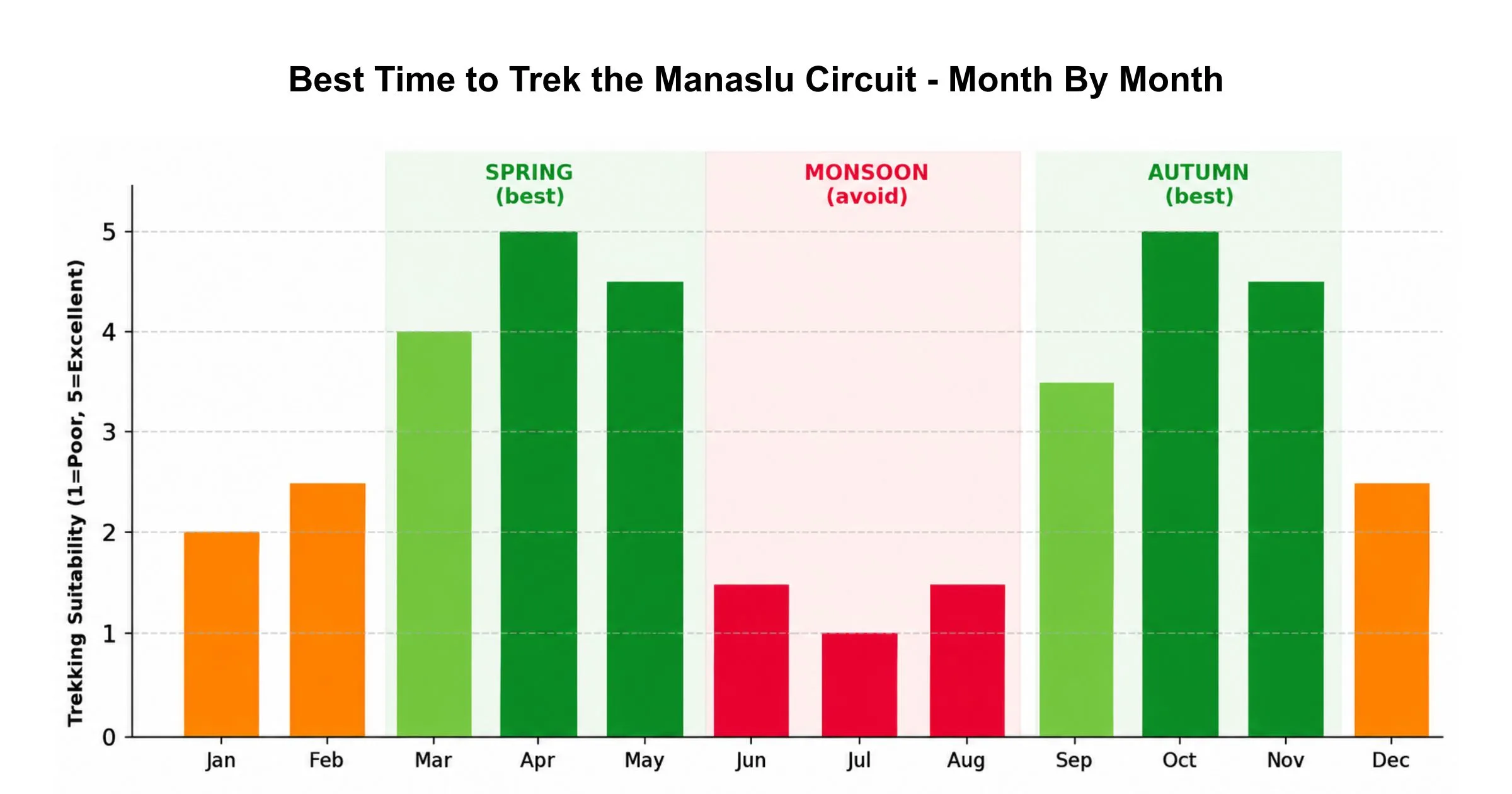
Autumn (Sep–Nov) and spring (Mar–May) are the two trekking windows; monsoon (Jun–Aug) is best avoided.
Autumn (late September to November) is generally considered the single best window — stable weather, the clearest mountain views of the year, and the lowest chance of Larkya La being snowed in. Spring (March to May) is a close second, adding rhododendron blooms in the lower valley at the cost of slightly hazier long-distance visibility. Winter (December–February) is workable for experienced, cold-tolerant trekkers who don’t mind fewer open teahouses and a real chance the pass closes after heavy snow. Monsoon (June–September) is the season to skip: leeches, slippery trails, landslide risk, and clouds that hide the very views you came for.
Weather on the Manaslu Circuit Trek
Because the route climbs from roughly 900 m to 5,160 m, you effectively pass through six climatic zones in two weeks — subtropical, temperate, sub-alpine, alpine and arctic. The result: it can be a warm, humid 20°C in the forest below Jagat on the same day it’s a windswept −10°C at Dharamsala. Nubri Valley also sits partly in a rain shadow, so it stays noticeably drier than similar altitudes on the Everest side.
| Season | Conditions | Larkya La Pass |
| Autumn (Sep–Nov) | Stable, dry, clearest views of the year | Usually snow-free, cold pre-dawn starts |
| Spring (Mar–May) | Mild, rhododendrons blooming, occasional afternoon cloud | May still hold leftover winter snow in shaded sections |
| Winter (Dec–Feb) | Very cold, dry, sunny days, short daylight | Frequently snowbound; some years the pass becomes impassable |
| Monsoon (Jun–Aug) | Hot, humid, daily rain, leeches, landslide risk below 3,000m | Poor visibility; Nubri Valley’s rain shadow helps a little above Samagaon |
Reality check: Unlike Everest Base Camp, a sudden Manaslu snowstorm isn’t something you can escape with a quick helicopter call or a nearby alternate village. The region is genuinely more isolated. Build in a buffer day and trust your guide’s call on delaying the pass crossing if the weather turns.
Packing List for the Manaslu Circuit Trek
The golden rule of Himalayan trekking is layering: a moisture-wicking base layer, an insulating mid layer, and a windproof/waterproof outer shell, adjusted as you move between subtropical valleys and the arctic conditions at the pass.
Documents & Money
- Passport (6+ months validity) + copies
- Passport photos for permits
- Travel insurance details (high-altitude + heli evacuation cover)
- USD cash in clean, undamaged notes — no ATMs past Arughat
Layering & Clothing
- Merino wool base layers (top & bottom)
- Fleece or light down mid layer
- Waterproof, windproof hard-shell jacket & pants
- Insulated down jacket for evenings above 3,500m
- Convertible trekking pants + shorts for lower valley
- Warm beanie, sun hat, neck buff, liner + insulated gloves
Footwear
- Broken-in waterproof trekking boots with ankle support
- Camp shoes/sandals for evenings at teahouses
- Gaiters, wool trekking socks, liner socks
- Microspikes (useful for icy sections near the pass)
Health & Gear
- 4-season sleeping bag (rated to at least −20°C)
- Trekking poles — genuinely important on the Larkya La descent
- Water purification tablets or filter (not enough ATMs or shops for endless bottled water)
- Diamox (if prescribed), basic first-aid kit, blister care, painkillers
- Headlamp + spare batteries (Larkya La day starts at 3–4 a.m.)
- UV-rated sunglasses (snow glare near the pass), SPF 50 sunscreen & lip balm
- Power bank (20,000 mAh+) — charging gets expensive and unreliable above 3,500m
Pack light: If you’re hiring a porter, standard weight limits apply (commonly 20–25 kg, often shared between two trekkers). Anything beyond your duffel allowance is your own carry-on weight for the day.
Culture and Tradition in the Manaslu Region
The upper Manaslu region, which is also known as Nubri, is ethnically and culturally Tibetan, settled centuries ago by communities who crossed the passes from Tibet. From Namrung upward, villages are built around gompas (monasteries), chortens (stupas) and long mani walls carved with the Buddhist mantra Om Mani Padme Hum. Lower down, around Jagat and Philim, the population is predominantly Gurung, with its own distinct language, dress and festivals, before the trail transitions into Tibetan-Buddhist Nubri culture around Lho and Sama Gaon.
A few customs worth knowing before you go:
- Pass chortens and mani walls on the left, walking clockwise, as is traditional Buddhist practice.
- Spin prayer wheels clockwise with your right hand if you choose to spin them at all.
- Ask before photographing people, monasteries, or interiors of gompas — some inner shrine rooms are off-limits to visitors entirely.
- Dress modestly, especially near monasteries, and remove hats and sunglasses when entering religious buildings.
- Use your right hand (or both hands) when giving or receiving anything, including money and food.
Ribung Gompa above Lho and Pungyen Gompa near Samagaon are two of the most visited monasteries on the route; the latter has a particularly strong connection to Manaslu itself, as the mountain is considered sacred by the Nubri community, which historically discouraged its ascent for religious reasons.
Tipping Culture in Nepal (Guide & Porter)
Tipping isn’t legally mandatory in Nepal and isn’t historically part of local custom, but it’s become a well-established expectation in the trekking industry, where it can make up a significant share of a guide’s or porter’s seasonal income. The standard approach: give a single lump sum on the last evening of the trek, in cash, rather than tipping daily.
| Role | Typical tip (14-day trek) | Notes |
| Lead guide | USD 150–300 total (~$15–20/day) | Higher for exceptional service, small groups, or private treks |
| Porter | USD 100–180 total (~$8–15/day) | Tip each porter individually if you have more than one |
| Driver (Kathmandu to trailhead) | USD 5–10 | One-time tip, not per day |
Etiquette that matters: While tipping the tip should be in clean, undamaged US dollar notes or Nepali rupees. The torn or heavily worn notes can be hard for recipients to use. In a group, pool tips together and present them as one gift rather than several small, uneven ones. And avoid token amounts of $1–2 after a multi-day trek; if your budget is genuinely tight, a smaller tip paired with a sincere thank-you (and a detailed online review naming your guide) is far better than nothing.
Transport To and From the Trailhead
There’s no airstrip in the Manaslu region, so every trekker reaches the trailhead by road. There is no shortcut by air on the way in.
| Route | Option | Cost in USD | Duration |
| Kathmandu → Machha Khola / Soti Khola | Local Bus | $10–20 | 8–10 hrs, rough after Arughat |
| Kathmandu → Machha Khola / Soti Khola | Shared jeep/person 7–8 hrs | $30–40/per person | 7-8hrs |
| Kathmandu → Machha Khola / Soti Khola | Private jeep | $150–280 / vehicle | 6–8 hrs, most comfortable |
| Dharapani / Tilje → Besisahar | Shared or private jeep | $20–35 / person (shared) | 3–4 hrs |
| Besisahar → Kathmandu / Pokhara Bus or jeep $10– | $10-40 | 5–6 hrs |
The road now reaches slightly beyond Soti Khola to Machha Khola, which shaves roughly half a day of walking off the traditional itinerary — some agencies start the trek there instead of at Soti Khola. During monsoon (June–early October), the road beyond Soti Khola can become impassable for buses, forcing a switch to jeeps for the final stretch.
Related Packages
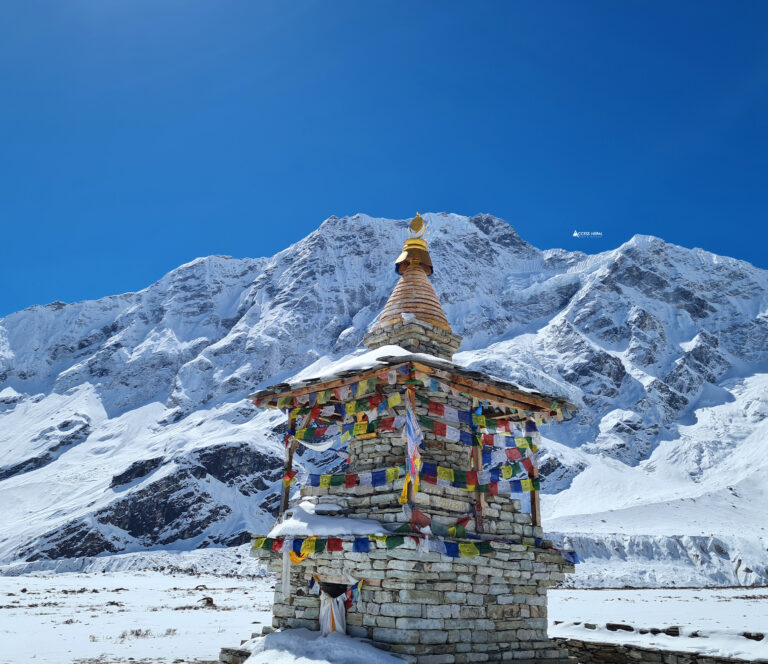
Manaslu Tsum Valley Trek - 18 Days
- 5,106m/16,752ft
-
Challenging
- All
Inclusive Plan
There is currently no domestic flight or scheduled helicopter service directly to the trailhead. A helicopter is only realistic as an emergency evacuation for the Manaslu Circuit Trek or an optional exit from Samagaon on a shortened itinerary, and typically costs $700 per seat.
Manaslu Circuit Trek: Frequently Asked Questions
How long is the Manaslu Circuit?
Around 150–177 km depending on start point and side trips, typically walked over 14–18 days including acclimatization and Kathmandu travel days.
Is Manaslu Circuit a restricted area trek?
Yes. The section between Jagat and Dharapani is a government-controlled Restricted Area, which means a Restricted Area Permit and a licensed guide are both mandatory — you cannot trek this route independently without an agency.
Can a beginner do Manaslu trek?
A physically fit beginner with a licensed guide, sensible acclimatization, and some pre-trip cardio training can complete it, but it’s not a true “first trek ever” route because of the altitude and remoteness.
Plan Your Manaslu Circuit Trek with Access Nepal Tour and Treks
Confirm your dates, book with a TAAN-registered agency, and start your permit paperwork at least a few weeks out, especially if you’re aiming for the autumn window. The mountain, the pass, and the Tibetan-influenced villages along the way are worth every step of the planning.
Awards and Achievements
Access Nepal Tour and Treks has been recognized with TripAdvisor’s prestigious Travelers’ Choice Award for multiple consecutive years, reflecting our unwavering commitment to quality and clients’ satisfaction.