OFF
Discounts are solely based on your group size. We do not add anyone to your group.
- Best Price Guarantee
- Hassle-Free Booking
- Team of highly experienced Experts
- Your Happiness Guaranteed
Book Now. No Booking or Credit Card Fee
- Schedule Your Own Dates
- Group Discounts
- Guaranteed Departures
- Easy Cancellation
- 60% Repeated Customers
-

- Duration
- 22 Days
-

- Transportation
- Flight and Private Jeep
-

- Trip Grade
- Strenuous
-

- Max-Altitude
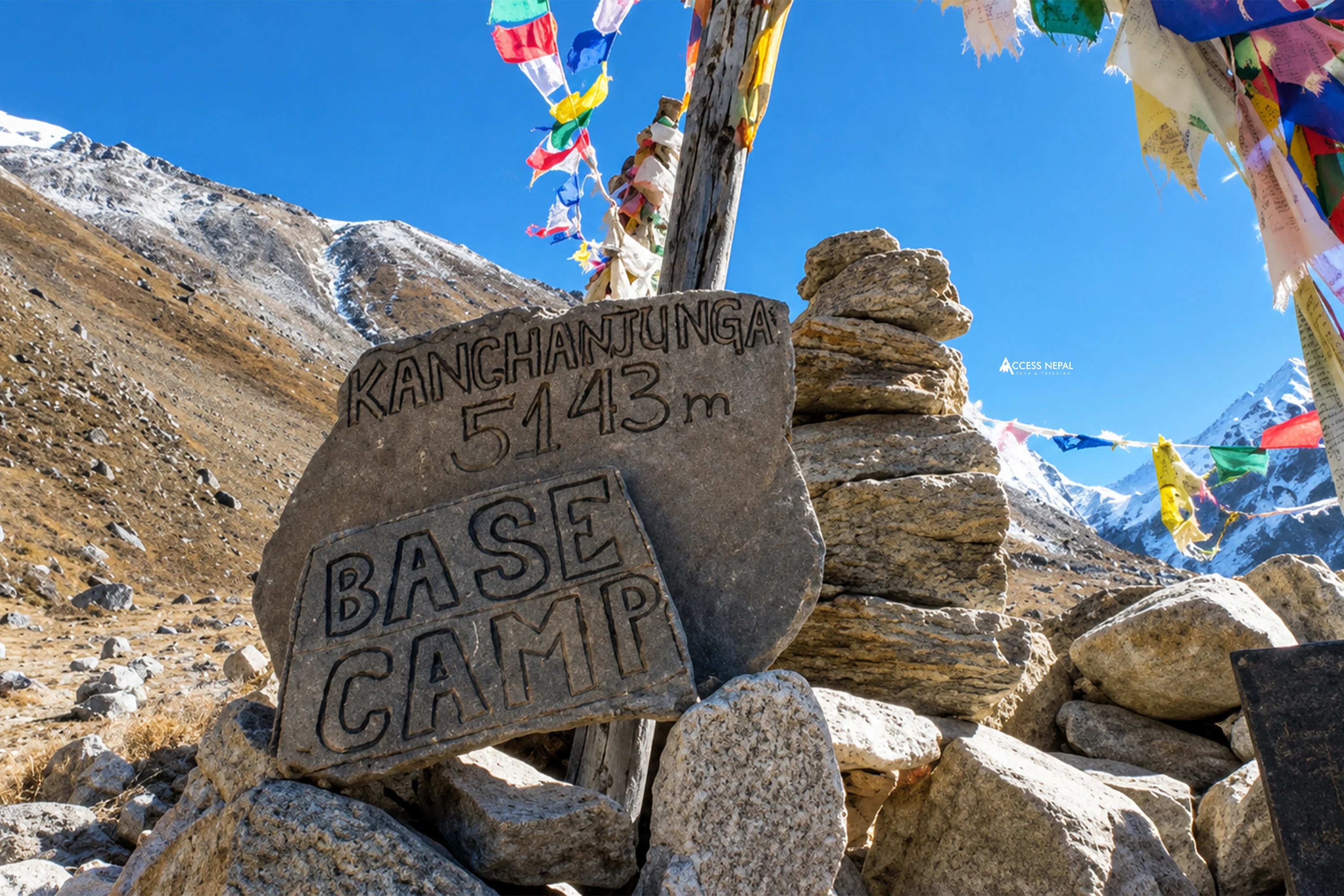
- 5,143 m / 16,863 ft (Pangpema)
-

- Accomodation
- Teahouse and Lodge
-

- Primary Activity
- Trekking
-

- Meals
- Breakfast, Lunch and Dinner on the trek
-

- Best Season
- Spring and Autumn
-

- Distance
- 300 km total (Including Trek, Drive and Flight)
Introduction to Kanchenjunga Base Camp Trek
The Kanchenjunga Base Camp Trek is a 22-day trek to the north and south base camps of Mount Kanchenjunga (8,586m), the world’s third-highest mountain. It is a remote, restricted-area route in eastern Nepal’s Taplejung district, covering both Pangpema (North Base Camp, 5,143m) and Oktang (South Base Camp viewpoint, 4,730m). The trek is graded Strenuous and is best suited to experienced high-altitude trekkers.
| Category | Detail |
| Duration | 22 days |
| Max Altitude | 5,143m / 16,863ft at Pangpema (North Base Camp) |
| Cost | US$3,290 per person |
| Difficulty | Strenuous / Challenging |
| Permits | Restricted Area Permit (RAP) + Kanchenjunga Conservation Area Permit (KCAP) |
| Best Season | Spring (March–May) and Autumn (September–November) |
| Region | Taplejung District, eastern Nepal |
| Start / End | Kathmandu (flight to Bhadrapur) / Kathmandu |
Kanchenjunga Base Camp Trek Overview
Mount Kanchenjunga is the third-highest mountain in the world, rising to 8,586 meters (28,169 feet) on the border between Nepal’s Taplejung district and the Indian state of Sikkim. It is the highest peak in the Kanchenjunga Himal section of the Himalayas. Until 1852, it was believed to be the highest mountain in the world before Everest was confirmed taller.
The Kanchenjunga Base Camp Trek, also known as the Kanchenjunga Circuit Trek or the Kanchenjunga North and South Base Camp Trek, takes you into the far eastern corner of Nepal, a region that sees very few trekkers compared to Everest or Annapurna. The trail begins with a flight from Kathmandu to Bhadrapur in the eastern Terai, followed by a long drive through tea-growing hills to Taplejung. From there, you walk north along the Tamor River, then follow the Ghunsa Khola into the heart of the Kanchenjunga Conservation Area.
What makes this trek different is the quiet. Some days you may not see another trekking group. The villages along the Kanchenjunga trekking route, namely Chirwa, Sekathum, Amjilosa, Gyabla, Ghunsa, Khambachen, Lhonak, are small and basic, with stone houses and teahouses that offer simple food and shared bathrooms.
Above Ghunsa, the landscape shifts from forest to alpine scrub and then to glacial moraine. The trees disappear. The air gets thin and cold. By the time you reach Lhonak at 4,790m, you are well above the tree line, sleeping in basic stone shelters.
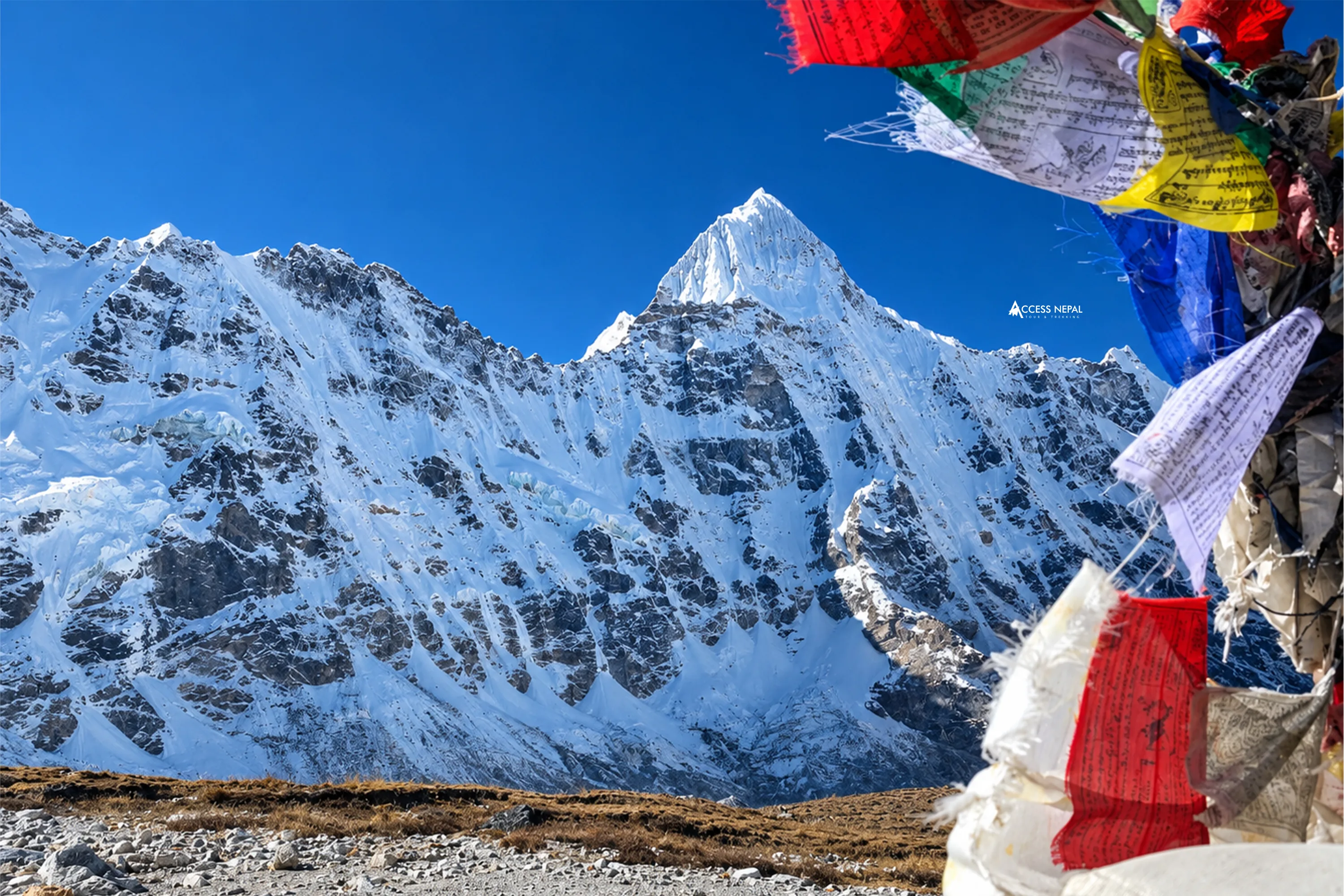
The destination is Pangpema (North Base Camp) at 5,143m. From there, the north face of Kanchenjunga rises three and a half thousand meters directly across the glacier. On clear days, Makalu is visible to the west, along with the long ridge of Chamlang.
The classic views of Everest and Lhotse are typically seen from the south side of the circuit, not from Pangpema. It is a big view, earned over many days of walking.
This is not a trek for beginners. It is remote, long, and demanding. But for travellers who want solitude, raw mountain scenery and a genuine sense of distance from the modern world, the Kanchenjunga Circuit Trek delivers.
Kanchenjunga Base Camp Trek Highlights
- The North Face of Kanchenjunga from Pangpema
Standing at Pangpema (5,143m) and looking across the glacier at the north face of Kanchenjunga is the defining moment of this trek. The wall of ice and rock climbs from base camp to the summit, which is a vertical rise of about 3,500 meters. On a clear day, Makalu is visible to the west, along with the long ridge of Chamlang.
- Jannu (Kumbhakarna) Views
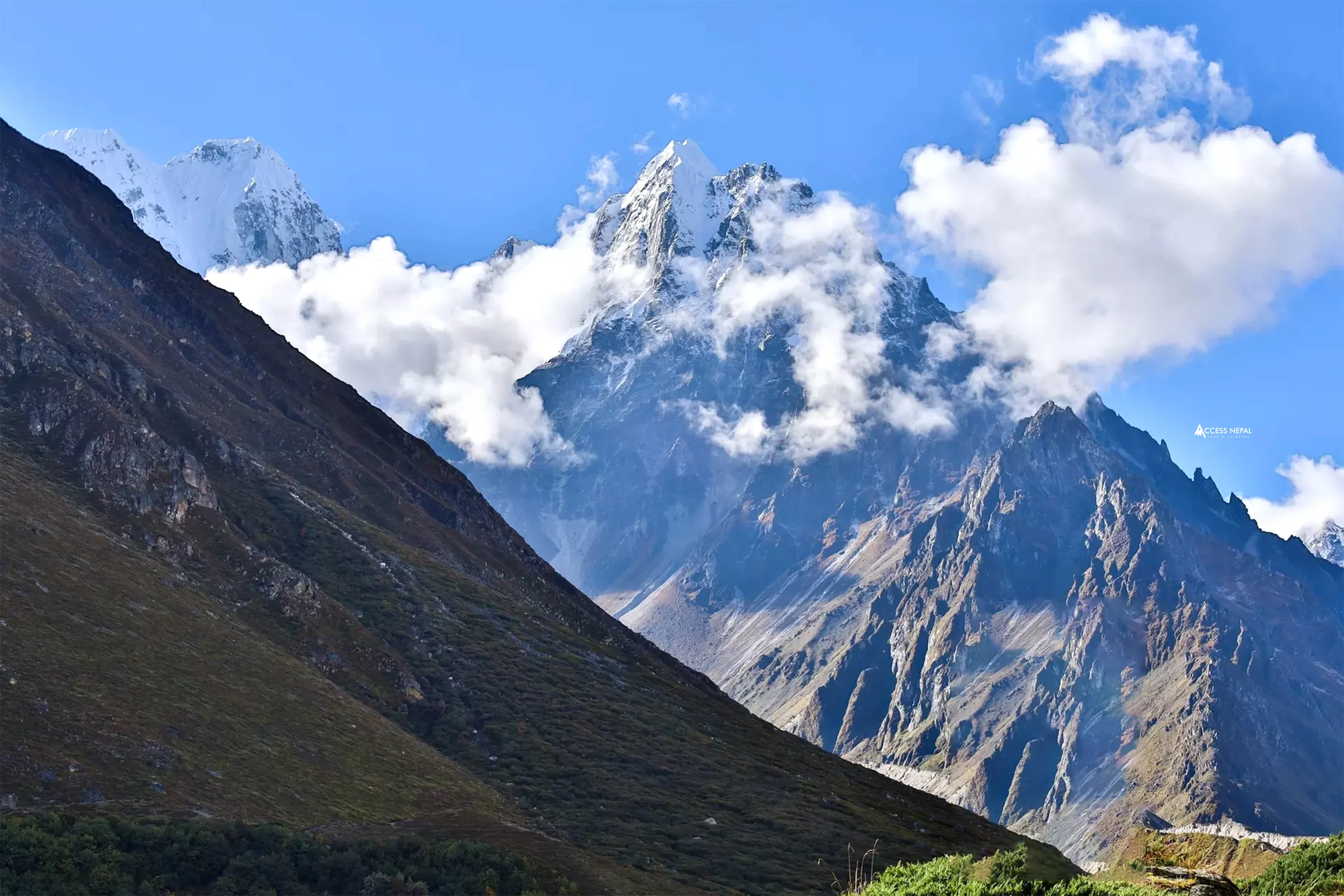
From Khambachen and the trail above it, you get your first close views of Jannu, a striking 7,711m peak that stands apart from the main Kanchenjunga massif. The glacier below it is visible from the trail, and you can hear it creaking and cracking.
- Tibetan-Influenced Villages
Ghunsa is the largest village in the upper valley, with stone-walled houses, flat roofs, a working monastery, a health post, a school, and a small hydropower station. Firewood is stacked against the walls. Above Ghunsa, Khambachen and Lhonak have a similar Tibetan character, though smaller and more basic.
- Solitude and Remoteness
The Kanchenjunga region sees a fraction of the trekkers that Everest or Annapurna receive. Some days you walk for hours without meeting anyone. By the time you reach Sekathum, you are two days’ walk from the nearest road.
- Rhododendron and Forest Sections
The lower trail from Chirwa to Gyabla passes through subtropical broadleaf forest, then oak and rhododendron. Red panda habitat exists in the bamboo and rhododendron zones, though sightings depend on luck.
- The Tamor River and Ghunsa Khola Valleys
The trail follows the Tamor River through terraced farmland, then turns north into the Kanchenjunga valley. The rivers are grey-green with glacial sediment, and the sound of water is constant in the lower sections.
- Lhonak and the Glacial Landscape
Lhonak (4,790m) sits in a flat area of rubble and frozen ground, surrounded by unnamed six- and seven-thousand-meter peaks. The trail from Khambachen follows the northern moraine of the Kanchenjunga Glacier, which has loose rock, boulders, and ground that thaws in the midday sun and refreezes at night. It feels like another world.
- The Crossing of Sele La
The trek crosses from the north side of the circuit to the south via Sele La (4,290m), a pass that connects two distinct valleys. From the top, you look out over the surrounding peaks before descending steeply to Cheram.
Kanchenjunga Base Camp Trek Itinerary
Day 01Arrival in Kathmandu
-
- Flight dependent
-
- 1,400 m / 4,593 ft (Kathmandu)
-
- Full day
-

- 1,400 m / 4,593 ft
Day 02Fly Kathmandu to Bhadrapur, Drive to Taplejun
-
- About 240 km drive
-
- 1,820 m / 5,971 ft
-
- 45-minute flight and 7 to 8 hour drive
-
- 1,820m / 5,971 ft (Taplejung)
Day 03Taplejung to Chirwa
-
- 10 km
-
- 1,270 m / 4,167 ft
-
- 5 to 6 hours
-

- 1,270 m / 4,167 ft (Chirwa)
Day 04Chirawa to Sekathum
-
- 13 km
-
- 1,660 m / 5,446 ft (Sekathum)
-
- 5 to 6 hours
-
- 1,660 m / 5,446 ft (Sekathum)
Day 05Sekathum to Amjilosa
-
- 9 km
-
- 2,510 m / 8,235 ft (Amjilosa)
-
- 5 to 6 hours
-
- 2,510 m / 8,235 ft (Amjilosa)
Day 06Amjilosa to Gyabla
-
- 10 km
-
- 2,730 m / 8,957 ft (Gyabla)
-
- 4 to 5 hours
-
- 2,730 m / 8,957 ft (Gyabla)
Day 07Gyabla to Ghunsa
-
- 9 km
-
- 3,595 m / 11,795 ft (Ghunsa)
-
- 4 to 5 hours
-
- 3,595 m / 11,795 ft (Ghunsa)
Day 08Acclimatization Day at Ghunsa
-
- Short acclimatization hike, depends on destination
-
- About 4,000m (on acclimatization hike)
-
- 3 to 4 hours
-
- 3,595 m / 11795 (Ghunsa)
Day 09Ghunsa to Khambachen
-
- 11 km
-
- 4,145 m / 13,600 ft (Khambachen)
-
- 5 to 6 hours
-
- 4,145 m / 13,600 ft (Khambachen)
Day 10Acclimatization Day at Khambachen
-
- Short, depending on the plan
-
- About 4,700 m / 15,420 ft (on acclimatization hike)
-
- 4 to 5 hours
-
- 4,145 m / 13,600 ft (Khambachen)
Day 11Khambachen to Lhonak
-
- 10 km
-
- 4,790 m / 15,715 ft
-
- 4 to 5 hours
-
- 4,790 m / 15,715 ft
Day 12Lhonak to Pangpema (North Base Camp) and back to Lhonak
-
- 18 km round trip
-
- 5,143 m / 16,873 ft
-
- 6 to 7 hours
-
- 4,790 m / 15,715 ft (Lhonak)
Day 13Lhonak to Khambachen
-
- 10 km
-
- 4,790 m / 15,715 ft (Lhonak)
-
- 4 to 5 hours
-
- 4,145 m / 13,600 ft (Khambachen)
Day 14Khambachen to Ghunsa
-
- 15 km
-
- 4,145 m / 13,600 ft (Khambachen)
-
- 5 to 6 hours
-
- 3,595 m / 11,795 ft (Ghunsa)
Day 15Ghunsa to Sele La Base Camp
-
- 12 km
-
- 4,200 m / 13,780 ft (Sele La Base Camp)
-
- 6 to 7 hours
-
- 4,200 m / 13,780 ft (Sele La Base Camp)
Day 16Sele La Base Camp to Cheram via Sele La Pass
-
- 10 km
-
- 4,290 m / 14,074 ft (Sele La Pass)
-
- 5 to 6 hours
-
- 3,870 m / 12,696 ft (Cheram)
Day 17Cheram to Ramche, visit Oktang (South Base Camp)
-
- 13 km round trip
-
- 4,730 m / 15,518 ft (Oktang)
-
- 6 to 7 hours
-
- 4,580 m / 15,026 ft (Ramche)
Day 18Ramche to Tortong
-
- 16 km
-
- 4,580 m / 15,026 ft (Ramche)
-
- 6 to 7 hours
-
- 2,980 m / 9,777 ft (Tortong)
Day 19Tortong to Yamphudin
-
- 13 km
-
- 2,980 m / 9,777 ft (Tortong)
-
- 5 to 6 hours
-
- 2,080 m / 6,824 ft (Yamphudin)
Day 20Yamphudin to Taplejung
-
- 12 km trek and short jeep transfer
-
- 2,080 m / 6,824 ft (Yamphudin)
-
- 4 to 5 hours
-
- 1,820 m / 5,971 ft (Taplejung)
Day 21Drive to Bhadrapur, Fly to Kathmandu
-
- 240 km drive, 45-minute flight
-
- 1,820 m / 5,971 ft (Taplejung)
-
- 7 to 8 hours drive, 45-minute flight
-
- 1,400 m / 4,593 ft (Kathmandu)
Day 22Final Departure
-
- Depends on your destination
-
- 1,400 m / 4,593 ft (Kathmandu)
-
- Depends on your destination
-
- Depends on your destination
- Airport transfer in Kathmandu, both pick-up and drop-off.
- Welcome dinner at a Nepali restaurant with a cultural performance.
- Twin-sharing accommodation for two nights at a luxurious hotel in Kathmandu.
- Domestic flight from Kathmandu to Bhadrapur.
- Domestic flight from Bhadrapur to Kathmandu.
- Private jeep transfer from Bhadrapur to Taplejung.
- Private jeep transfer from Taplejung road head to Bhadrapur.
- 18 nights of accommodation in mountain teahouses and lodges, plus 1 night in basic stone shelters at Sele La Base Camp.
- Three meals per day during the trek: breakfast, lunch and dinner.
- Seasonal fruits and three cups of tea or coffee per day during the trek.
- One experienced, government-licensed, English-speaking guide for a maximum of seven trekkers, with insurance and expenses covered.
- One porter for every two trekkers, with insurance and expenses covered.
- Hot showers and attached toilet facilities in some teahouses.
- Chlorine tablets for water purification.
- Access Nepal T-shirt, duffel bag and trekking map as complimentary gifts.
- Sleeping bags and down jackets upon request.
- Adventure certificate after completing the trek.
- Basic first-aid kit carried by the guide.
- Kanchenjunga Conservation Area Permit and Restricted Area Permit
- International flights to and from Kathmandu.
- Nepal visa fee.
- Travel insurance. This must cover helicopter evacuation, medical expenses and trip cancellation. It is compulsory.
- Meals in Kathmandu, except the welcome dinner and farewell dinner.
- Personal expenses such as drinks, snacks, laundry and confectionery.
- Wi-Fi and charging of electronic devices on the trek.
- Hot showers where teahouses charge extra.
- Tips for guides, porters and drivers.
- Personal trekking equipment and clothing.
- Extra porterage service if needed.
- Additional transport outside the itinerary.
- Extra nights in Kathmandu or along the route due to weather delays, flight cancellations or landslides.
- Any other expenses or charges not mentioned in the Trip Includes list
Kanchenjunga Base Camp Trek Departures 2026/2027
Our groups are small with maximum 14 people. We create groups of independent travelers, friends and families which maintains close interpersonal connection, engage more and get into depth of the journey. Choose a date from the calendar to reserve your spot.
Kanchenjunga Trekking Route 22 Days

Things to Know Before Booking Kanchenjunga Base Camp Trek
Kanchenjunga Base Camp Trek Route
| Day | Route | Key Points |
| 1 | Arrival in Kathmandu | Trip briefing, gear check, welcome dinner (1,400m) |
| 2 | Kathmandu to Bhadrapur to Taplejung | Flight to Bhadrapur, drive through Ilam tea hills to Taplejung (1,820m) |
| 3 | Taplejung → Chirwa | Descend to Tamor River valley, terraced farmland, Limbu/Rai villages (1,270m) |
| 4 | Chirwa to Sekathum | Follow Tamor, then Ghunsa Khola, subtropical forest, suspension bridge (1,660m) |
| 5 | Sekathum to Amjilosa | Climb through oak and rhododendron, small Tibetan-influenced settlement (2,510m) |
| 6 | Amjilosa to Gyabla | Rhododendron and bamboo forest, red panda habitat, waterfalls (2,730m) |
| 7 | Gyabla to Ghunsa | Pass Phale potato fields, pine forest, largest village in upper valley (3,595m) |
| 8 | Ghunsa (Acclimatisation) | Short hike to ~4,000m, return to sleep at 3,595m |
| 9 | Ghunsa to Khambachen | Mani walls, chortens, landslide zone, first views of Jannu (4,145m) |
| 10 | Khambachen (Acclimatisation) | Hike toward Jannu base camp viewpoint (~4,700m), return to 4,145m |
| 11 | Khambachen to Lhonak | Northern moraine of Kanchenjunga Glacier, barren glacial landscape (4,790m) |
| 12 | Lhonak to Pangpema to Lhonak | Early start to North Base Camp (5,143m), return to Lhonak |
| 13 | Lhonak to Khambachen | Retrace route down valley, juniper then alpine scrub (4,145m) |
| 14 | Khambachen to Ghunsa | Down the Ghunsa Khola valley, alpine meadows, pine and rhododendron forest (3,595m) |
| 15 | Ghunsa to Sele La Base Camp | Climb through rhododendron and juniper to high camp (4,200m) |
| 16 | Sele La Base Camp to Cheram via Sele La | Cross Sele La (4,290m), steep descent past small lake (3,870m) |
| 17 | Cheram to Ramche to Oktang | Yalung Glacier, South Base Camp viewpoint (4,730m), return to Ramche (4,580m) |
| 18 | Ramche to Tortong | Long descent via Tseram, rhododendron and mixed forest (2,980m) |
| 19 | Tortong to Yamphudin | Descend through subtropical forest and terraced farmland, Limbu/Rai village (2,080m) |
| 20 | Yamphudin to Taplejung | Final walking day, then jeep transfer to Taplejung (1,820m) |
| 21 | Taplejung to Bhadrapur to Kathmandu | Drive to Bhadrapur, flight to Kathmandu (1,400m) |
| 22 | Final Departure | Transfer to Tribhuvan International Airport |
We will follow this route to complete the Kanchenjunga North and South Base Camp Trek in Nepal, which links both base camps in a single circuit. The journey begins with a flight from Kathmandu to Bhadrapur in the eastern Terai, followed by a drive north through the tea-growing hills of Ilam district to Taplejung, the district headquarters and gateway to the Kanchenjunga region.
From Taplejung, the trail descends toward the Tamor River valley, passing through terraced farmland and forested slopes dotted with Limbu and Rai settlements. You’ll follow the Tamor River through rice paddies and bamboo groves to Chirwa, then continue north to Sekathum, where the Tamor and Ghunsa Khola rivers meet. A long suspension bridge crosses the Tamor near Sekathum, swaying gently above the water.
The route then turns up the Ghunsa Khola, the river that drains the Kanchenjunga valley. The trail passes through subtropical broadleaf forest with sal, chilaune, and schima trees, then climbs gradually through oak and rhododendron.
Wildlife is more active in this stretch, though sightings are never guaranteed. You’ll pass through Amjilosa, a small Tibetan-influenced settlement, then Gyabla, also called Kyapra, before reaching Ghunsa at 3,595m.
Ghunsa is the main Sherpa settlement on this trek. There is a working monastery, a health post, a school, and a small hydropower station.
From Ghunsa, the trail continues north along the southern bank of the Ghunsa Khola, passing several religious sites along the way. You’ll cross a landslide zone and a waterfall before reaching Ramtang, a temporary yak herders’ camp, then continue through rocky terrain and glacial moraine to Khambachen at 4,145m.
Above Khambachen, the landscape opens up. On clear days, you get your first close views of Jannu (Kumbhakarna) at 7,711m. The trail continues up the valley toward Lhonak at 4,790m. This is moraine terrain with loose rock, boulders, and frozen ground.
From Lhonak, you’ll make the early morning hike to Pangpema, the North Base Camp at 5,143m. The trail follows the moraine wall of the Kanchenjunga Glacier, crossing several ridges of rubble. After about three hours, the basin of Pangpema comes into view.
From here, the north face of Kanchenjunga rises directly across the glacier.
After returning to Lhonak, the route retraces down the valley to Khambachen and then to Ghunsa. From Ghunsa, the trek climbs to Sele La Base Camp, then crosses from the north side of the circuit to the south via Sele La at 4,290m.
This pass is the gateway between two distinct worlds, connecting the Kanchenjunga North and South Base Camp sections.
After crossing the pass, the descent to Cheram is steep, dropping through rocky terrain past a small lake to the village at 3,870m.
From Cheram, the trail climbs toward the Yalung Glacier, also called the Kanchenjunga South Glacier. You’ll pass through grassy meadows alongside the Simbua River to Ramche at 4,580m, then continue to Oktang at 4,730m, the South Base Camp viewpoint.
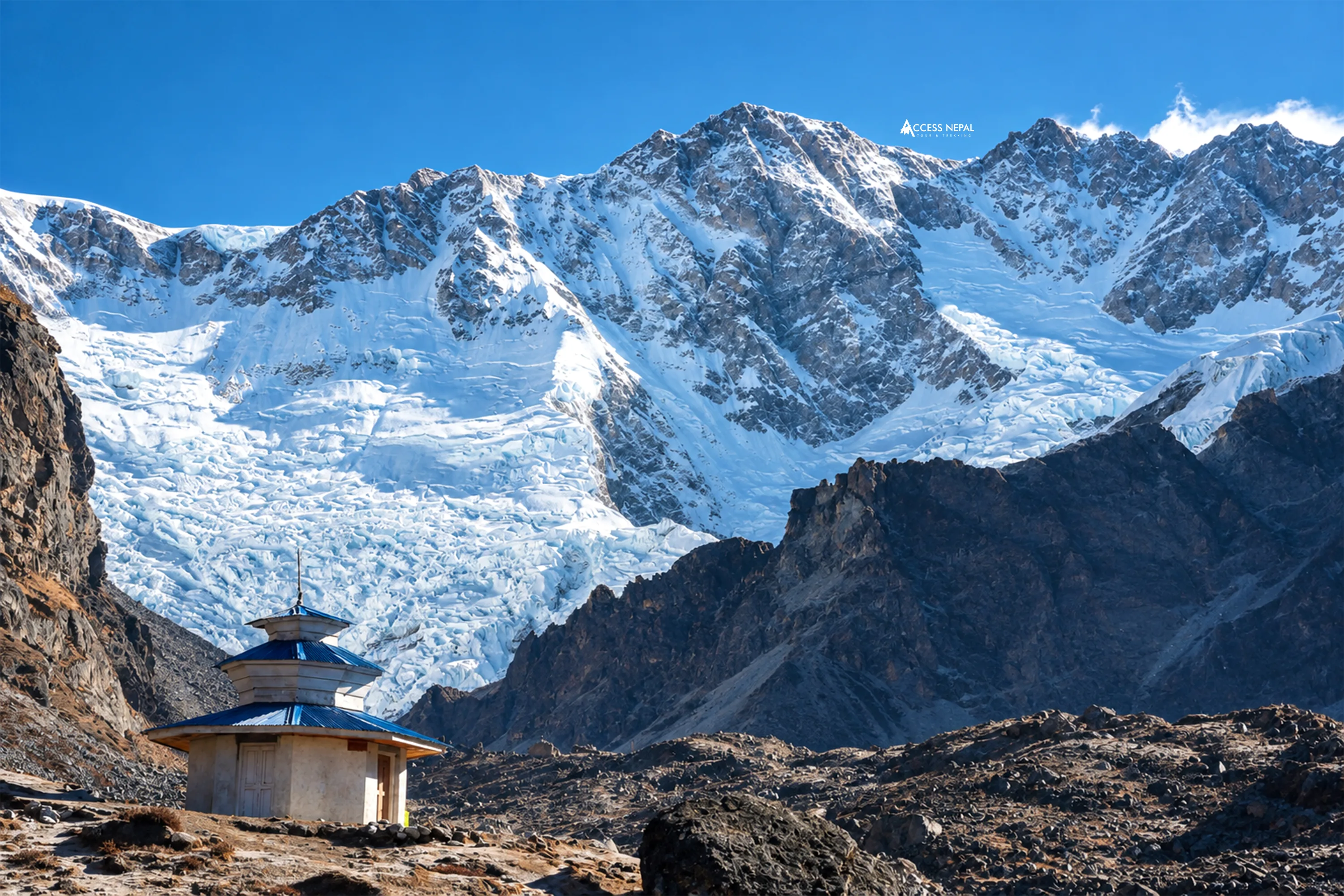
The trail follows the moraine of the Yalung Glacier. From Oktang, the southwest face of Kanchenjunga rises almost vertically above, flanked by Kabru, Rathong, and Kottang.
The descent from Ramche follows the Simbua Khola downstream, retracing the route back through Tseram to Tortong, before branching onto the southern trail toward Yamphudin.
You’ll pass through rhododendron and mixed forest, crossing several suspension bridges over tributary streams.
Yamphudin is a large village inhabited by Limbu and Rai communities, with good teahouses and a warm atmosphere.
From Yamphudin, the trail descends through subtropical forest and terraced farmland to the road head near Taplejung, where a jeep will be waiting to drive you back to Bhadrapur for the flight to Kathmandu.
Kanchenjunga Base Camp Trek Attractions
The Mountain itself
Mount Kanchenjunga stands at 8,586 meters (28,169 feet), the third-highest mountain in the world. Until 1852, it was believed to be the highest mountain on Earth before Everest was confirmed taller.
The name means ‘five treasures of the snow’ in Tibetan, referring to its five summits. From Pangpema, the north face rises as a wall of ice and rock that climbs three and a half thousand meters from base camp to summit.
Pangpema (North Base Camp)
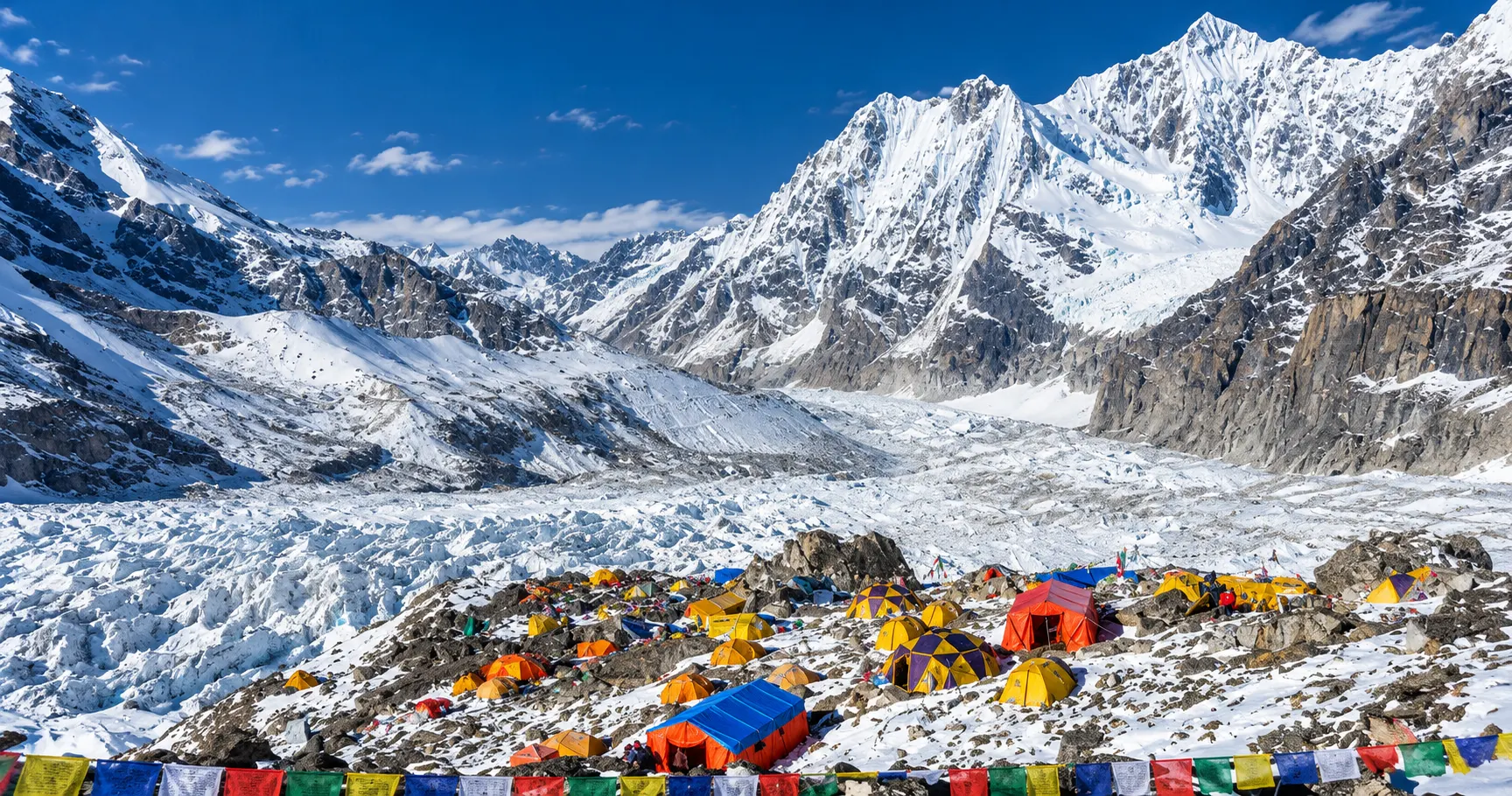
Pangpema sits at 5,143m, higher than Everest Base Camp. From here, the north face of Kanchenjunga rises directly across the glacier. To the west, Makalu stands out clearly on good days.
Everest and Lhotse, often associated with this viewpoint, are actually best seen later in the trek from the passes on the southern section. The base camp itself has a few low walls and a simple chorten. The basin is quiet, with no sound but the wind.
Oktang (Kanchenjunga South Base Camp Viewpoint)
Oktang sits at 4,730m on the moraine of the Yalung Glacier. From here, the southwest face of Kanchenjunga rises almost vertically above, flanked by Kabru, Rathong, and Kottang. This is a different view from Pangpema—broader, more sculptural, and considered by many to be the most beautiful face of Kanchenjunga.
Jannu (Kumbhakarna)
Jannu, also called Kumbhakarna, is a striking peak at 7,711m that stands apart from the main Kanchenjunga massif. From Khambachen and the trail above it, you get your first close views of Jannu. The Jannu glacier is visible from the trail, grinding slowly down the valley below.
Ghunsa Village and Monastery
Ghunsa is the largest village in the upper valley, with stone-walled houses built in Tibetan style, flat roofs, and firewood stacked against the walls. The village has a working monastery, a health post, a school, and a small hydropower station. The accommodation here is better than in the lower villages, with some lodges offering private rooms and solar-heated showers.
Tibetan-Influenced Culture
The upper villages of Ghunsa, Khambachen, and Lhonak have a strong Tibetan Buddhist character. You’ll pass mani walls, chortens, and small monasteries along the trail. Prayer flags flutter in the wind. The people here have deep-rooted ties to Tibetan Buddhist culture, and the way of life feels separate from the modern world.
Solitude and Remoteness
The Kanchenjunga region sees very few trekkers compared to Everest or Annapurna. Some days you may not see another trekking group. By the time you reach Sekathum, you are two days’ walk from the nearest road. The quiet is part of what makes this trek special.
Forests and Wildlife
The lower trail passes through subtropical broadleaf forest with sal, chilaune, and schima trees. Above that, oak and rhododendron become more common. Langur monkeys are common in the forest sections, their grey bodies visible in the canopy when they move. Red panda habitat exists in the bamboo and rhododendron zones, though sightings depend on luck. Snow leopard tracks have been reported in the Khambachen area, though sightings are extremely rare.
Glacial Landscapes
Above Khambachen, the landscape shifts from forest to alpine scrub and then to glacial moraine. Lhonak sits in a flat area of rubble and frozen ground, surrounded by unnamed six- and seven-thousand-meter peaks. The Ghunsa Khola, now a glacial stream, runs below the trail, audible but often hidden beneath the rubble.
How Difficult Kanchenjunga Base Camp Trek 22 Days?
This is a strenuous and challenging trek. It is not for beginners. The route is remote, the trails are rough, and the altitude is high. You will walk for five to eight hours on most days, sometimes longer.
The terrain includes steep ascents, rocky moraine, and high passes. The maximum altitude is 5,143m at Pangpema, and you will spend multiple nights above 4,000m.
The trek is graded as Challenging. It is best suited to experienced trekkers who have completed multi-day high-altitude treks before, such as Everest Base Camp or the Annapurna Circuit. If you have never done a long trek at altitude, this is not the place to start.
The region is remote, with limited medical facilities and no quick exits. Prior trekking experience is strongly recommended.
Physical fitness matters, but mental preparation matters just as much. The trek is long with many days of walking, basic accommodation, cold nights at high altitude, and limited food variety above Ghunsa.
You need to be comfortable with simple teahouses, shared bathrooms, and unpredictable weather. The altitude makes every step deliberate. Some days are physically demanding, like the crossing of Sele La and the descent to Cheram.
Altitude sickness is a real risk. Above 3,000m, anyone can develop symptoms. The Kanchenjunga Base Camp Trek itinerary includes acclimatization days at Ghunsa (3,595m) and Khambachen (4,145m) to help your body adjust.
On these days, you take a short hike to a higher altitude and return to sleep at the same altitude. This ‘climb high, sleep low’ approach is the standard way to prepare for the days ahead. If symptoms worsen, the only safe response is to descend.
The trek is not technical as you don’t need ropes or mountaineering gear. But it is a serious physical and mental challenge. The reward is a genuine sense of remoteness, raw mountain scenery, and the quiet that comes from walking where few others go.
Is the Kanchenjunga Base Camp Trek suitable for beginners?
No. The combination of altitude, duration, terrain and remoteness makes it unsuitable for a first high-altitude trek. Trekkers with no prior experience above 3,000 metres should consider a shorter, lower-altitude trek first.
Experienced trekkers who are physically prepared and comfortable with remote conditions will find the trek demanding but manageable.
Is it harder than Everest Base Camp?
The Kanchenjunga Base Camp Trek is longer than the standard Everest Base Camp trek and reaches a higher point at Pangpema. It also involves more remote terrain and fewer services.
Trekkers who have done Everest Base Camp will find the altitude and walking hours familiar, but the lack of infrastructure and the length of the route make Kanchenjunga more demanding in terms of self-sufficiency.
Altitude and Acclimatisation Guide for Kanchenjunga
Altitude is the single biggest factor on this trek. The Kanchenjunga Base Camp Trek itinerary includes two acclimatisation days at Ghunsa (3,595m) and Khambachen (4,145m) to help your body adjust before you go higher.
On these days, you take a short hike to a higher altitude and return to sleep at the same altitude.
Above 3,000m, anyone can develop altitude sickness. The signs include headache, nausea, loss of appetite, dizziness, and shortness of breath. If symptoms worsen, the only safe response is to descend.
Our guide will monitor your condition throughout the trek and carry a first aid kit, oxygen, and a Gamow bag for emergencies. Drink at least 3 to 4 litres of water per day, more at high altitude. Take the rest days seriously; they are built into the itinerary for a reason.
When Is the Best Time for the Kanchenjunga Base Camp Trek?
| Season | Months | Conditions |
| Spring | March–May | Clear skies, rhododendron blooms, moderate temperatures |
| Autumn | September–November | Stable weather, clear mountain views |
| Monsoon | June–August | Heavy rain, landslides, poor visibility |
| Winter | December–February | Extreme cold, snow, many teahouses closed |
The best seasons for the Kanchenjunga base camp trek are spring (March to May) and autumn (September to November). During these months, the weather is stable, the skies are clear, and the mountain views are at their best. Spring brings rhododendron blooms in the lower valleys, while autumn offers the clearest panoramas and stable conditions.
Late October to mid-November is often considered the optimal window for clear views and manageable temperatures. Late April to mid-May is the best spring window, with warmer temperatures but slightly less clear visibility.
The monsoon (June to August) brings heavy rainfall, landslides, and slippery trails. Winter (December to February) is extremely cold, with temperatures dropping well below freezing, and many teahouses at higher altitudes close for the season.
While trekking is not impossible in these seasons, conditions are much harder and the risks are higher.
Kanchenjunga Trek Permit Cost
The Kanchenjunga region is a restricted area, which means you need specific permits and must trek with a licensed guide through a registered agency. You can get more information about restricted area permit updates in Nepal.
The table below is a breakdown of the Kanchenjunga trek permit costs, which feed into the overall Kanchenjunga trek cost for 2026 and 2027. Access Nepal Tour handles the entire permit process for you before you travel east to the trailhead.
| Permit | Cost (2026) | Issued By |
| Restricted Area Permit (RAP) | USD 20/person/week (first 4 weeks); USD 25/week beyond | Department of Immigration |
| Kanchenjunga Conservation Area Permit (KCAP) | NPR 2,000 (~USD 15) | Department of National Parks |
| TIMS Card | Not required when RAP is held | N/A |
The Kanchenjunga trek permit you’ll hear most about is the Restricted Area Permit (RAP), which is the main permit for the trek. It costs USD 20 per person per week for the first four weeks, and USD 25 per week beyond that. For a typical four-week circuit, the permit totals around USD 80 to USD 100 per person.
The permit is issued by the Department of Immigration and must be processed through a registered trekking agency.
The Kanchenjunga Conservation Area Permit (KCAP) is a conservation fee for entering the protected area. It costs NPR 2,000 (USD 15) per person, with no time limit. This permit supports the protection of snow leopard and red panda habitats in the region.
In 2026, Nepal removed the rule requiring a minimum of two trekkers for restricted-area permits, so solo travellers can now obtain the RAP alone.
However, a licensed guide is still mandatory for the entire trek. You will need to provide a passport copy valid for at least six months, passport-sized photographs, and proof of travel insurance covering high-altitude trekking and helicopter evacuation.
A Typical Day on the Kanchenjunga Base Camp Trek
A typical day on the trek begins early. Trekkers wake before sunrise, usually around 5:30 to 6:00 am. The teahouse provides hot tea or coffee. Breakfast is served between 6:30 and 7:00 am.
Options include porridge, toast, pancakes, eggs and local bread. After breakfast, trekkers pack their day packs and the group sets off by 7:00 or 7:30 am. The porters carry the main luggage and usually leave before or with the group.
The morning walk is the longest part of the day. The trail may climb through forest, cross a suspension bridge, or follow a river valley. The pace is steady but not fast, especially on ascent days. Our guide sets a rhythm that allows the body to adjust to the altitude.
Breaks are taken every hour or so, with time to drink water and catch breath. The scenery changes gradually. In the lower valleys, the trail passes terraced fields, cardamom plants and villages. Higher up, the forest gives way to rhododendron, pine and bamboo, then to open slopes and moraine.
Lunch is usually taken around midday, often at a teahouse along the route. The meal is simple but filling, with a mix of local and familiar dishes. After lunch, the group continues walking.
The afternoon section is often shorter than the morning, but on some days it is just as long. The terrain may include steep descents, rocky moraine or high passes. On pass-crossing days, such as Sele La, the afternoon involves a long descent to the next camp.
The group reaches the night’s teahouse in the late afternoon, usually between 3:00 and 5:00 pm. Trekkers settle into their rooms, which are basic: two single beds, a mattress, blankets and pillows. Bathrooms are often shared, and hot showers are not always available at higher altitudes.
Trekkers rest, change into dry clothes and drink tea. Dinner is served around 6:30 or 7:00 pm. The meal is similar to lunch, with rice, vegetables, curry and soup. After dinner, the guide gives a short briefing about the next day’s route, distance, walking time and altitude. Trekkers then sleep, usually by 8:30 or 9:00 pm.
This rhythm changes at key points. On acclimatisation days, at Ghunsa and Khambachen, there is no long walk. Trekkers take a short side trip to a higher altitude, such as the hike toward the Jannu base camp viewpoint from Khambachen, before returning to sleep at the same altitude.
On pass-crossing days, the day is longer and more tiring, with an early start and a late arrival.
At higher altitudes, the daily rhythm is slower. Walking is more effortful, and breaks are more frequent. Sleep can be broken. Appetite may decrease.
The guide monitors trekkers for signs of altitude sickness. The day still follows the same pattern: wake, breakfast, walk, lunch, walk, teahouse, dinner, briefing, sleep. But the distances are shorter, and the pace is gentler.
Transport Options
| Stage | Mode | Duration | Notes |
| Kathmandu → Bhadrapur | Flight | 45 minutes | Aerial views of eastern hills and Himalayan peaks |
| Bhadrapur → Taplejung | Private jeep | 7–8 hours | Through Ilam tea-growing region, winding mountain roads |
| Taplejung → Trek start | On foot | — | Trail begins with descent toward Tamor River |
| Trek end → Taplejung road head | On foot | — | Descend through subtropical forest to road |
| Taplejung → Bhadrapur | Private jeep | 7–8 hours | Retrace route through Ilam tea-growing region |
| Bhadrapur → Kathmandu | Flight | 45 minutes | Return to capital |
Your journey to the trailhead begins with an early morning flight from Kathmandu to Bhadrapur in the eastern Terai. The 45-minute flight offers aerial views of the eastern hills and, on clear days, distant Himalayan peaks including the Everest range to the north.
On arrival at Bhadrapur Airport, a jeep will be waiting to drive you north. The road passes through Kanyam, a tea-growing area where neat green plantations cover the gentle hills, and continues through the Ilam region, Nepal’s main tea-producing district bordering Darjeeling.
The drive takes most of the day on winding mountain roads, through terraced fields, small settlements, and forested hills, arriving in Taplejung by late afternoon.
At the end of your trek, a jeep will meet you at the road head near Taplejung. From there, the drive to Bhadrapur takes several hours on the same winding mountain roads, retracing the route you took on Day 2.
In Bhadrapur, you board a flight back to Kathmandu. Access Nepal Tour arranges all transport, including airport transfers, domestic flights, and private jeep transfers. The transport is included in your package.
Accommodation
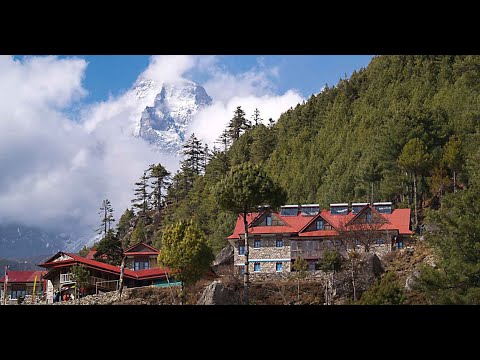
Accommodation on this trek is basic. From Taplejung through the lower villages, you stay in simple guesthouses and teahouses. These are often made of wood and stone, with twin-sharing rooms, foam mattresses, and blankets. Common areas are usually heated by a central wood-burning stove, and toilets are shared.
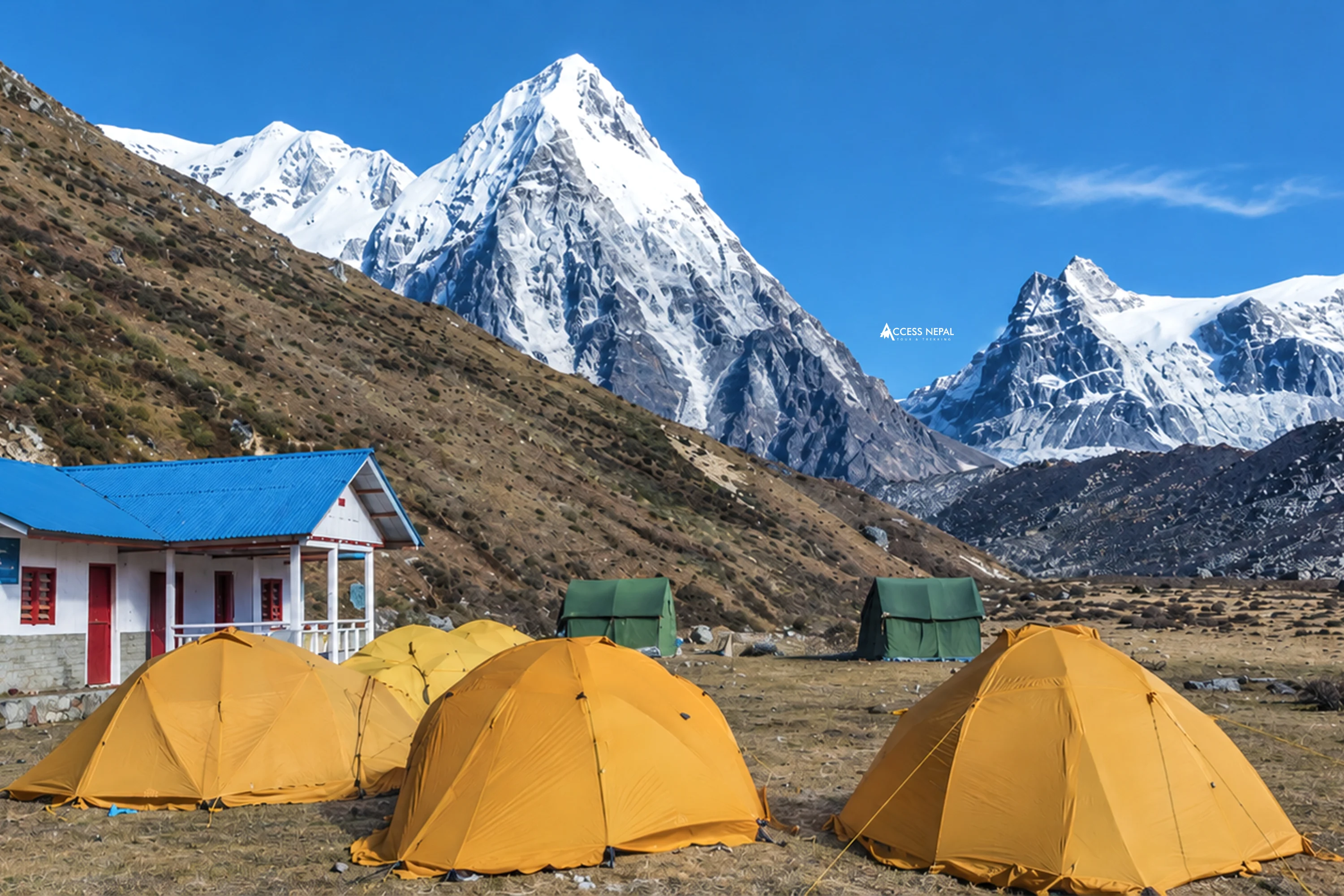
Ghunsa has the best accommodation on the trek. Some lodges offer private rooms and solar-heated showers. Above Ghunsa, facilities become more basic. At Khambachen, teahouses have wooden rooms, outdoor bathrooms, and a communal dining area with a stove.
At Lhonak, accommodation consists of stone shelters with raised sleeping platforms and sometimes a stove, but no insulation. The interior temperature approximates the exterior temperature within an hour of the stove going out. Nights here are very cold, often below minus fifteen degrees.
At Sele La Base Camp, there is no teahouse. Accommodation is in basic stone shelters with no insulation and limited facilities. This is the coldest and most basic night on the trek. Be prepared with a good sleeping bag and warm layers.
At Ramche, the teahouses are basic but the views are extraordinary. As you descend to Yamphudin, accommodation improves. Yamphudin is a large village with good teahouses, private rooms, and hot food. After the cold and remoteness of the high valleys, it feels comfortable by trekking standards.
You can explore more about the Kanchenjunga Base Camp Trek Accommodation guide, which covers everything on accommodation.
Food
Teahouse meals are simple but filling. Breakfast is usually light, with options like Tibetan bread, porridge, and eggs. Lunch and dinner are larger, typically dal bhat (rice with lentil soup, vegetables, and pickles), noodles, fried rice, or soup. Dal bhat is the staple meal and is usually refillable.
As you gain altitude, the menu becomes more limited. Almost all supplies above Ghunsa are brought up from Taplejung, so prices are higher and choices are fewer. At Lhonak, the menu is very limited. Hot drinks like tea, coffee, and hot chocolate are available at teahouses, typically priced between $2 and $3.
Vegetarian options are easy to find, with dal bhat, vegetable curries, and plain rice available at most teahouses. Vegan trekkers should specify no butter, ghee, milk, or eggs, as these are common ingredients. It is wise to carry extra snacks like nuts, dried fruit, and energy bars for the higher sections where options are limited.
Staying hydrated is important, especially at altitude. Bottled water is available but expensive and creates plastic waste. Boiled water is available at teahouses for a small charge.
The best option is to carry a reusable water bottle and purification tablets or a filter to treat water from streams or teahouses. Avoid alcohol at higher altitudes, as it slows acclimatisation.
A guide to food on the Kanchenjunga Trek that fuels your adventure.
Your package with Access Nepal Tour includes three meals a day during the trek. Our guide will help you order and ensure your dietary needs are communicated to the teahouse kitchens.
Short on time? Try our 14-day Everest Base Camp Trek for comfortable teahouses, Sherpa culture, and close-up views of Mount Everest.
Safety at the Kanchenjunga Base Camp Trek
Safety on the Kanchenjunga Base Camp Trek depends on preparation, pacing and following the guide’s instructions. The trek is in a remote restricted area. Medical facilities are limited. Help in an emergency is not quickly available. Trekkers should be aware of the risks and take them seriously.
Altitude is the main risk. The trek reaches 5,143 metres at Pangpema. Altitude sickness can occur above 3,000 metres. Symptoms include headache, nausea, vomiting, dizziness, sleeping problems, breathing difficulties, and increased heart rate.
Trekkers should report any symptoms to their guide immediately. Your guide monitors you throughout the trek. Our Kanchenjunga Base Camp Trek itinerary also includes rest days and acclimatisation halts at Ghunsa (3,595m) and Khambachen (4,145m). You should walk at a steady pace, drink plenty of water, and avoid alcohol. If symptoms do not improve, descent is the safest option.
Weather is another risk. Conditions change quickly at high altitude. Snow can fall at Lhonak and Pangpema even in season. Sele La can be covered in snow. You should have waterproof clothing, warm layers and sturdy boots. Your guide will decide whether to cross a pass or change the route if conditions are unsafe, and you should follow that decision.
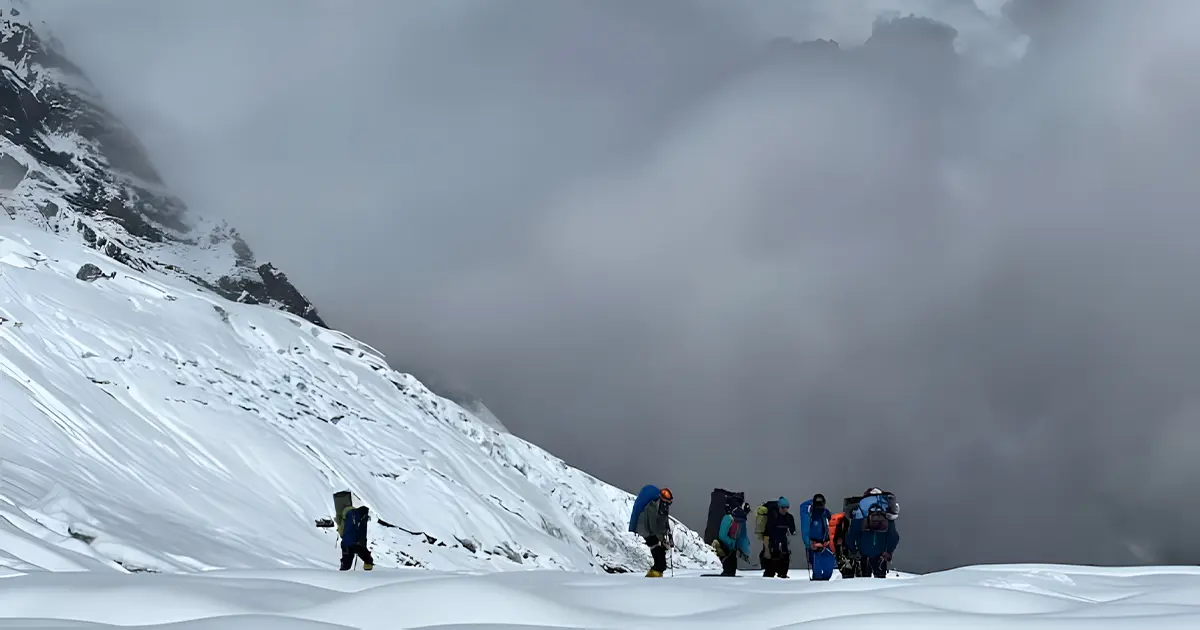
Terrain is a risk on some sections. The trail to Pangpema follows the edge of the Kanchenjunga Glacier and crosses moraine. This ground is uneven and slow to walk on. Rockfall is possible near the glacier. The descent from Ramche to Tortong is steep in places. Trekking poles help with balance. Trekkers should watch their footing and not rush.
Remoteness is a factor, too. There are a few settlements on the route. Communication is limited. The guide carries a first-aid kit. Trekkers should carry personal medication. Travel insurance is required for this trek. Your insurance must cover helicopter evacuation, medical expenses and trip cancellation.
We do not include travel insurance in the package, but we can help you arrange it, even before you arrive in Nepal.
Emergency evacuation, if needed, is by helicopter. This is arranged by the insurance company. You should carry a copy of their insurance policy and emergency contact numbers. Your guide will coordinate with the company and the insurance provider if an evacuation is required. Trekkers should also carry a passport copy and passport-sized photos.
You should not trek alone here as the region is restricted and a licensed guide is mandatory. Group sizes are kept small so your guide can monitor each trekker. Your guide is trained in first aid and emergency evacuation. Porters are also part of the team.
Trekkers should listen to the guide’s advice on pace, hydration and rest. Safety on this trek is a shared responsibility between the guide, the porters and the trekkers themselves.
Is a porter required? Porter vs Non-Porter
Yes, a porter is required for the Kanchenjunga trip. Our Kanchenjunga Base Camp Trek package includes one porter for every two trekkers. The porter carries up to 15 kilograms per trekker, including the backpack and gear. This arrangement is part of our package and does not cost extra. Trekkers who prefer to carry their own luggage can do so, but the package still includes the porter service.
| With Porter | Without Porter |
| Lighter personal load | Carry your own main luggage |
| Less physical strain | Greater pack weight |
| Porter carries agreed luggage | Greater independence |
| Included in package | No porter cost, but no reduction in package price |
| One porter for two trekkers | Not recommended on this trek |
On this trek, a porter is recommended as the walking days are long, the altitude is high and the terrain is rough in places. Carrying a heavy pack above 4,000 metres is difficult.
The porter service allows trekkers to walk with a day pack only, which reduces fatigue and lowers the risk of injury. The porters are experienced and physically strong. You walk at your own pace and usually arrive at the teahouse before or with the group.
You should pack only what is needed. The duffel bag we provide can be used for the main luggage. The day pack, 30 to 40 litres, carries water, snacks, a rain jacket, a warm layer and personal items. Trekkers should keep the duffel bag under 15 kilograms. The porter carries this bag. Trekkers carry their own day pack.
Trekkers who choose not to use a porter should be prepared for a heavier load. This is not recommended for the Kanchenjunga Base Camp Trek because of the altitude and the length of the walking days. The package includes the porter service regardless of whether trekkers use it. There is no discount for not using a porter. Trekkers who want to carry their own bag can do so, but the porter will still be with the group and available if needed.
Landscapes, Wildlife and Culture
| Aspect | Details |
| Landscape Zones | Subtropical forest, oak/rhododendron, alpine scrub, glacial moraine |
| Key Wildlife | Snow leopard, red panda, musk deer, Himalayan black bear, langur monkeys, blue sheep |
| Ethnic Groups | Limbu, Rai, Sherpa, Tibetan-Buddhist communities |
| Cultural Features | Monasteries, mani walls, chortens, prayer flags, Kirati traditions |
| Protected Area | Kanchenjunga Conservation Area (2,035 km²) |
The Kanchenjunga region is part of the Kanchenjunga Conservation Area, a protected area of 2,035 square kilometers in Taplejung district. This area forms part of a larger transboundary landscape shared by Nepal, India, Bhutan, and China, and is recognised as part of the Himalayan Biodiversity Hotspot. The landscape supports over 4,500 plant species, 169 mammal species, and 618 bird species.
As you trek, the landscape changes with every few hundred meters of elevation. The lower trail from Chirwa to Gyabla passes through subtropical broadleaf forest with sal, chilaune, and schima trees, then climbs into oak and rhododendron. Above Ghunsa, the forest thins to juniper scrub and alpine vegetation. Beyond Khambachen, you enter glacial moraine with loose rock, boulders, and frozen ground. The Ghunsa Khola, now a glacial stream, runs below the trail, audible but often hidden beneath the rubble.
The Kanchenjunga Conservation Area is home to some of the rarest animals in the Himalayas. Snow leopards live here, and GPS tracking has shown they frequently move across the borders into India and China. Red pandas inhabit the bamboo and rhododendron forests at mid-elevations, though sightings depend on luck. Other species include musk deer, Himalayan black bear, grey wolf, Himalayan tahr, and blue sheep. In the lower forest sections, langur monkeys are common, their grey bodies visible in the canopy when they move.
The people of this region belong to several distinct ethnic groups. In the lower villages like Taplejung, Chirwa and Yamphudin, you meet Limbu communities, also called Yakthungba. The Rai people live in middle-altitude villages such as Sekathum and Amjilosa.
These groups follow Kirati traditions, a blend of animism and shamanism, and celebrate festivals like Chasok Tangnam, a Limbu harvest festival. Higher up, in Ghunsa, Phale, Khambachen, and Lhonak, the population is Sherpa and Tibetan-Buddhist.
In these upper villages, Tibetan Vajrayana Buddhism shapes daily life. Religious structures are part of daily life here, and you will encounter them throughout the upper villages. Ghunsa has a working monastery where monks recite prayers and light butter lamps. The houses are stone-walled with flat roofs, built in Tibetan style, with firewood stacked against the walls.
Communication on the Trek
Communication on this trek is limited, and you should plan accordingly. In the lower villages like Taplejung, Sekathum, and Amjilosa, you may get a weak mobile signal, but it is inconsistent and data speeds are very slow. Nepal Telecom (NTC) is the only provider with any presence in the region, and even that is unreliable.
Ghunsa, the largest village in the upper valley, has satellite internet and Wi-Fi at some teahouses, but outages are common, especially during peak trekking season. Beyond Ghunsa, mobile coverage is almost entirely absent. At Khambachen and Lhonak, you should expect no mobile signal at all. Some trekkers report mobile signal disappearing from around Day 4 and not returning until Day 14.
Wi-Fi, where available, is solar-powered and shared among all guests. Speeds are often too slow for images or voice calls. Charging facilities are available at teahouses for a fee, typically NPR 1,000 (about $9) at higher altitudes, but power can be unreliable due to weather and battery storage limits.
For emergency communication, mobile phones should be treated as secondary tools only. Satellite phones or GPS-based communicators are strongly recommended for safety, as relying solely on the mobile network in this region can create serious risks. Our guide will carry emergency communication equipment.
Before you leave, inform your family and friends that you will be out of contact for several days. Download offline maps and any essential documents before the trek. The disconnection is part of what makes this region so immersive that travellers often describe it as a chance to reconnect with the mountains and with themselves, away from the constant pull of notifications and screens.
Packing List
Packing for the Kanchenjunga Base Camp Trek should be based on layering and protection from cold, wind and rain. The trek reaches 5,143 metres, so warm clothing is essential.
We provide a duffel bag, a T-shirt, a trekking map and sleeping bags and down jackets upon request in our package. Trekkers need to bring the rest.
- Upper body: Waterproof jacket, down jacket, raincoat, warm layers, thermal base layers, fleece mid-layers, shirts, woollen hat, neck gaiter, sports bra for women.
- Hands: Waterproof gloves, insulated gloves or mittens.
- Lower body: Waterproof pants, trekking pants, four pairs of underwear.
- Feet: Multiple pairs of wool or synthetic socks, trekking boots, sandals.
- Toiletries: Toothpaste, toothbrush, toilet paper, hand sanitiser, moisturiser, sunscreen, high-SPF lip balm.
- First aid: Water purification tablets, anti-nausea medication, mosquito and insect repellent, personal medication.
- Gear: Duffel bag (provided), -20°C sleeping bag (available on request), backpack 30 to 40 litres, water bottles, sunglasses or glacier goggles, camera, two-pin charging plug, trekking poles, headlamp with extra batteries, power bank.
- Documents: Passport with six months’ validity, passport-sized photos, tourist visa, photocopies of passport, travel insurance paper and booking confirmation. Permits are arranged by our team.
Trekkers should pack only what is needed. The duffel bag should stay under 15 kilograms. The day pack carries water, snacks, a rain jacket, a warm layer and personal items. Good trekking boots are important. They should be worn in before the trek.
Kanchenjunga Trek Cost and Price 2026/2027 and Expenses You May Have
The package price for the Kanchenjunga trip (2026/2027 departures) covers the main costs of the trip. This includes airport transfers, two nights in a hotel in Kathmandu, domestic flights, private road transfers, , all meals during the trek, a licensed guide, porters, permits and a welcome and farewell dinner.
There are additional expenses that trekkers should budget for. These are not included in the package.
- Travel insurance: This is required. It must cover helicopter evacuation, medical expenses, and trip cancellation. We do not provide insurance. Trekkers must buy it themselves before arriving in Nepal.
- Nepal visa: The visa fee is paid on arrival at the airport in Kathmandu. The cost depends on the length of stay. Trekkers should check current fees before travel.
- International flights: These are not included. Trekkers arrange their own flights to and from Kathmandu.
- Meals in Kathmandu: Only the welcome dinner and farewell dinner are included. All other meals in Kathmandu are the trekker’s own cost.
- Drinks and snacks: Tea and coffee are included three times a day during the trek. Other drinks, including bottled water, soft drinks and alcohol, are not included. Snacks such as chocolate, biscuits and nuts are also extra.
- Charging and Wi-Fi: Some teahouses charge for charging devices and for Wi-Fi. Trekkers should carry small cash for this.
- Hot showers: Some teahouses charge for hot showers, especially at higher altitudes.
- Tips: Tips for guides and porters are not included. They are customary in Nepal and should be budgeted for. The amount depends on the length of the trek and the service received.
- Personal equipment: Any gear trekkers need to buy or rent in Kathmandu is at their own cost. The package provides a duffel bag, T-shirt, and map. Sleeping bags and down jackets are available on request.
- Extra transport: Any transport outside the itinerary, such as early return or additional travel in Nepal, is not included.
- Unexpected costs: Delays due to weather, landslides or flight cancellations may require extra nights in Kathmandu or along the route. Trekkers should carry a buffer of extra money for this.
You should carry enough cash for the trek. ATMs are available in Kathmandu and some larger towns, but not along the trail. Nepali rupees are needed for small purchases, tips and extras.
A recommended daily budget for personal expenses on the trek is not fixed, but trekkers should plan for drinks, snacks, charging, showers, and tips. We can help you with this. Leave us a message, and we will plan your daily budget.
Tipping Culture in Nepal
Tipping is customary in Nepal. It is not compulsory, but it is expected on trekking routes. Guides, porters and drivers rely on tips as part of their income. Trekkers should budget for this.
On the Kanchenjunga Base Camp Trek, the people who usually receive tips are the guide, the porters and the driver. The guide leads the trek, manages logistics, monitors altitude and makes safety decisions.
The porters carry the luggage and walk the same route. The driver handles the road transfers. All of them work long hours in difficult conditions.
There is no fixed rule for how much to tip. The amount depends on the length of the trek, the size of the group, the level of service and the trekker’s own budget. The trekking industry in Nepal often uses a rough guideline, but trekkers should treat this as a suggestion, not a requirement.
Tips are usually given at the end of the trek, before the group separates. It is common to tip the guide and porters together, or to give separately.
Tips are best given in Nepali rupees. Trekkers should carry enough cash for this. The tip is a token of appreciation, not a payment for a service that was promised.
It should be given willingly. If the service was good, a tip reflects that. If there was a problem, the trekker can decide what is appropriate.
Extra Luggage Storage
Trekkers on the Kanchenjunga Base Camp Trek will not need all their belongings on the trail. City clothes, extra shoes, electronics and other items can be left behind in Kathmandu. Access Nepal arranges storage for these items. Trekkers should confirm the arrangement with the company before the trek.
The hotel in Kathmandu, Apsara Boutique Hotel, can usually store luggage for guests. Trekkers should check with the hotel reception. Access Nepal can also help arrange storage. Trekkers should pack the items they need for the trek in the duffel bag provided. The rest can stay in Kathmandu.
Trekkers should not leave valuables in storage. Passports, money, insurance documents and electronics should be carried on the trek. A photocopy of the passport and insurance policy is enough for the trail. The original documents can stay in the hotel safe or with the company.
Who Is This Trek For?
The Kanchenjunga Base Camp Trek is for experienced trekkers who have walked at high altitude before. The route reaches 5,143 metres at Pangpema and stays above 3,000 metres for much of the second half. Trekkers should know how their body responds to altitude. They should have completed at least one previous trek above 3,000 metres.
The trek is also for people who are physically fit. Walking days run from five to seven hours, and some days are longer. The terrain includes steep climbs, long descents and glacial moraine. Trekkers should be able to walk for five to seven hours on uneven ground with a day pack. Training before the trek is recommended. Cardiovascular exercise and leg strength work help.
This trek suits those who are comfortable with remote conditions. The Kanchenjunga region is a restricted area with few settlements. Medical facilities are limited. Communication can be unreliable at higher altitudes. Accommodation is in basic teahouses. Trekkers should be prepared for some cold nights, shared bathrooms and limited electricity.
Our guides are trained, experienced, and carry a first aid kit. Emergency helicopter rescue is available if your insurance covers it. However, this remains a serious high-altitude trek in a remote region and trekkers must be prepared for the conditions described above.
The trek is a good fit for people who want to see both the northern and southern sides of Kanchenjunga in one trip. It is also good for trekkers who want a less crowded route than the Everest Base Camp or the Annapurna. The Kanchenjunga region sees fewer trekkers. The trail is quiet, and the villages are traditional.
This trek is not suitable for beginners. Trekkers with no high-altitude experience should consider a shorter, lower trek first. It is not suitable for people who dislike long walking days or basic accommodation. It is not suitable for anyone who needs extensive infrastructure, reliable internet or quick access to medical care.
Trekkers with heart conditions, respiratory problems or other medical issues should consult a doctor before booking. Altitude can worsen certain conditions. Trekkers should be honest about their fitness and experience when booking. Access Nepal can advise on preparation.
Our package, in particular, is also for people who want a fully supported trip. A licensed guide, porters, permits, flights and teahouse accommodation are all arranged for you. Trekkers do not need to organise logistics themselves. They need to train, pack correctly and follow the guide’s advice on the trail.
Why Book the Kanchenjunga Base Camp Trek with Access Nepal?
Access Nepal Tour and Trekking is based in Kathmandu and we have operated treks in Nepal for years. We hold a licence from the Nepal government and are registered with the relevant authorities.
The Kanchenjunga Base Camp Trek is a restricted-area trek, and we take care of the permits, guide and agency requirements for you.
We also arrange domestic flights, road transfers, and teahouse accommodation.
Our guides are government-licensed and English-speaking. They are trained in first aid and emergency evacuation. We provide one guide for a maximum of seven trekkers. This keeps the group small and allows the guide to monitor each trekker. Porters are provided as a part of the package. The porters are insured and their expenses are covered.
Our full package includes airport transfers, hotel in Kathmandu, domestic flights, private road transfers, teahouse accommodation, all meals during the trek, a guide, porters, permits and a welcome and farewell dinner. We also give you a duffel bag, T-shirt and trekking map.
We have received TripAdvisor’s Travelers’ Choice Award for multiple consecutive years. This reflects consistent service and customer satisfaction. Access Nepal also operates other treks in Nepal, including Upper Dolpo and Dhaulagiri Circuit. Trekkers who want a remote Himalayan experience can book with confidence.
The booking process is simple. A 10% deposit secures the booking. The rest is paid within 24 hours of arrival in Nepal. Payment can be made by credit card or bank transfer. Once the deposit is received, the booking is confirmed and the trip is guaranteed to operate on the scheduled dates.
We do not claim to be the best company in Nepal. We provide a specific service: a fully supported, permitted trek to both base camps of Kanchenjunga, with a licensed guide and porter, in a small group, with all logistics handled. Trekkers who want that service can book with us.
Who is this 22-Day Kanchenjunga Base Camp Trek for?
The 22-day Kanchenjunga Base Camp Trek is for fit, experienced trekkers who have walked above 3,000 metres before and want a quiet, remote route to both the North Base Camp (Pangpema, 5,143 m) and the South Base Camp viewpoint (Oktang, 4,730 m) of the world’s third-highest mountain. It is not a first trek. It rewards people who value solitude and raw mountain scenery over comfort.
Because 22 days is the shortest schedule that still includes both base camps and safe acclimatisation, without paying for days you don’t need.
Both base camps are still included. Longer 24–26 day treks visit the same places: Pangpema (North) and Oktang (South). Extra days don’t add new destinations, only slower walking.
Acclimatisation is not cut. The two rest days at Ghunsa and Khambachen stay in the plan. The time saved comes from the lower and descending sections, where altitude risk is low.
Faster access. Flying to Bhadrapur and driving to Taplejung on the same day saves one to two days compared with slower approach routes.
Descending is quicker than climbing. Going down, trekkers cover in a shorter time what took them longer going up, for example, Lhonak to Ghunsa.
Less time off work, lower cost. Fewer nights means fewer meals, fewer teahouse nights and fewer guide and porter days, so the trip is cheaper and fits into a normal holiday.
Built for experienced trekkers. This trek is aimed at fit people who have already been at altitude. They don’t need the extra rest days that a first-time high-altitude trekker would.
Final Say
The Kanchenjunga Base Camp Trek is a 22-day restricted-area trek to both the northern and southern sides of Mount Kanchenjunga. As veterans in the travel scene in Nepal, Access Nepal operates this trek with a licensed guide, porters, permits, flights, and teahouse accommodation included.
To book or ask a question, contact us by email, WhatsApp, or through the website. We will confirm availability, departure dates, arrange permits, and provide a full packing list and preparation guide before departure.
Kanchenjunga Trek FAQs
What is the Kanchenjunga Base Camp Trek?
It is a 22-day high-altitude trek in eastern Nepal that reaches both the northern and southern sides of Mount Kanchenjunga, the third-highest mountain in the world at 8,586 metres. The route passes through the Taplejung, Chirwa, Sekathum, Amjilosa, Gyabla, Ghunsa, Khambachen and Lhonak.
How long is the Kanchenjunga Base Camp Trek?
What is the altitude of Kanchenjunga Base Camp?
What is the Kanchenjunga Base Camp Trek route?
Which is the base camp of Mount Kanchenjunga?
How difficult is the Kanchenjunga Base Camp Trek?
When is the best time for the Kanchenjunga Base Camp Trek?
Is it possible to trek Kanchenjunga solo?
Do I need a guide for Kanchenjunga?
Do I need a porter?
Is the Kanchenjunga Trek safe?
How much should I tip my guide and porter?
What permits are required for Kanchenjunga?
What food is available?
Where do I stay?
What should I pack?
Where can I store extra luggage?
What kind of sleeping gear do I need?
What kind of trekking boots should I wear?
How do I get to Kanchenjunga?
How much does the Kanchenjunga Base Camp Trek cost?
What is a typical daily budget on the trek?
Does the package price include permits and flights?
How much should I tip my guide and porter?
Why book with Access Nepal?
Awards and Achievements
Access Nepal Tour and Treks has been recognized with TripAdvisor’s prestigious Travelers’ Choice Award for multiple consecutive years, reflecting our unwavering commitment to quality and clients’ satisfaction.