OFF
Discounts are solely based on your group size. We do not add anyone to your group.
- Best Price Guarantee
- Hassle-Free Booking
- Team of highly experienced Experts
- Your Happiness Guaranteed
Book Now. No Booking or Credit Card Fee
- Schedule Your Own Dates
- Group Discounts
- Guaranteed Departures
- Easy Cancellation
- 60% Repeated Customers
-

- Duration
- 19 Days
-

- Transportation
- Private Vehicle & Flight
-

- Trip Grade
- Challenging
-

- Max-Altitude
- 6,119 m
-

- Accomodation
- Teahouse & Hotel
-

- Primary Activity
- Trekking and Climbing
-

- Meals
- Trek: B|L|D, KTM: |B|
-

- Best Season
- Spring and Autumn
Overview
Stand at the foot of the world’s highest mountain, cross one of the Khumbu’s most thrilling glaciated passes, and reach a genuine Himalayan summit all in one extraordinary expedition. The Lobuche East Peak Climbing with Chola Pass & EBC is the ultimate Khumbu adventure, combining three iconic milestones into a single seamless journey through the heart of the Everest region.
Beginning with the classic trail to Everest Base Camp (5,364m) and the breathtaking sunrise views from Kala Patthar (5,550m), the expedition then takes you across the technical Chola La Pass (5,420m) a glaciated crossing that rewards bold trekkers with entry into the magical Gokyo Valley before the grand finale: summiting Lobuche East Peak (6,119m), a genuine 6,000-metre Himalayan peak offering close-up views of Everest, Lhotse, Nuptse, and the entire Khumbu Glacier system that few adventurers ever experience.
This is not a standard trek. It is a carefully crafted, end-to-end Himalayan expedition designed for those who want more than a base camp photograph. Those who want to push higher, cross further, and return home having truly tested themselves against the Himalayas. With expert licensed guides, fully supported high camps, and built-in acclimatization days for your safety, this package gives you the very best chance of standing on that summit and looking down on the world below.
If the Khumbu region is on your bucket list, this is the package that checks every box at once.
There is a particular kind of silence that settles over Kathmandu just before a Himalayan expedition begins. The hum of the city still outside the window, a duffel bag half-packed on the floor, and somewhere out past the haze, a wall of white peaks waiting. That is where this journey starts: 19 days, one small mountain nation, and one very large mountain. Lobuche East is not Everest.
It doesn’t need to be. At 6,119 metres, it is tall enough to demand real respect, technical enough to reward real skill, and positioned almost mischievously so that its summit ridge stares directly across the valley at Everest, Lhotse, and Nuptse. Climbers who stand there often say the same thing: it feels like being let in on a secret view that the world’s highest mountain was never meant to share so freely.
The route begins the way most great Khumbu journeys are done, with one of the most thrilling short flights in the world, banking low over green foothills before dropping onto the tilted, cliff-edge runway at Lukla. From there, the trail follows the Dudh Koshi river through pine forest and prayer-flagged suspension bridges, climbing steadily into Sagarmatha National Park toward Namche Bazaar, the amphitheatre-shaped Sherpa capital carved into the mountainside like a natural coliseum built for watching mountains.
A built-in acclimatization day here does double duty: a hike up to Khumjung village or the Everest View Hotel trades altitude for adjustment, following the golden rule every climber on this trip learns to trust completely: climb high, sleep low.
Rather than following the crowd straight toward Base Camp, this itinerary makes a deliberate detour into the quieter Gokyo Valley, past yak pastures and glacial moraine to Gokyo village, perched beside the extraordinary Dudh Pokhari, a lake so intensely turquoise against the grey of the Ngozumpa Glacier, Nepal’s largest, that it looks almost unreal.
A pre-dawn climb of Gokyo Ri delivers one of the trek’s great rewards: four peaks over 8,000 metres in a single sweep — Everest, Lhotse, Makalu, and Cho Oyu — standing shoulder to shoulder above the frozen river below. From here, the route crosses the dramatic, glaciated Cho La Pass, a genuine mountaineering threshold of boulder fields and ice underfoot, before descending to rejoin the classic Everest Base Camp trail.
What follows is the pilgrimage every trekker in the Khumbu is quietly working toward: Everest Base Camp itself, reached across a chaos of glacial boulders with the tumbling seracs of the Khumbu Icefall looming overhead like a frozen wave caught mid-collapse.
A pre-dawn climb of Kala Patthar the next morning answers the question every visitor to Everest Base Camp secretly asks — but where’s the summit? — with the closest eye-level view of Everest’s summit pyramid available without a climbing permit for the mountain itself, lit gold alongside Nuptse and Pumori as the sun comes up.
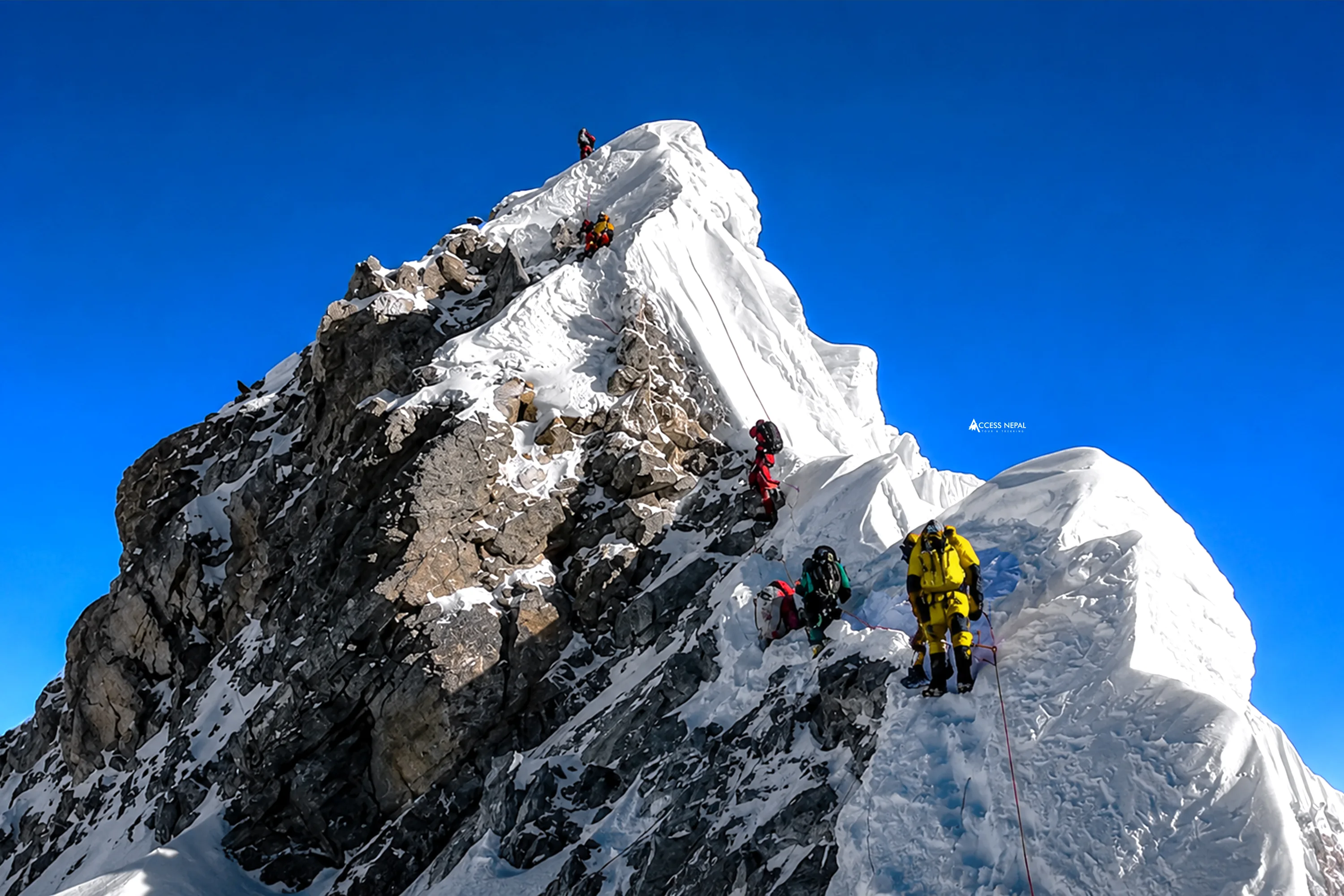
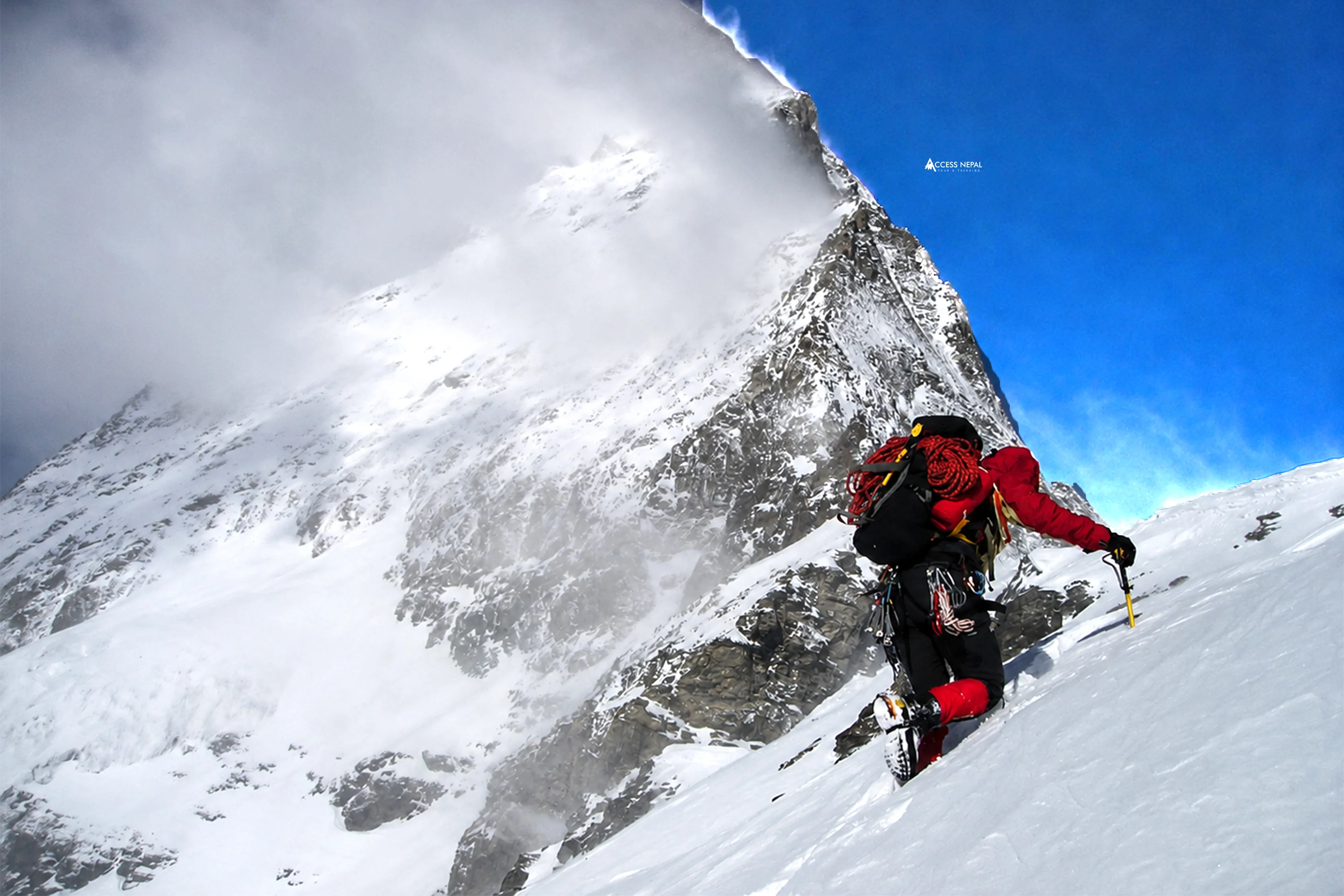
This is also where the trip quietly shifts from trek to expedition. A move up to Lobuche High Camp, a night in a tent instead of a teahouse, and a final technical briefing on crampons, harnesses, and rope work with the climbing Sherpas set the stage for Summit Day itself. Climbers leave camp in the deep hours before midnight, roped together, headlamps cutting small cones of light out of total darkness, moving up snow and rock toward a fixed-rope headwall that leads to the ridge.
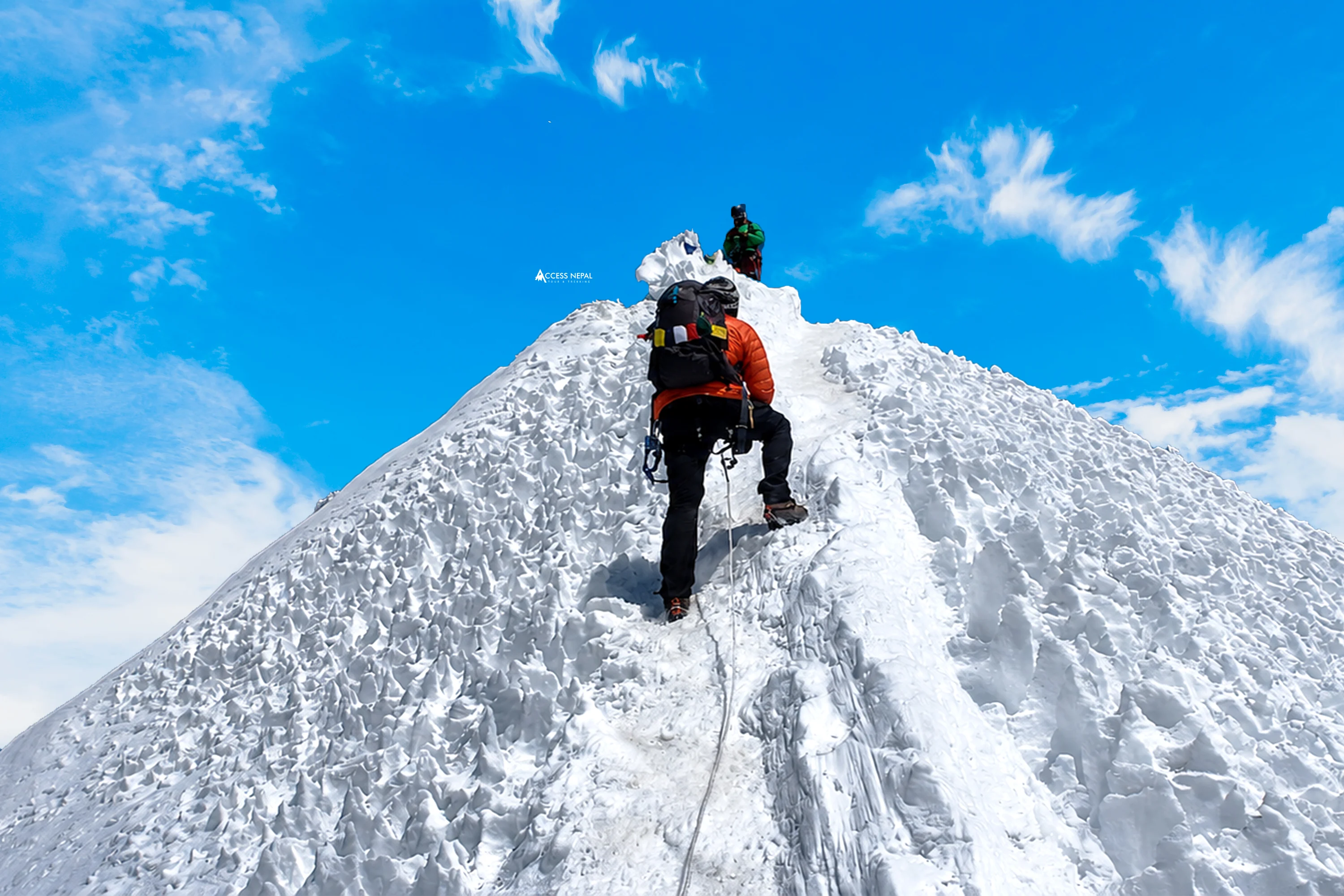
And then — if the mountain allows it — sunrise: Everest, Lhotse, Nuptse, and Makalu arranged around a 6,119-metre summit that makes every hard day before it make sense. A built-in reserve day protects this moment from bad weather or bad luck, so the push is never rushed into too narrow a window.
The way back down retraces the valley through Tengboche Monastery and warming, thickening forest, giving climbers time to process what just happened before the short flight back to Kathmandu and a well-earned farewell dinner.
Trekkers choose Everest Base Camp for the view. Climbers choose Lobuche East for the ridge. This itinerary is built for those who want both: the culture of Namche and Tengboche, the alpine drama of Cho La and Gokyo, the pilgrimage of Base Camp and Kala Patthar, and finally, a genuine Himalayan summit underfoot, with fixed ropes, a rising sun, and Everest itself standing witness.
Every acclimatization day, every “short” walking day, and the reserve day built into the schedule exist for one reason — the Khumbu has taught guides, over decades, exactly how much patience altitude demands in exchange for a view like this. By the time the summit ridge appears underfoot in the dark, cold hours before dawn, it doesn’t feel sudden. It feels earned.
Who This Trek Is For Ideal for?
- Experienced trekkers who’ve done EBC, Annapurna Circuit, or similar treks above 4,000m or prior technical climbing helps but isn’t mandatory.
- Trekkers with strong cardio fitness who can hike 6–8 hours daily, multiple days in a row
- Trekkers ready to push beyond a “base camp photo” and attempt a genuine 6,000m summit
- Those willing to complete basic crampon/ice axe/rope training with guides before the summit push
- Climbers comfortable with cold, exposure, and basic teahouse + tented high-camp living
- No cardiac, respiratory, or other conditions putting them at elevated risk above 5,000m (doctor’s clearance recommended)
Major Highlights of Lobuche East Peak Climbing with Chola Pass & EBC
Here are the 8 major highlights of the Lobuche East Peak Climbing with EBC Trek:
- Summit a genuine Himalayan peak: This package provides you with the opportunity to stand atop Lobuche East (6,119 m/20,070 ft) via fixed ropes and a qualified climbing Sherpa, a real mountaineering achievement rather than just a high trekking point.
- Everest Base Camp: Walk into the actual staging ground of Everest expeditions (5,365 m), weaving between glacial boulders beneath the towering seracs of the Khumbu Icefall.
- Sunrise from Kala Patthar: Climb to 5,545 m for the closest eye-level view of Everest’s summit pyramid available without a permit for the mountain itself, lit gold alongside Nuptse and Pumori at dawn.
- The Cho La Pass crossing: Cross a dramatic, glaciated 5,368 m pass of boulder fields and ice, one of the Khumbu’s genuine mountaineering thresholds.
- Gokyo Lakes & Gokyo Ri: Discover the intensely turquoise Dudh Pokhari at the foot of Cho Oyu, then climb Gokyo Ri (5,483 m) for a panorama of four 8,000 m peaks — Everest, Lhotse, Makalu, and Cho Oyu in a single sweep.
- A true summit-night experience: Leave High Camp before midnight, roped and headlamp-lit, ascending a fixed-rope headwall to reach the ridge exactly as the sun rises over Everest, Lhotse, and Nuptse.
- Sherpa culture immersion: Walk through Namche Bazaar, Khumjung, and Tengboche Monastery, the spiritual heart of the Khumbu, alongside prayer flags, mani walls, and chortens.
- Sagarmatha National Park: Trek through this UNESCO World Heritage Site, home to some of the most rugged and spectacular Himalayan scenery on Earth, with a small, favourable 1:2 climber-to-Sherpa ratio on summit day for safety and support throughout
Why Book With Access Nepal Tour and Trek?
When you’re trusting a team to get you up a 6,000 m summit and back down safely, you want more than a company with a nice website. You want people who’ve actually stood where you’re about to stand. That’s us. We’re not a booking platform that outsources your trip to whoever’s cheapest that season. We’re a locally owned, Khumbu-based team, and the guides and climbing Sherpas we send up the mountain with you are the same people who grew up in these valleys.
When we tell you a weather window looks good, or that you should turn back an hour before the summit, it’s not a guess. It’s decades of combined experience on this exact terrain talking. We’ve also built this itinerary the way we’d want it built if we were the ones climbing. Altitude doesn’t negotiate, so we don’t rush. You’ll get proper acclimatization days, a reserve day built in specifically so a bad weather window doesn’t wreck your summit chance, and daily health checks from guides who take “how are you feeling” seriously rather than as small talk.
On summit day, we keep the climbing ratio tight, generally one Sherpa for every two climbers — because that’s the ratio that lets us actually take care of you, not just walk near you. We know a trip like this is a real financial and physical commitment, so we try to make everything else easy.
Our pricing is upfront with no surprise add-ons buried in the fine print, and our office in Kathmandu is reachable 24/7 — if something changes, whether it’s a flight delay or a question about gear, you’re talking to someone who can actually do something about it, not a call centre reading from a script.
And honestly, we care about how this goes for you beyond just the summit photo. We’ll tell you honestly if we think you need more preparation time; we’ll walk you through crampon and rope basics before you need them for real, and we’d rather adjust your itinerary than watch you push through something you shouldn’t. We’ve been doing this long enough to know that the climbers who come back wanting to trek with us again are the ones who felt genuinely looked after, not just guided.
So when you book Lobuche East Peak Climbing with Chola Pass & EBC with us, you’re not just buying a permit and a flight to Lukla. You’re getting a team that’s spent years in these mountains, that knows this route in every season and mood it has, and that wants you standing on that ridge as much as you do.
Lobuche East Peak Climbing With Chola Pass & EBC Route
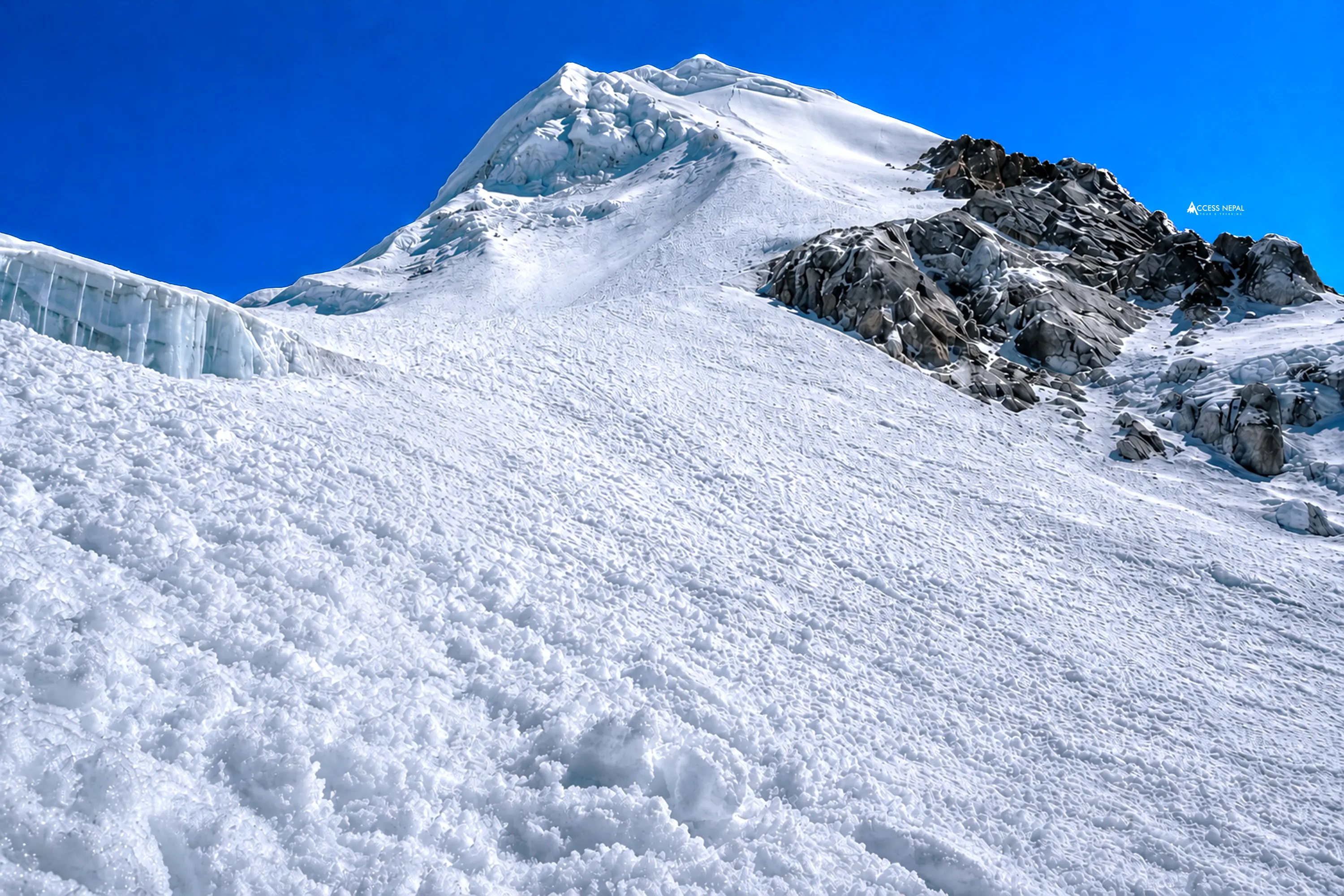
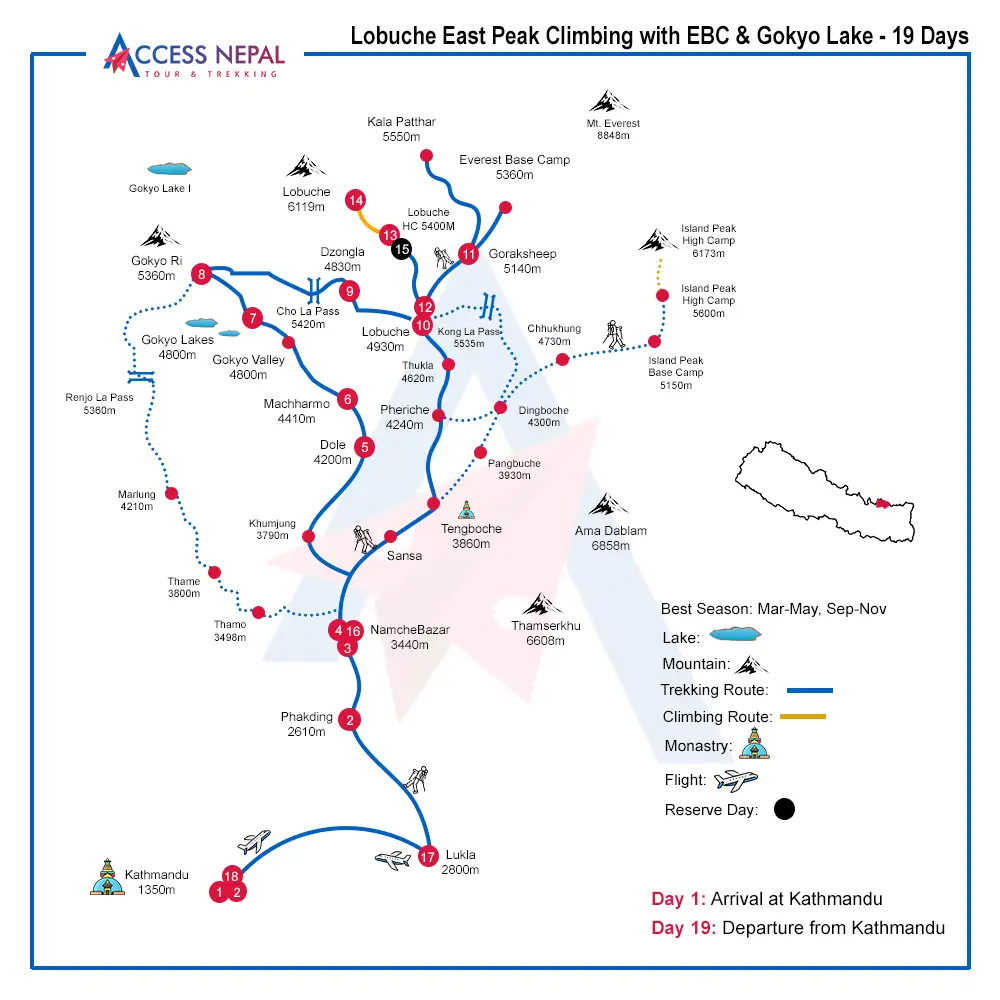
The route follows the standard Everest Base Camp trail from Lukla to Namche Bazaar, then branches into the Gokyo Valley via Dole and Machermo to reach Gokyo Lakes and Gokyo Ri. From Gokyo, the route crosses the glaciated Cho La Pass (5,368 m) to Dzongla, rejoining the main Khumbu Valley at Lobuche. From there, climbers detour to Everest Base Camp and Kala Patthar before returning to Lobuche to begin the technical ascent: Lobuche village → Lobuche High Camp (5,600 m) → summit ridge (6,119 m) via a mix of scrambling, snow slopes, and a fixed-rope headwall near the top. The descent retraces the same trail back through Namche Bazaar to Lukla for the return flight to Kathmandu.
A gain of roughly 4,700 m from Kathmandu to summit, spread over 14 climbing/trekking days for gradual, safe acclimatization.
Lobuche East Peak Climbing with Chola Pass & EBC Itinerary
Day 1Arrival in Kathmandu & Transfer to Hotel
-
- 1,440m/4,724ft
-

- 1,440m/4,724ft
Day 2Fly to Lukla (2,804 m) & Trek to Phakding (2,610 m)
-

- 8km
-
- 2,804 m (9,199 ft)
-
- 3 to 4 hours
-
- 2,610 m (8,563 ft)
Day 3Trek to Namche Bazaar (3,441 m)
-
- 8 km
-
- 3,440m/ 11,286ft
-
- 5-6 hrs
-
- 3,440m/ 11,286ft
Day 4Acclimatization Day at Namche Bazaar (3,441 m)
-
- 3,880m/12, 729ft
-
- 3,440m/ 11,286ft
Day 5Trek to Dole (3,680 m)
-
- 12km
-
- 3,680 m / 12,073 ft.
-
- 5–6 hrs
-
- 3,680 m / 12,073 ft.
Day 6Trek from Dole to Machermo (4,470 m)
-
- 4.5 km
-
- 4,470 m/ 14,665 ft
-
- 3–5 hrs
Day 7Trek to Gokyo (4,790 m)
-
- 7 km
-
- 4,790 m / (15,715 ft)
-
- 5–6 hrs
-
- 4,790 m / (15,715 ft)
Day 8Gokyo Ri (5,483 m) & Trek to Thangnak (4,500 m)
-
- 7-9 km
-
- 5,483 m
-
- 6–7 hrs
-
- (4,500 m)
Day 9Cross Cho La Pass (5,368 m) & Trek to Dzongla (4,830 m)
-
- 8 km
-
- 5,420 m (17,782 ft)
-
- 6–9 hrs
-
- : 4,830 m / 15,846 ft
Day 10Trek to Lobuche (4,910 m)
-
- 6.5 km
-
- (4,910 m / 16,108 ft)
-
- 4–5 hrs
-
- (4,910 m / 16,108 ft)
Day 11Everest Base Camp (5,365 m) & back to Gorak Shep (5,180 m)
-
- 7-8 km
-
- 5,365 m / 17,601 ft
-
- 6–7 hrs
Day 12Kala Patthar (5,545 m) & Trek to Lobuche (4,940 m)
-
- 13 km
-
- (5,545m/18,192ft)
-
- 6–7 hrs
-
- (4,940m/16,207ft)
Day 13Trek to Lobuche High Camp (5,600 m)
-
- 2-3 Km
-
- 5,600 m (18,368 ft)
-
- 4-5 hrs
Day 14Summit Day, Lobuche Peak (6,119 m) & back to Thukla
-
- 7-10 hrs
Day 15Reserve Day
Day 16Trek from Thukla to Namche Bazaar (3,440 m)
-
- 6–7 hrs
Day 17Trek from Namche to Lukla (2,840 m)
Day 18Fly back to Kathmandu
-
- 30 min flight
Day 19Departure Transfer
- Airport Transfer (Pick-up and Drop-off)
- Standard 2 nights accommodation in Kathmandu on a twin-sharing basis with breakfast. (Customizable)
- Traditional Nepali-style Welcome dinner (Day 1) along with cultural performances.
- Kathmandu-Lukla-Kathmandu: Flight tickets with airport transfer and tax fees covered.
- Standard teahouse accommodation on a twin-sharing basis throughout the trek.
- Tented camp during the climbs (Solo supplement option for a private stay).
- Attached toilet and hot shower for 7 nights (1 Phakding, 2 Namche, 2 Deboche, 1 Monjo, 1 Lukla) + 2 nights with attached toilet only at Dingboche.
- Full board meals, seasonal fruits, and 3 cups of tea/coffee during the trek.
- Highly experienced, licensed, first-aid trained, English-speaking guide with insurance and fees covered (1:7).
- Porter with insurance and fees covered (1:2).
- All the gear needed for the climb, except shoes (available for rent).
- Farewell dinner at one of the finest restaurants in Kathmandu.
- Adequate Chlorine Tablets for water purification.
- Access Nepal T-shirt, a duffel bag, and a Lobuche Peak climbing route map as a souvenir.
- Down jackets and sleeping bags are available for use free of cost.
- Certificate of adventure completion.
- Basic first-aid kit with an oximeter.
- Arrangements for emergency helicopter evacuation services (cost covered by your travel insurance).
- All required trekking permits and government taxes are included.
- Nepal Tourist Visa.
- Meals in Kathmandu (welcome and farewell dinner included).
- Personal expenses, travel insurance, extra luggage charges, Wi-Fi, charging of electronic devices, etc.
- Tips for guides, porters, and other field staff.
- Additional trip or stay in Nepal.
Fixed Departure
Our groups are small with maximum 14 people. We create groups of independent travelers, friends and families which maintains close interpersonal connection, engage more and get into depth of the journey. Choose a date from the calendar to reserve your spot.
Lobuche East Peak Climbing with Chola Pass & EBC Route Map
Altitude Chart
Useful Information
A Typical Day on Lobuche East Peak Climbing With Chola Pass & EBC
A typical trekking day of Lobuche Peak climbing begins around 6:00–6:30 AM with tea served at the lodge, followed by a wash and packing of duffel bags for the porters. Breakfast (porridge, eggs, Tibetan bread, or pancakes with tea/coffee) is served around 7:00 AM, and the group sets off by 7:30–8:00 AM to make the most of the clearer morning weather typical of the Khumbu.
The guide sets a slow, steady pace (“bistari bistari”) with regular short breaks and a longer lunch stop at a teahouse along the trail. The group usually reaches the next lodge by early-to-mid afternoon, leaving time to rest, explore the village, or attend an acclimatization briefing before a hot dinner and an early night, typically by 8:30–9:00 PM.
On the summit day itself, the schedule shifts: climbers leave Lobuche High Camp around 11:00 PM–1:00 AM, roped up and wearing headlamps, aiming to reach the summit around sunrise before descending as temperatures rise and afternoon winds pick up.
Views During Lobuche East Peak Climb
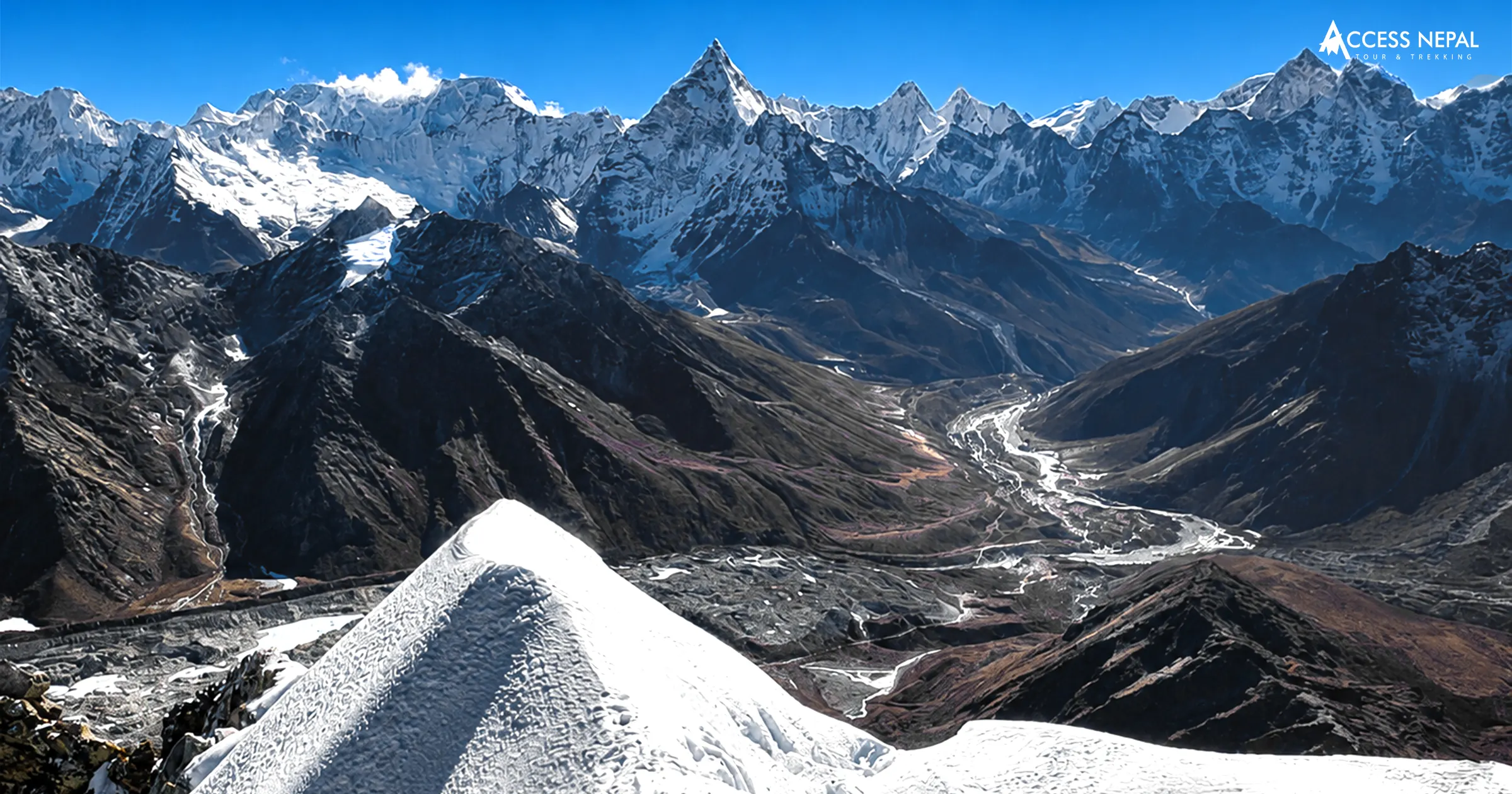
View During Lobuche East Peak Climb
From the summit ridge of Lobuche East, climbers are rewarded with an unbroken 360° panorama that few trekking peaks in Nepal can match: Mount Everest (8,849 m) and Lhotse (8,516 m) rise directly ahead, with Nuptse’s ice wall in the foreground and Makalu (8,485 m) visible to the east. To the west, Cho Oyu, Pumori, and the Gokyo peaks complete the horizon, while the Khumbu Glacier and Everest Base Camp are visible far below. The final summit ridge itself, narrow, exposed, and often wind-scoured — is regarded as one of the most photogenic high points of any trekking peak in the region. The Everest region of Nepal offers some of the most spectacular, rugged Himalayan panoramas found anywhere on the planet, and this route is designed to showcase them at every stage.
Weather Conditions During the Summit
Summit-day conditions on Lobuche East are governed largely by the jet stream and local katabatic winds. Night-time temperatures at High Camp typically fall to −15°C to −25°C, with wind chill making it feel considerably colder on the exposed upper ridge. Winds are generally calmest in the pre-dawn hours, which is why summit attempts start at night — by mid-morning, winds on the ridge can exceed 40–50 km/h, and afternoon cloud build-up from the valleys below often reduces visibility.
Clear, stable weather windows are most reliable in the pre-monsoon (April–May) and post-monsoon (October–November) seasons; our guides monitor mountain-specific forecasts daily and will adjust the summit schedule, using the Day 15 reserve day if necessary, to match the best available window.
Best Time for Lobuche East Peak Climbing With Chola Pass & EBC
Pre-monsoon (March–May): Stable weather, warming temperatures, and blooming rhododendron forests lower down; considered the most popular climbing season.
Post-monsoon (late September–November): Crisp, clear skies with excellent visibility and stable snow conditions; the second prime climbing window.
Winter (December–February): Possible for experienced climbers but very cold, with a higher chance of high-altitude closures — better suited to trekking than climbing.
Monsoon (June–August): Not recommended — heavy rain, leeches at lower elevations, poor visibility, and higher avalanche/rockfall risk on the peak.
Difficulty Level of Lobuche East Peak Climbing
This trip is graded strenuous. The trekking sections to Everest Base Camp, Gokyo, and over Cho La Pass involve consecutive long days (up to 9 hours) at altitudes above 4,000–5,300 m, and are demanding even without the climbing component.
The climb itself is technically graded PD (Peu Difficile / “a little difficult”) on the French alpine scale — not requiring advanced technical mountaineering skill, but involving steep snow/ice slopes up to 40–50°, a fixed-rope headwall near the summit, crevassed glacier travel, and exposure on the final ridge.
Success depends more on altitude tolerance, stamina, and mental resilience than on prior technical climbing experience — though basic rope and crampon skills make the climb significantly safer and more enjoyable.
Is Lobuche East Peak Climbing with EBC Trek Suitable For You?
This Lobuche East Peak Climbing with Chola Pass & EBC suits trekkers and climbers who:
- Have a good base level of cardiovascular fitness and can comfortably walk 5–8 hours a day for multiple consecutive days
- Have some prior high-altitude trekking experience (EBC, Annapurna Circuit, or similar above 4,000 m) — prior technical climbing is an asset but not mandatory
- Are willing to complete basic climbing training with our guides before the summit push
- Are mentally prepared for cold, basic teahouse living, and the discomforts of high altitude
- Have no underlying cardiac, respiratory, or other conditions that place them at elevated risk above 5,000 m (a doctor’s clearance is recommended)
If you are a strong hiker but have never used crampons or an ice axe, this itinerary is still achievable — our guides run a dedicated training session at Lobuche before the climb.
Skills and Training Required for Peak Climbing
No prior mountaineering certification is required, but climbers should arrive with:
- General fitness: the ability to hike 6–8 hours a day, ideally with some hill-walking or stair-climbing training in the 2– 3 months beforehand
- Basic familiarity with crampons, an ice axe, and a climbing harness is helpful (our team runs a full refresher/training day near Lobuche before the summit push)
- Comfort with exposure and heights, as the summit ridge and Cho La Pass both involve steep, exposed terrain
- Prior experience at altitudes above 4,000–5,000 m is a strong asset, though not mandatory
On-route training with Access Nepal’s climbing Sherpas covers: fitting crampons and harnesses, use of jumar (ascender) and figure-8/ATC (descender), walking in crampons on snow/ice, self-arrest basics, and roped movement — all practiced on suitable terrain before the summit attempt.
How to prepare for Lobuche East Peak Climbing With Chola Pass & EBC?
- Begin cardiovascular and leg-strength training (hiking, stair climbing, running, cycling) at least 8–12 weeks before departure
- Include weighted pack walks (8–10 kg) to simulate daypack conditions on the trail
- Get a medical check-up, particularly for cardiac/respiratory history, and discuss Diamox with your doctor.
- Break in your mountaineering boots well before the trip — new boots on summit day is a common cause of blisters and frostnip
- Arrange comprehensive travel insurance with helicopter evacuation cover up to at least 6,000 m
- Pack according to the checklist provided and test all technical gear before arrival
- Arrive in Kathmandu at least one day before departure to allow for gear checks and a full team briefing
Proper Acclimatization Days in the trail
Altitude sickness is the single biggest risk on this trip, and the itinerary is deliberately built around the mountaineering principle of “climb high, sleep low.” Two dedicated acclimatization days are built in at Namche Bazaar (Day 4) and effectively at Lobuche/Gorak Shep before the summit push, along with several days where altitude gain is kept below 500 m. Our guides monitor each climber’s oxygen saturation and pulse daily with a fingertip oximeter, watch closely for early symptoms of Acute Mountain Sickness (headache, nausea, loss of appetite, disturbed sleep), and will not hesitate to slow the itinerary, prescribe rest, or arrange descent/evacuation if symptoms do not resolve.
The Day 15 reserve day provides further buffer in case additional acclimatization or rest is needed before or after the summit attempt.
Availability of Food and Accommodation
Accommodation throughout the trek is in local teahouses/lodges — simple twin-share rooms with shared bathroom facilities in most villages (attached bathrooms and hot showers, sometimes for a small fee, are available up to around Dingboche/Lobuche). At Lobuche High Camp, climbers stay in expedition-style tents with sleeping mats, as no teahouse exists at that altitude.
Meals are freshly prepared at each teahouse and typically include a mix of traditional Nepali dal bhat, noodle and pasta dishes, soups, momos, potatoes in various forms, porridge, eggs, and bread, with black tea, milk tea, and coffee widely available. Boiled or filtered water and bottled water for purchase are available at every stop; we recommend a water purification system to reduce plastic waste and cost. Menu variety naturally narrows at higher elevations, and hot meals are provided at High Camp before and after the summit push.
Sherpa Culture and Tradition
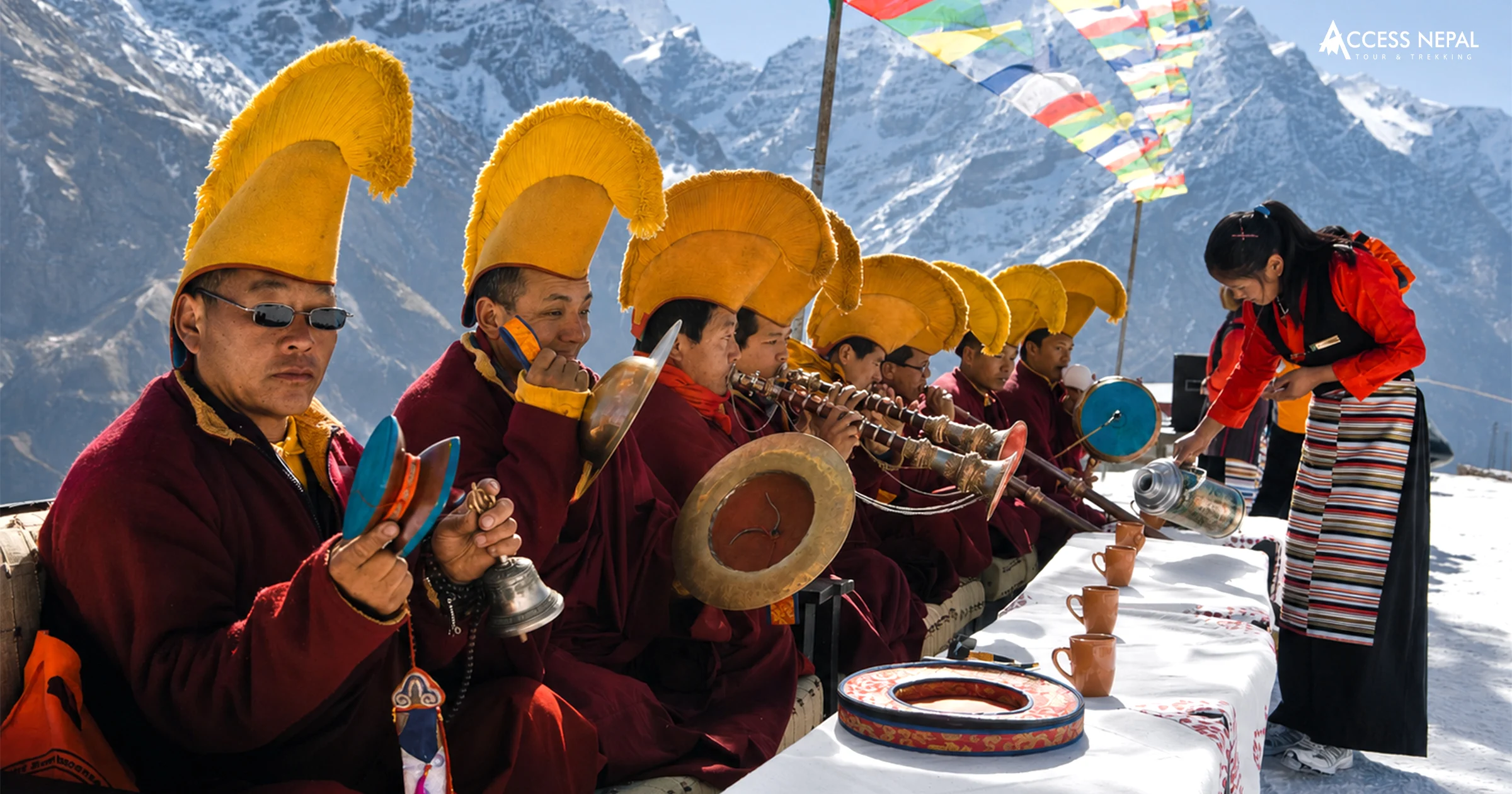
Sherpa Culture and Tradition
The trail passes through the heartland of the Sherpa people, whose Tibetan Buddhist culture and legendary mountaineering skill define the character of the Khumbu.
In Namche Bazaar, Khumjung, and at the Tengboche Monastery — the spiritual centre of the region — climbers can witness prayer flags, mani walls, chortens, and, if timing allows, a monastic prayer ceremony.
Our Sherpa guides are happy to share the customs, etiquette (such as passing mani walls and chortens on the left), and history of their communities throughout the trek, offering a cultural dimension alongside the physical challenge of the climb.
Access Nepal Team and Support During the Summit
Every Lobuche East climb with Access Nepal Tour and Trek is led by a government-licensed climbing guide, supported by NMA-registered climbing Sherpas at a ratio of approximately one Sherpa to every two climbers above Lobuche High Camp.
The team fixes ropes on the summit headwall in advance where needed, carries a full medical kit and emergency oxygen, and stays in daily satellite/radio contact with our Kathmandu office, which monitors weather forecasts and coordinates any emergency evacuation.
Porters and kitchen staff support the trekking sections, while a dedicated climbing crew manages technical gear, rope-fixing, and safety systems for the summit push itself.
Gokyo Lakes and Gokyo Ri
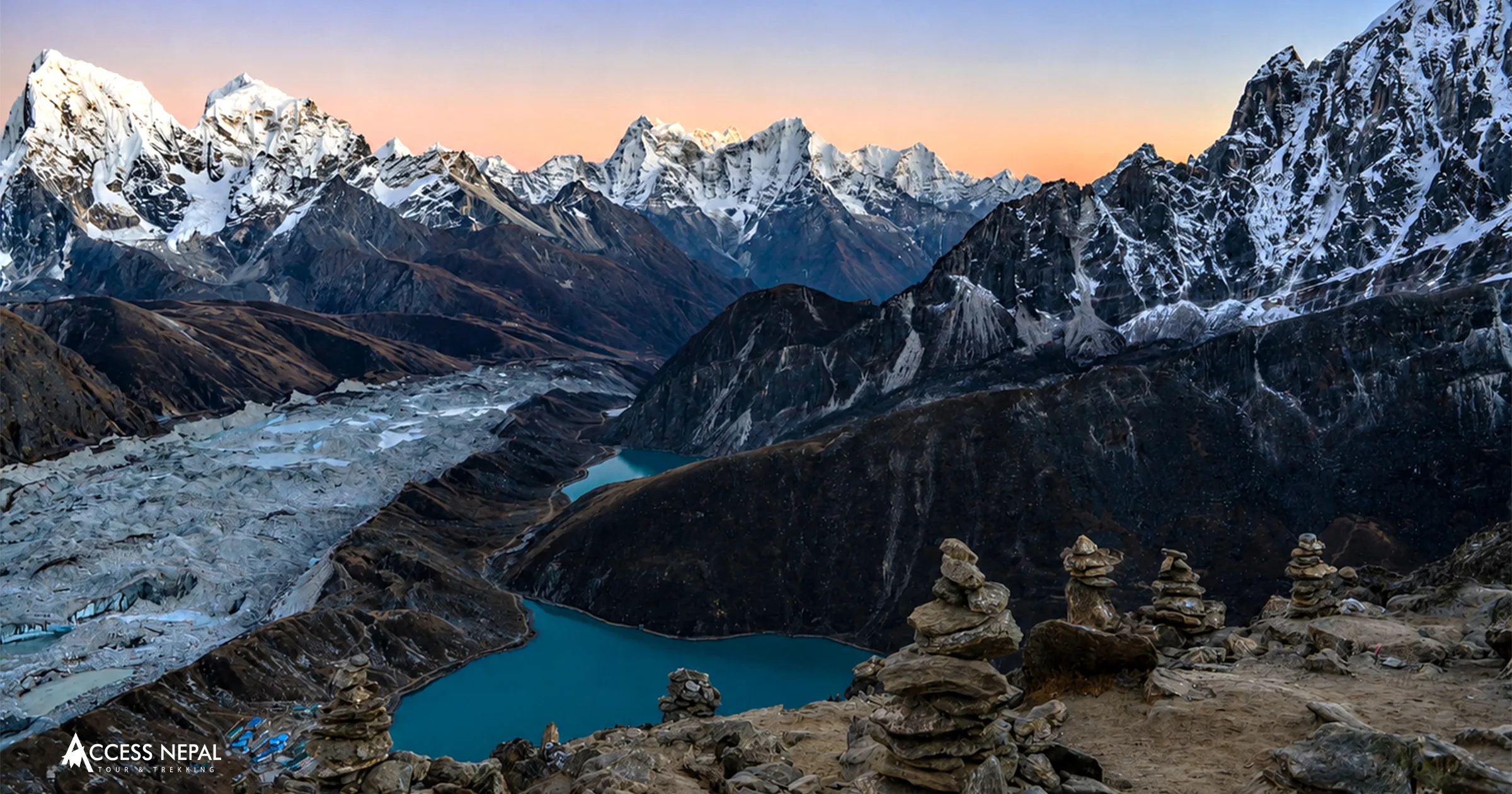
Gokyo Lakes
The Gokyo Valley is one of the most scenic detours in the Khumbu, home to a chain of glacial lakes fed by the Ngozumpa Glacier, Nepal’s largest — including the striking turquoise Dudh Pokhari beside Gokyo village.
A pre-dawn climb of Gokyo Ri (5,483 m) rewards climbers with a panorama frequently rated on par with, or by some accounts even better than, the view from Kala Patthar: four of the world’s six highest peaks — Everest, Lhotse, Makalu, and Cho Oyu — are visible in a single sweep, alongside the lakes and glacier below.
Requirements of Travel Insurance
Comprehensive travel insurance is mandatory for this trip and must include:
- Emergency helicopter evacuation cover up to at least 6,000 m (7,000 m is safer, given the 6,119 m summit)
- Coverage for high-altitude trekking and mountaineering/peak-climbing activities specifically (many standard travel policies exclude this)
- Medical treatment and hospitalization cover in Nepal and repatriation cover to your home country
- Trip cancellation, curtailment, and delay cover, particularly for Lukla flight disruptions •
- Cover for loss or damage of climbing and trekking equipment.
Please send us your insurance policy details (insurer, policy number, and 24-hour emergency contact) before departure. Our team can recommend trusted insurers that explicitly cover peak climbing above 6,000 m.
Packing List for Lobuche East Peak Climbing
Technical Climbing Gear
- Down summit suit or 4-season down jacket & salopette
- Insulated summit gloves + liner gloves
- Mountaineering boots (e.g. La Sportiva Nepal Evo / Olympus Mons)
- Plastic or insulated trekking boots for approach
- Crampons (fitted to boots), climbing harness, ice axe
- Ascender (jumar), descender/figure-8 or ATC, tape slings, carabiners (2 locking, 2 non-locking)
- Helmet, UV-protection glacier glasses/goggles
Clothing & Sleep System
- Base layers (thermal top & bottom, 2–3 sets)
- Fleece or softshell mid layer
- Waterproof/windproof shell jacket and pants
- Trekking trousers, T-shirts, and buff/neck gaiter
- Warm hat, sun hat, and headlamp with spare batteries
- 4-season sleeping bag (rated to at least -20°C) and liner
- Trekking poles and gaiters
Personal & Health Items
- Daypack (35–45L) and duffel bag for porters
- Water bottles/thermos and water purification tablets or filter
- Sunscreen (SPF 50+), lip balm with SPF, personal toiletries
- Personal first-aid kit and Diamox (acetazolamide) after doctor consultation
- Snacks and rehydration electrolytes
Documents & Extras
- Passport, permits, and passport-sized photos
- Cash (Nepali rupees) for personal expenses and tips
- Power bank, camera, universal adaptor
- Travel insurance documents (with rescue/evacuation cover)
- Basic trekking towel, earplugs, and a good book for teahouse evenings
Book Your Lobuche East Peak Climb with Access Nepal Tour and Trek
With a safety-first itinerary, experienced Khumbu-native guides, transparent pricing, and 24/7 support from our Kathmandu office, Access Nepal Tour and Trek is ready to take you to the summit of Lobuche East and the heart of Everest Base Camp. Fixed 2026 and 2027 departure dates are available, and private departures can be arranged on any date to suit your schedule.
Contact our team today to check availability, ask questions about training or gear, or to reserve your place on this unforgettable 19-day Himalayan expedition.
Lobuche East Peak Climbing with Chola Pass & EBC FAQs
What is the Lobuche East Peak Climbing with Everest Base Camp and Chola La Pass package?
This is a combined high-altitude adventure that takes you through three iconic Himalayan experiences in a single expedition — trekking to Everest Base Camp (5,364m), crossing the technical Chola La Pass (5,420m), and summiting Lobuche East Peak (6,119m). It is one of the most comprehensive Khumbu experiences available, combining trekking, a high-altitude glacier crossing, and a genuine mountaineering summit.
How long does this expedition take?
What is the maximum altitude reached on this expedition?
Is this expedition suitable for first-time climbers?
What is Lobuche East Peak?
What level of physical fitness is required for Lobuche East Peak Climbing?
Do I need prior mountaineering experience?
How physically demanding is the Chola La Pass crossing?
What training is recommended before this expedition?
What is the general route sequence of the expedition?
Are there acclimatization days built into the itinerary?
When do we attempt the summit of Lobuche East?
How long does the summit day take?
What technical skills are needed for the Lobuche East summit?
Are guides mandatory for this expedition?
Is altitude sickness a serious risk on this expedition?
What happens if weather prevents a summit attempt?
What equipment is provided and what do I need to bring?
What permits are required for this expedition?
How much does the Lobuche East climbing permit cost in 2026?
What is the approximate total cost of this expeditio
What is the best time of year for this expedition?
What is the accommodation like during the expedition?
What food and water arrangements are made at high altitude?
Can I combine this expedition with Gokyo Lakes or other side trips?
Awards and Achievements
Access Nepal Tour and Treks has been recognized with TripAdvisor’s prestigious Travelers’ Choice Award for multiple consecutive years, reflecting our unwavering commitment to quality and clients’ satisfaction.