


Mount Everest vs Kilimanjaro: Which is harder?
- Places
- By accessnepaltour
The one thing Mount Kilimanjaro and Mount Everest have in common is that both are the highest mountains in their respective continents: Africa and Asia. However, the other conditions one faces while climbing these mountains are drastically different.
The question of which is harder to climb, between Mount Everest and Mount Kilimanjaro, can be difficult to address, as the answer is subjective. You have to compare the details of the experience of both treks to come to a reasonable conclusion. We list out the details on location, accommodation, the terrain and landscape, oxygen levels, cost, what you need to pack and more in this blog.
While Mount Everest is clearly the more challenging trek if we talk about the summits themselves, with Everest being almost 3,000m taller than Kilimanjaro, but Everest Base Camp and the Mount Kilimanjaro summit are a more fitting comparison of similar heights. Which should you trek first, then?
Keep reading to find out which is more suitable for you.
Where are Mount Kilimanjaro and Mount Everest located?
Mount Kilimanjaro and Mount Everest are located on different continents, thousands of km apart. Mount Kilimanjaro is located in Africa, while Mount Everest is situated in Asia.
Related Packages
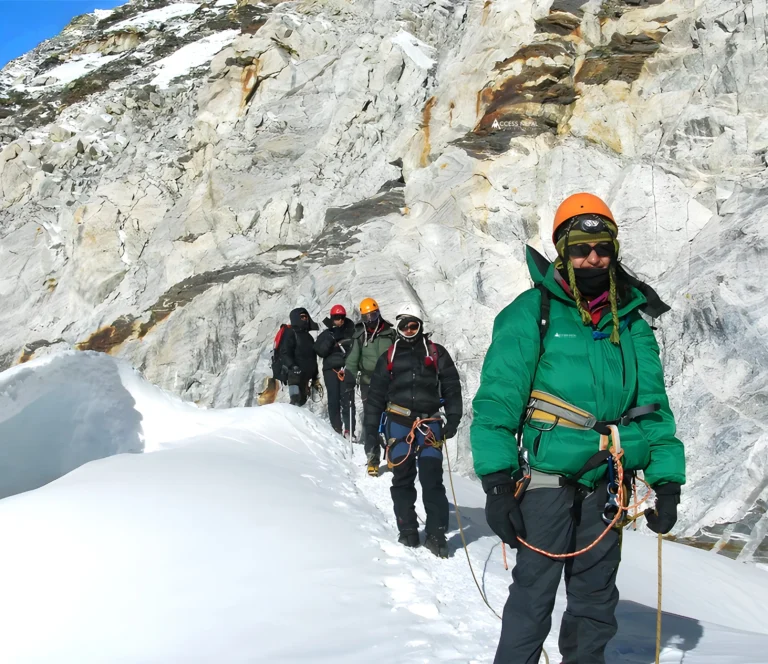
Everest Expedition - 55 Days
 8,848m/29,029ft
 Extremely Difficult
 All
Inclusive Plan
All
Inclusive Plan
Mount Kilimanjaro is located in northeastern Tanzania, near the country’s border with Kenya. It sits in the Kilimanjaro Region, approximately 300 km south of the equator.
The mountain is also a dormant volcano that rises from the open savannah plains, which makes it the tallest free-standing mountain in the world. Unlike most major peaks, Kilimanjaro is not a part of any mountain range.
Mount Everest, on the other hand, is located in South Asia and lies in the Mahalangur Himal sub-range of the Himalayas. It is on the border between Nepal and Tibet, China.
On the Nepalese side, the mountain falls in the Solukhumbu District of Koshi Province within Sagarmatha National Park, and on the Tibetan side, it is in Tingri County. Everest is almost always climbed from the Nepal side, as the south route is more accessible and comparatively easier to climb than the north face from Tibet.
What are other mountains in the Himalayan range?
The Himalayas contain some of the highest peaks on Earth. Besides Mount Everest which is the tallest at 8848m, the Himalayan range has nine other peaks above 8,000 meters, including K2 (8,611m), Kangchenjunga (8,586m), Lhotse (8,516m), Makalu (8,463m), Cho Oyu (8,201m), Dhaulagiri I (8,167m), Manaslu (8,163m), Nanga Parbat (8,125m) and Annapurna I (8,091m).
Kilimanjaro doesn’t have such mighty neighbours and stands alone in the Kilimanjaro region.
Which is taller, Mount Kilimanjaro or Mount Everest?
By now, we have established that Mount Everest is much taller than Mount Kilimanjaro.
Mount Everest is the highest mountain in the entire world with a height of 8,848m (29,03ft) above sea level. This measurement was officially jointly certified by Chinese and Nepalese authorities back in 2020.
Mount Kilimanjaro stands at 5,895m (19,341ft) above sea level, and the difference between them is almost 3,000m–almost the height of yet another mountain.
Rather, a more relevant comparison for trekkers could be Kilimanjaro vs Everest Base Camp height. Everest Base Camp on the south side sits at 5,364m, and in this lens, Mount Kilimanjaro’s summit (5,895m) is actually higher than Everest Base Camp by about 531m.

Summit of mount Kilimanjaro vs Mount Everest
So while the Everest peak or summit is much taller, you stand higher on the summit of Mount Kilimanjaro than you would at the base of Everest (the Everest Base Camp).
Where does Kilimanjaro rank in height in the world?
Mount Kilimanjaro is not among the tallest mountains in the world. It ranks fourth among the Seven Summits (the highest peak on each continent), as the representative of Africa.
Globally, Kilimanjaro ranks around 150th in terms of height among all mountains in the world. However, it is the tallest free-standing mountain in the world, which means it is not part of any mountain range. It rises directly from the flat savannah grounds.
Which is more difficult to climb: Mount Kilimanjaro or Mount Everest?
This comparison depends entirely on what the word ‘climb’ means to you. There are many factors that end up making the experience of trekking these two mountains very different.
Kilimanjaro vs Everest Summit
If you are simply comparing summiting Everest versus summiting Kilimanjaro, Everest is a bit more difficult. Summiting Everest requires weeks of climbing, technical mountaineering skills (you should know how to use ropes, crampons, and ladders when climbing), and supplemental oxygen when you get above 8,000m.
Kilimanjaro requires no technical climbing, as it is a high-altitude trek, it is not a mountaineering expedition. You don’t really need ropes, ice axes or ladders to finish on the standard routes.
Mount Kilimanjaro vs Everest Base Camp
Now this is a much more similar comparison as neither trek requires extensive technical climbing, despite both being high-altitude treks. The differences between them come down to the altitude profile, duration of climb, and the terrain.
Mount Kilimanjaro’s difficulty comes from the rapid ascent you have to make. Most routes are 5 to 9 days long, and a climber gains nearly 6,000m from the trailhead to the summit in a short period of time.
There are very few opportunities for acclimatisation on the shorter routes like these, unless you intentionally create ones. Summit night is also particularly brutal as climbers usually start around midnight at 4,600m and push to 5,895m in a single 6-8 hour climb.
Then they have to descend immediately, and this rapid climb leads to altitude sickness for many climbers.

Which is more difficult to climb: Mount Kilimanjaro or Mount Everest
Everest Base Camp’s difficulty comes from its duration and terrain. The trek takes 12 to 14 days and covers approximately 130 kilometres (round-trip wise). The trail has many ups and downs, and you follow the climb high, sleep low principle, where you climb to higher altitudes in the day, then descend midway through to sleep lower, then climb the next morning again. This helps with acclimatisation.
Related Packages

Everest Base Camp Trek - 14 Days
- 5,550m/18,209ft
-
Challenging
- All
Inclusive Plan
There are long sections of stone stairs, suspension bridges, and rocky moraine paths. While the maximum altitude (5,364m) is slightly lower than Kilimanjaro’s summit, you spend more days above 4,000 meters than on a Kilimanjaro climb.
Success Rates
For Everest Base Camp, the success rate is very high–at around 95%, as most trekkers who start end up completing the trek. For Kilimanjaro, surprisingly, success rates are lower, ranging from 65% to 90% depending on route length. Turns out the shorter the route, the lower the success rate is in this case.
Mount Everest vs Kilimanjaro: Which trek to choose first?
If you plan to go on both Mount Everest and Mount Kilimanjaro treks eventually, the better choice for most individuals would be to climb Mount Kilimanjaro first.
This is because Mount Kilimanjaro is a shorter trek of usually 6-9 days total, compared to the Everest Base Camp trek, which is usually 12-14 days. So you have to face fewer harsh days on foot.
The travelling logistics for the Mount Kilimanjaro trek are also a bit simpler. You fly into Kilimanjaro International Airport, drive to the nearby towns of Moshi or Arusha, and start walking on your trek immediately.
On the Everest trek, however, you have to take another short flight to Lukla. This isn’t that difficult a task, as the agency you book through handles this. You can take it as an opportunity to explore Kathmandu and Lukla–both are culturally and geographically very different, but beautiful in their own way.
That said, if you already have experience with multi-day treks at altitude, you could start out with Everest Base Camp. But for a true beginner choosing between the two, Kilimanjaro should be the first choice, and then you attempt the Everest Base Camp.
Which trek is more difficult, Everest or Kilimanjaro?
Neither climb is objectively more difficult, as they just test different things, so again it depends.
Kilimanjaro is more difficult in terms of altitude gain per day. On summit night, you climb from approximately 4,600m to 5,895m in a single push of 6–8 hours. You then descend immediately.
Such extreme ascent causes altitude sickness in a large percentage of trekkers. On the other hand, success rates on Kilimanjaro are around 65–75% for 6-day routes and 85–90% for 8-day routes.
Everest Base Camp can be a bit more difficult in terms of endurance and the terrain you have to face. You walk 7–10 days to reach Base Camp, with constant ups and downs. The trail has stone stairs, suspension bridges, and some rocky sections too.
You also spend more nights above 4,000m (up to 5,364m at Base Camp itself).
So, to summarise all of this up, you should choose Kilimanjaro if you want a shorter more intense altitude challenge and pick the Everest Base Camp trek if you want a longer more endurance-based climb.
History, naming, and first climbs of Mount Kilimanjaro and Mount Everest
Mount Kilimanjaro
Kilimanjaro has been known to the local communities for centuries. The Chagga people, who live on the mountain’s lower slopes, have long been referring to it by names that represent its snow-capped peak.
The exact origin of the name ‘Kilimanjaro’ is still debated, but the most popular explanation is that it combines the Swahili word ‘kilima’ (meaning mountain) and the Chagga word ‘njaro’ (meaning whiteness or shining).
The first ever known European man to reach Kilimanjaro was the German missionary Johannes Rebmann, in 1848. His reports of a snow-capped mountain near the equator were not believed by many in Europe at the time.
The first successful ascent to the summit happened much later. On October 6, 1889, German geographer Hans Meyer and Austrian mountaineer Ludwig Purtscheller reached the highest point of Kilimanjaro. They apparently named the peak Kaiser-Wilhelm-Spitze.
After Tanzania gained independence, the summit was renamed Uhuru Peak, which means ‘Freedom Peak’ in Swahili.
Mount Everest
Mount Everest has been known among locals for centuries under different names. In Tibet, it is called Chomolungma, which means ‘Goddess Mother of the World’. In Nepal, it is known as Sagarmatha, meaning ‘Peak of Heaven’.
Everest was noted as the world’s highest peak in 1852 by the Great Trigonometric Survey of British India. An Indian mathematician named Radhanath Sikdar calculated it to be the tallest on Earth.
Surveyors of the time said they could not find a popular local name for the mountain, so in 1865, they named it after Sir George Everest, who was the British surveyor general of India.
The first successful ascent to the Everest summit happened nearly a century later, on May 29, 1953, when Edmund Hillary from New Zealand and Tenzing Norgay Sherpa of Nepal reached the top together.
Comparing the Route to Mount Kilimanjaro and Mount Everest (Base Camp)
The terrain on Kilimanjaro and the Everest Base Camp trek is different in several ways.
Kilimanjaro has five distinct climate zones, and you have to pass through all of them. Starting from the rainforest zone at the gate (around 1,800m), you move through heath and moorland, then alpine desert, and finally reach the arctic zone near the summit.
The trail is generally a steady incline with some descents here and there. Most routes are on dirt paths, rocky sections, and volcanic scree near the very top.
The final push to Uhuru Peak makes you walk on loose gravel and small stones, which is a bit slow with all the sliding back. The good thing is, there are no technical sections that require ropes or climbing gear.
Everest Base Camp, on the other hand, has constant ups and downs throughout the climb. The trail follows the Khumbu Valley, with suspension bridges crossing the Dudh Kosi river, stone stairs built into hillsides, and some sections of rocky moraine from glaciers.

Mount Everest Base Camp Trek Itinerary
The EBC route gains and loses elevation repeatedly. You climb from Lukla (2,840m) to Namche (3,440m), then descend a bit, then climb again to Tengboche and descend to cross rivers, then climb again. This happens throughout the trek.
For acclimatisation, the Everest route has many built-in rest days at Namche Bazaar and Dingboche, and trekkers do short hikes to higher elevations and return to sleep lower all the time too.
Kilimanjaro has many fewer stops for acclimatisation. On shorter routes (5-6 days), you climb continuously with only overnight stops. The longer routes (7-9 days) can include an extra day around 4,600m to help you adjust.
The main difference here is that Kilimanjaro’s difficulty comes from the altitude gain per day, while Everest Base Camp’s difficulty comes from the length of the trek and the constant elevation changes.
Standard itineraries of Mount Kilimanjaro trek vs Mount Everest Base Camp trek
Mount Kilimanjaro Itinerary (Lemosho Route, 8 Days)
A standard Kilimanjaro package using the Lemosho route is typically 8 days. This is one of the longer routes, which improves acclimatisation and success rates. It looks something like this.

Mount Kilimanjaro Itinerary (Lemosho Route, 8 Days)
Mount Everest Base Camp Itinerary (14 Days)
A standard Everest Base Camp package is 14 days from arrival to departure. Here is our own itinerary.
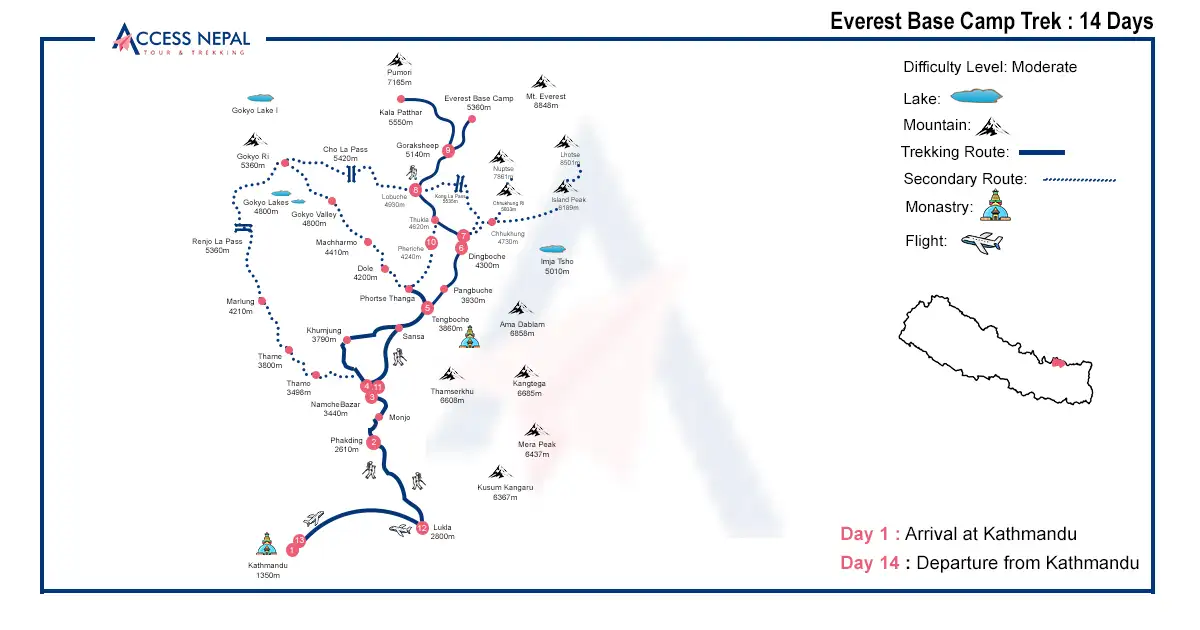
Route map of 14-day Everest Base Camp Trek Itinerary
Trekking gear and packing list for Kilimanjaro vs Everest Base Camp
Generally, the gear you need for both treks is pretty much the same. The difference is that Kilimanjaro involves more camping, while Everest Base Camp uses teahouses, so you carry slightly less on the Everest trek.
- Footwear: A pair of waterproof trekking boots that are broken in, camp shoes like Crocs or sneakers for evenings, 3-4 pairs of trekking socks, and some thick thermal socks.
- Clothing: 2-3 sets of moisture-wicking base layers, a fleece jacket, a down jacket (rated -10°C to -20°C), a waterproof shell jacket and trousers, 2 pairs of trekking pants, a warm beanie, a sun hat, and a buff or neck gaiter.
- Gloves: A pair of lightweight liner gloves and a pair of insulated outer gloves are needed. On Kilimanjaro summit night, your hands will be exposed to below-freezing temperatures for many hours, so good gloves are very much needed.
- Sleeping gear: For Kilimanjaro, you need a 4-season sleeping bag rated to -10°C or lower because you sleep in tents. For Everest Base Camp, teahouses provide blankets, so a 3-season bag (rated to 0°C) is usually sufficient, though a warmer bag is better for higher villages like Gorak Shep.
- Backpacks: You need a daypack (20-30L) for your daily essentials and a duffel bag (10-15kg max) that your porter carries.
- Hydration: A water bottle of 2-3L capacity and purification tablets are a must for both. On Kilimanjaro, you can get boiled water at camps, and on Everest, teahouses sell boiled water for a small fee.
- Sun protection: SPF 50+ sunscreen, SPF lip balm, and UV-rated sunglasses. At high altitude, UV exposure is intense on both treks, so bring your sunscreen at any cost.
- Lighting: A headlamp with spare batteries. On Kilimanjaro, summit night starts around midnight, so this is critical. On Everest, you may start early for Kala Patthar as well.
- First aid and altitude: Diamox (acetazolamide), blister plasters, throat lozenges, ibuprofen, rehydration salts, and basic motion sickness or nausea medication.
- Electronics: Power bank (20,000mAh+), camera or phone, universal adapter. On Everest, teahouses have charging points for a fee. On Kilimanjaro, there is no charging once you leave the gate, so a large power bank is necessary.
- Documents: Passport, permits, travel insurance details, and some cash.
- Optional but useful: Sleeping bag liner, pillowcase, earplugs, clothesline, trekking poles could all be useful.

Trekking gear and packing list for Kilimanjaro vs Everest Base Camp
The main difference here is that Kilimanjaro involves camping, so you carry more sleep gear and cannot charge electronics on the mountain. Everest Base Camp has teahouses with beds, blankets, and charging options, but you walk longer distances over more varied terrain.

Is Mount Kilimanjaro safer than Mount Everest?
If you want to explore Mount K2 vs Mount Everest: Which one is harder? You can read our blog content as well.
Cost to trek Kilimanjaro vs cost to trek Everest Base Camp
The cost to trek Kilimanjaro and Everest Base Camp is pretty much similar, but there are differences based on route, duration, and inclusions.
Kilimanjaro packages typically range from USD 2,000 to USD 4,000 for the standard 6-8 day routes. Cheaper routes (like Marangu, 5 days) can cost around USD 1,500-2,000, but these have lower success rates. More luxurious options with private toilets, better tents, and extra staff cost up to USD 5,000-6,000.
Everest Base Camp packages typically range from USD 1,400 to USD 3,500 for a standard 14-day itinerary. The lower end (around USD 1,400-1,800) usually includes teahouse accommodation, a guide, porter, permits, and meals. Higher-end packages (USD 3,000 and above) have better hotels in Kathmandu and other amenities–you have to check the package for exact details.

Cost to trek Kilimanjaro vs cost to trek Everest Base Camp
Why the difference?
Kilimanjaro is usually more expensive, mainly for three reasons. First, you pay for a full camping setup (tents, cooking equipment, sleeping mats). Second, Kilimanjaro needs a much bigger support team for climbers, which is typically 2-3 porters per trekker, plus guides as well as cooks. Third, park fees on Kilimanjaro are higher.
Everest Base Camp has teahouses, so you do not pay for camping gear or cooking staff, and porters are usually shared by the group of trekkers.
Both treks usually exclude international flights, travel insurance, tips for staff, as well as personal expenses like snacks and drinks, and gear purchases.
Accommodation in Kilimanjaro vs Everest Base Camp, which is better?
There is quite a bit of difference in accommodation between the two treks. The Everest Base Camp accommodation could be called the better one, as comparatively, there are more services available here than en route to Kilimanjaro.
On Everest Base Camp, you stay in teahouses (also called lodges) run by local families. Most stops along the route are villages where people have lived for generations–like in Lukla, Phakding, Namche Bazaar, Tengboche, Dingboche, among others.
As tourism grew in the region, locals started building teahouses with basic facilities: beds with mattresses and blankets, shared bathrooms, and common dining areas with a wood-burning stove.
In larger villages like Namche and Lukla, you can find rooms with attached bathrooms, hot showers (for a fee), Wi-Fi (for a fee), and charging points for electronics. At higher villages like Lobuche and Gorak Shep, accommodation is more basic—simple rooms, no attached bathrooms, limited heating. But you still sleep in a bed under a roof.

Accommodation in Kilimanjaro vs Everest Base Camp
On Kilimanjaro, there are no villages or permanent lodges above the park gate, and you usually sleep in tents at designated campsites along each route. The tents are typically two-person dome tents with sleeping mats, and there are, of course, no beds, no attached bathrooms, and no Wi-Fi or charging. Toilet facilities are basic pit toilets at campsites, and you cannot even shower on the mountain.
Which is better?
For comfort, Everest Base Camp wins by miles: sleeping in a bed, having access to warm dining rooms, and the option to pay for a hot shower after a cold day. All this makes a big difference for trekkers. For wilderness experience, Kilimanjaro is the clear winner, as you get to camp under the stars with no villages in sight.
Best Scenery and Weather: Kilimanjaro vs Everest
Scenery and landscape differences between Everest and Kilimanjaro
Everest Base Camp offers a mix of cultural and natural scenery. You trek through Sherpa villages like Namche Bazaar, walk through pine and rhododendron forests in the lower elevations, and visit ancient monasteries like Tengboche. The mountain views are dramatic and close — from Kala Patthar, you see Everest, Lhotse, Nuptse, and the Khumbu Icefall up close. The landscape changes from green valleys to barren, rocky high-altitude desert as you gain elevation.
Kilimanjaro has no villages or cultural sites on the mountain itself. Instead, the highlight is the ecological zones. You start in dense, humid rainforest with colobus monkeys and birdlife. By day two, you emerge into heath and moorland with giant lobelias and senecios — plants that look prehistoric. Above 4,000m, you enter an alpine desert of volcanic rock and dust. Near the summit, you walk on a glacier and snowfield. The views from Uhuru Peak look down onto the African plains, not at surrounding peaks, because Kilimanjaro stands alone.
The weather of Kilimanjaro vs Everest is different
Temperature and conditions on Everest Base Camp: During the peak trekking seasons (March-May and September-November), daytime temperatures at lower elevations (2,500-3,500m) range from 10°C to 20°C. At night, temperatures drop to -5°C to -10°C. At higher elevations (above 4,500m), daytime temperatures are around 0°C to 5°C, and nighttime temperatures can fall to -15°C or lower. The weather is generally stable during these windows, though afternoon clouds and occasional snow showers are common.
Temperature and conditions on Kilimanjaro: At the starting gate (1,800m), temperatures are warm, 20°C to 25°C during the day. As you climb, temperatures drop steadily. At Shira Plateau (3,600m), daytime temperatures are 10°C to 15°C. At Barafu Camp (4,600m), daytime is 0°C to 5°C. Summit night is the challenge — temperatures at Uhuru Peak (5,895m) range from -10°C to -20°C, with wind chill making it feel much colder. Because Kilimanjaro is near the equator, the temperature difference between day and night is more extreme than on Everest.
Wind and risk of frostbite: On Everest Base Camp, wind is generally mild in the valleys but can be strong at exposed points like Kala Patthar. Frostbite is rare on the EBC trek because you are not spending hours at the highest elevations — you reach 5,550m and descend the same day.
On Kilimanjaro, summit night is the main risk. You start climbing at midnight from 4,600m and walk for 6-8 hours in darkness, with temperatures below freezing and wind chill. Frostbite on fingers and toes is possible if gloves or boots are inadequate. Guides check trekkers regularly for signs of cold injury on summit night.
Visibility
Everest Base Camp has predictable visibility windows. Autumn (September-November) offers crystal-clear skies after the monsoon, with the best mountain views. Spring (March-May) is warmer but hazier, with more afternoon cloud cover that can block views of the peaks. Morning hours generally have the best visibility in both seasons.
Kilimanjaro has less predictable visibility. The dry seasons (January-February and August-October) offer the best conditions, with clear mornings that cloud over in the afternoons. The wet seasons (March-May and November-December) bring rain and cloud cover, especially on the lower slopes. However, even in the dry season, the summit can be shrouded in cloud, and you may not see the surrounding plains until you descend below the cloud layer.

Best Scenery and Weather: Kilimanjaro vs Mount Everest
Oxygen strategies at Mount Kilimanjaro vs Mount Everest Base Camp
The oxygen strategies for Kilimanjaro and Everest Base Camp are completely different because one is summiting a 5,895m peak and the other is trekking to 5,364m without a summit push.
On Kilimanjaro, trekkers usually do not use supplemental oxygen. The summit is at 5,895m, which is below the ‘death zone’ (generally considered to be 8,000m and above). Your body can acclimatise to this altitude naturally if you give it enough time.
Most trekkers use the medication Diamox (acetazolamide) to help prevent altitude sickness, but bottled oxygen is not carried on standard Kilimanjaro treks. The focus, rather, should be on slow ascent, proper hydration, and recognising symptoms of altitude sickness.
On Everest Base Camp, too, trekkers do not use supplemental oxygen. The highest point on the EBC trek is Kala Patthar at 5,550m, which is still below the death zone.
You spend 12-14 days gradually gaining altitude, with built-in acclimatisation days–so no bottled oxygen is generally needed or carried on the standard EBC trek. The only people using oxygen on Everest are those attempting to summit the main peak itself, not trekkers going to just the Base Camp.
The difference
Neither of these treks really requires supplemental oxygen. Both rely more on proper acclimatisation schedules and descent. The key difference here is that Kilimanjaro’s summit night has a rapid elevation gain from 4,600m to 5,895m in a single push, which puts more stress on the climber’s body. Everest Base Camp spreads the altitude gain over more days, so the oxygen drop is more natural and gradual.
What are the needs and availability of guides and porters at Mount Kilimanjaro and Mount Everest?
You need to hire licensed guides for both of these treks, as required by each country’s laws.
On Kilimanjaro
Tanzanian National Parks (TANAPA) rules state that all trekkers must be accompanied by a licensed guide. Independent trekking is not allowed at all. A standard Kilimanjaro trekking team generally includes:
- One chief guide (who is certified and experienced and has a Wilderness First Responder or similar training)
- One or more assistant guides (this depends on the group size; typically, it is one assistant per 4 to 6 trekkers)
- A cook (who prepares all your meals on the mountain)
- Porters (who carry tents, food, cooking equipment, and the trekkers’ duffel bags)
Typically, it is 2-3 porters per trekker, and these porters carry a maximum of 15-20kg each. So make sure your personal duffel bag does not exceed 15kg.
Most trekking agencies include guides, porters, and cooks in their package costs. Tips, however, are not included and are expected at the end of the trek.
On Everest Base Camp
Nepal’s law also requires a licensed guide for all trekkers in the Everest region. This has been the case since 2023. So, independent trekking is not allowed. A standard EBC trekking team usually includes the likes of:
- One licensed, English-speaking guide (first-aid trained, usually with high-altitude trekking experience)
- Porters (one porter for every two trekkers, carrying a combined 15-20kg total)
The main difference here is that on Kilimanjaro, you will need a full camping support team (cook, multiple assistant guides, more porters) because there are no lodges or restaurants along the route. On Everest Base Camp, on the other hand, you eat at teahouses along the route, so you do not really need a cook or kitchen equipment. This makes the team much smaller and much less expensive.
Both treks require that you book through a registered agency, which handles permits and staff arrangements, as per the law and your needs.
Rescue plan details in Kilimanjaro vs Everest Base Camp
Rescue plan for Kilimanjaro
If you experience altitude sickness or any kind of injury on Kilimanjaro, you should immediately descend. Most mild to moderate cases of AMS resolve by themselves as you descend about 500-1,000 meters. Your guide will, of course, assess you and decide whether the descent is enough or more precautions are needed.
If you actually need an evacuation, there are stretcher rescue teams at various camps on the mountain. Park rangers and guides work together to carry you down to the nearest gate and from there, an ambulance will take you to a hospital in Moshi or Arusha.
Helicopter rescues on Kilimanjaro are pretty rare because the mountain’s weather is unpredictable and the landing zones above the moorland zone are kind of limited. So most evacuations are done on foot with a wheeled stretcher called the Kilimanjaro stretcher, which fits on the trails. Please note that your travel insurance must cover evacuation from the mountain, as this is mandatory for all trekkers.
Rescue plan for Everest Base Camp
On Everest Base Camp, the rescue system is more developed. For mild altitude sickness, you descend with your guide to a lower village. For more serious cases, the first step is still descent, but there are medical facilities along the route.
The Himalayan Rescue Association (HRA) has a clinic at Pheriche (4,200m) staffed by volunteer doctors. They can assess you, provide treatment, and decide if helicopter evacuation is necessary.
Helicopter rescues are common on the EBC route, with hundreds of trekkers evacuated annually from villages like Dingboche, Lobuche, and Gorak Shep. Helicopters fly only during daylight hours and in good weather. Your guide will contact the trekking agency, which will coordinate with your insurance provider and a rescue helicopter company. The helicopter can land at most villages along the route.
The difference
The major difference is that Everest Base Camp has a well-organised helicopter rescue system with medical clinics on the route. Kilimanjaro relies more on ground evacuations using stretchers because helicopter rescues are less common and weather-dependent. Both require that you have comprehensive travel insurance that specifically covers high-altitude trekking and evacuation.
Why you should book an Everest Trek with Access Nepal Tour
As one of the leading trek companies and travel agents in Nepal, we can assure you that your trip with Access Nepal Tour will be memorable, comfortable, and adventurous. We keep your safety and comfort at the forefront of our planning and give you the best experience in the Himalayas.
With over a decade of experience in the industry, we can customise your tour exactly to your liking. You just need to trust us and enjoy the trip; we will handle everything else.
Conclusion: Which is better between Kilimanjaro and Everest?
As with most comparison questions between such different mountains, there is again no hard and fast answer to this one. It is all dependent on your goal and personal preferences. For a more comfortable trip with tea house and lodge services available throughout, you should probably book an Everest Base Camp trip.
If you want a wilder, more adventurous experience, pick the Kilimanjaro Trek.

Everest Base Camp Trek Difficulty Altitude Sickness
Prev
How much does a destination wedding cost in Nepal?
NextAwards and Achievements
Access Nepal Tour and Treks has been recognized with TripAdvisor’s prestigious Travelers’ Choice Award for multiple consecutive years, reflecting our unwavering commitment to quality and clients’ satisfaction.











Leave Your Comment