

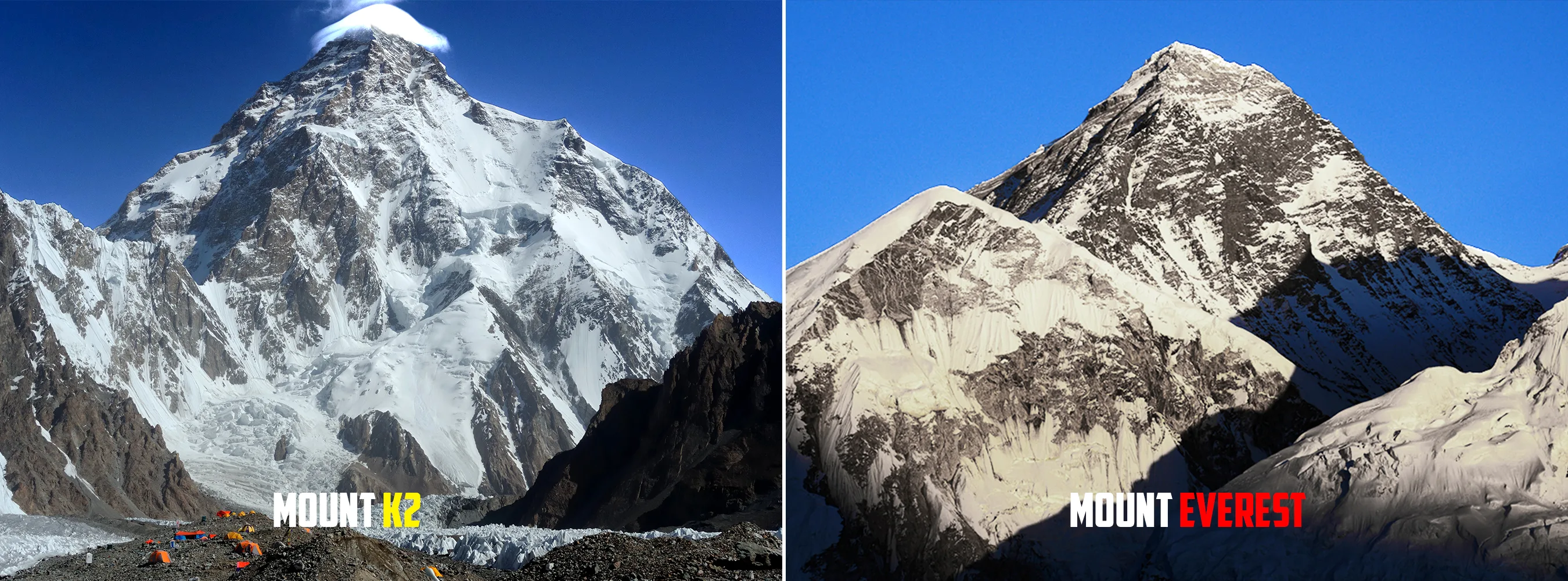
Mount K2 vs Mount Everest: Which is Harder?
- Places
- By accessnepaltour
Mount Everest and Mount K2 are among the highest mountains in the world. Both are also two of the most difficult mountains to climb for trekkers. For many beginner climbers, one of the most interesting questions regarding mountaineering is which one they should try climbing first.
If you have ever wondered about the different aspects of Mount K2 and Mount Everest (height, success rate, route, difficulty, accommodation, among other details), then this guide is for you. We have weighed every aspect of climbing these peaks in this blog. Keep reading to find out more.
Where are Mount K2 and Mount Everest located?
Mount K2 and Mount Everest are both located in South Asia. Mount K2 is located in the Karakoram Range, which lies across Pakistan, China, and India. To be more specific, it lies between Pakistan-administered Kashmir’s Gilgit Baltistan region and the Trans-Karakoram Tract of China.
Mount Everest, on the other hand, is located in northern Nepal near the Nepal-Tibet border. It lies in the Solukhumbu region of the country, among the Himalayas’ Mahalangur Himal sub-range, in the protected part of the Sagarmata National Park.
As such, both mountains are also on the border with China. However, as it is more difficult to trek either from the China side, i.e., the north face of Everest and the north base camp of K2, they are climbed from Nepal and Pakistan, respectively.
What are other mountains in the Karakoram range and the Himalayan range?
The Karokaram range is located mostly in the Kashmir region of Pakistan and India, but it spreads across parts of Afghanistan, China, Tajikistan, and parts of Central Asia. It is one of the highest mountain ranges in the world, ranging from 4,500 meters to over 8,000 meters, with four of the fourteen 8,000-meter mountains lying here.
These include: K2 (8,611 metres), Gasherbrum I (8,080 metres), Broad Peak (8,051 metres), and Gasherbrum II (8,034 metres), all of which fall in the Pakistan-China border region.

Karakoram range
The Himalayas, or the Himalayan range, are the highest mountain range in the world, which divides the Indian sub-continent from the Tibetan plateau and spans across five nations: Nepal, India, Bhutan, China, and Pakistan. It has a big difference in elevation across its range, from 450 meters above sea level up to 8,848.86 meters (which is, of course, at the top of Mount Everest).
The remaining ten out of the fourteen peaks above 8,000 meters are located in the Himalayan range. These include: Mount Everest (8,848 meters), Mount Kangchenjunga (8,586 meters), Mount Lhotse (8,516 meters), Mount Makalu (8,463 meters), Mount Cho Oyu (8,201 meters), Mount Dhaulagiri I (8,167 meters), Mount Manaslu (8,163 meters), Mount Nanga Parbat (8,125 meters), Mount Annapurna I (8,091 meters) and Mount Shishapangma (8,012 meters).
Is Mount K2 the same as Mount Kilimanjaro?
Many people mistake both mountains for being the same, but Mount K2 and Mount Kilimanjaro are two completely different mountains–in fact, they aren’t even on the same continent. Mount K2 is in Asia, while Mount Kilimanjaro is in Africa.
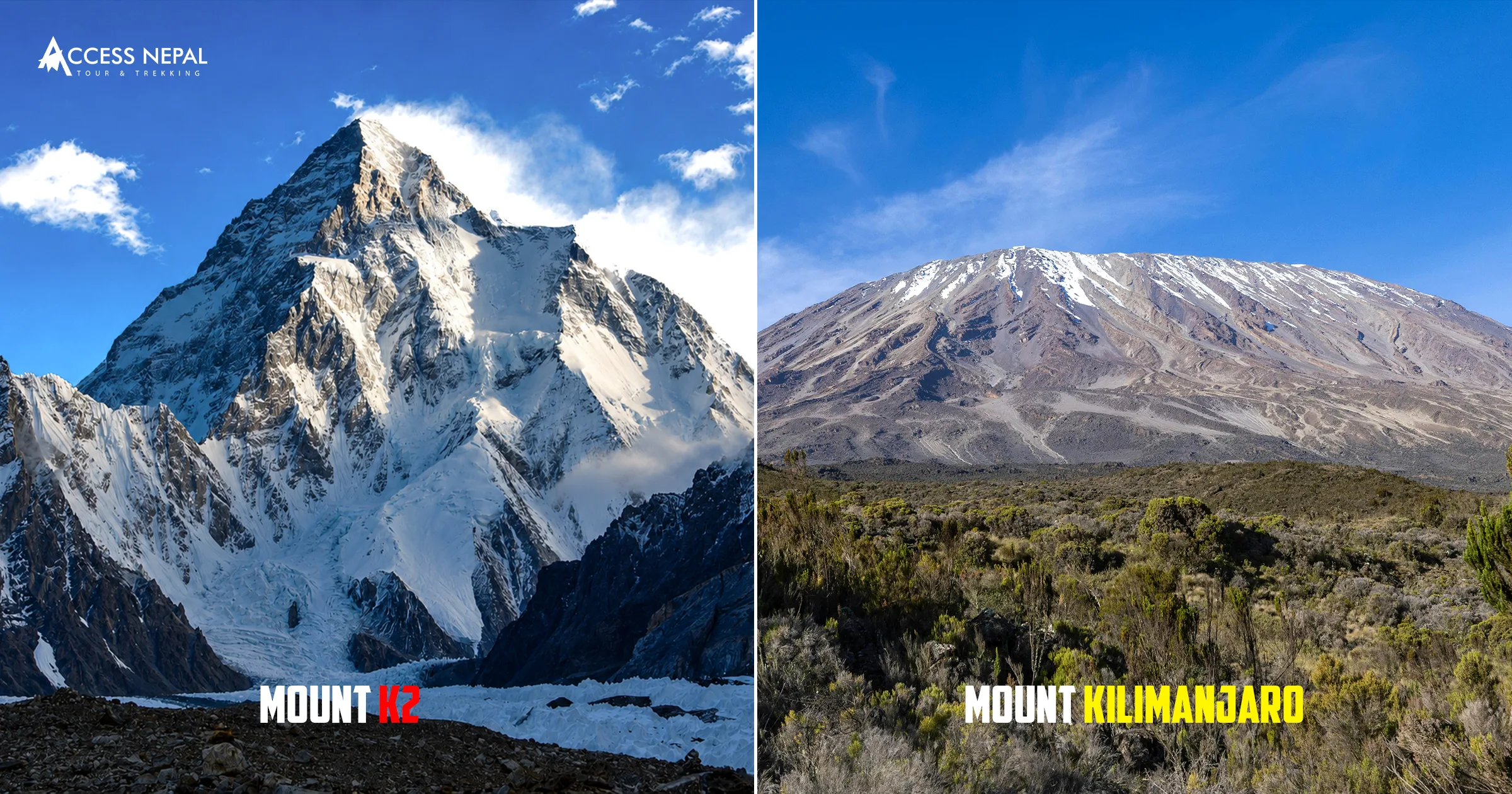
Is Mount K2 the same as Mount Kilimanjaro?
Kilimanjaro is the highest mountain in Africa. It is the tallest free-standing mountain in the world at 5,895 m or 19,341 ft, as it is not a part of any range and has a plateau base. It is also the highest volcano in the Eastern Hemisphere.
Which is taller, Mount K2 or Mount Everest?
Mount Everest is the highest peak in the world, lying 8,848.86 m or 29,031.7 ft above sea level, whereas Mount K2 is the second-highest peak in the world at the height of 8,611 m or 28,251 ft above sea level. There is only about 200 m of height difference between the two mountains.
Which is more difficult to climb: Mount K2 or Mount Everest?
While neither Mount K2 nor Mount Everest is necessarily a beginner climb, based on the experience of most climbers who have climbed both these peaks, Mount K2 is clearly the more difficult trek of the two.
Although Mount Everest is still the taller mountain, K2 is known to be extremely difficult technically. The biggest part of this difficulty is because of how steep the ridges in K2 are. Abruzzi Spur and the Bottleneck Couloir are notorious for their incline.
Mount K2’s severe weather also adds to the difficulty of its climb. It is further north compared to Mount Everest, which means the weather is colder there.

Mount Everest vs K2 Difficulty
Additionally, there are many fewer stops or places to rest on the way to the K2 summit compared to the Everest one. While climbing Mount Everest, trekkers frequently climb during the day, then come back down during the afternoons and late afternoons to sleep at a lower height.
This technique, known as ‘climb high, sleep low’, as well as the acclimatisation days, helps climbers get used to the altitude and the surroundings. K2 has many fewer stops and places to rest like this, which makes the overall trekking experience much more difficult.
American climber George Bell, after a 1953 expedition, even labelled K2 a ‘Savage Mountain’, which shows just how difficult it is to climb up to the summit.
Success Rates
Many have climbed Mount Everest to date; the exact number is in thousands, but fewer than a thousand individuals have climbed Mount K2. As such, the total number of climbers of Everest far exceeds that of Mount K2, and Everest impressively has a pretty good success rate of about 60%. K2, on the other hand, has a success rate of about 25%.
Similarly, the death rates of the two mountains also differ drastically. Everest has a mere 2% death rate, whereas K2 has a 23% death rate, as of now.
These numbers further show that Mount K2 might be more difficult to climb than Mount Everest, despite Everest being the taller mountain.
History, naming, and first climbs of Mount K2 and Mount Everest
Mount Everest
Mount Everest has been known among the locals for centuries under different names. In Tibet, it is called Chomolungma, which means ‘Goddess Mother of the World’ and in Nepal, it is known as Sagarmatha, the ‘Peak of Heaven’.
Everest was popularly discovered in 1852 by the Great Trigonometrical Survey of British India. An Indian mathematician named Radhanath Sikdar calculated that a peak, which was then called ‘Peak XV’, was the tallest on Earth, and it is said that surveyors could not find the local name for the mountain. This is why, in 1865, they named it after Sir George Everest, who was the British surveyor general of India.
The first ever successful ascent to the Everest summit happened almost a century later, on May 29, 1953, when Edmund Hillary from New Zealand and Tenzing Norgay Sherpa of Nepal reached the top together.
Mount K2
Mount K2’s name is a little unusual, as it is a label from a 1856 British survey by Thomas Montgomerie, who was mapping the Karakoram range from over 100 miles away from its real location. He sketched two big peaks in the region and labelled them K1 and K2. The K here stands for Karakoram.
Today, some locals call it Chogori, which means the ‘Big Mountain’ in Balti.
The first ascent of K2 happened on July 31, 1954, by Italian climbers Lino Lacedelli and Achille Compagnoni, who reached the summit during the expedition led by Ardito Desio.
Comparing the Route to Mount K2 and Mount Everest
The terrain of Mount K2 is the biggest challenge to climbing it. It is unbelievably steep and has a pyramidal structure–with each mountain face turned towards north, east, south and west. It also has massive glaciers, some of the biggest outside of the frigid polar regions.
On top of that, the mountain is also not as easily accessible as Mount Everest (which needs more technical skills, but all that only makes the mountain a bit easier to climb). When journeying to the K2 summit, you need to get through long periods of ice and rock climbing. All this with bulky trekking gear takes a heavy toll on your body.
The Abruzzi Spur, House’s Chimney and Black Pyramid are all incredibly difficult to get past on the K2 trail. And when you rest, it is in tented camps.
Everest, on the other hand, is a bit easier due to the well-travelled tracks and the comparatively better beds you get, which will make resting a bit more relaxing than on K2.
As for the acclimatisation part, there are several common acclimatisation stops in the standard Everest route at towns like Namche Bazaar and Dingboche. We can always customise your acclimatisation spots if you want to stop at a certain village or would like to visit a nearby cultural or natural site as a side trip.
While trekking K2, you trek for a week to reach K2 Base Camp. On the way there, you can stop at towns like Askole or at campsites like Paiyu. The way till the Base Camp isn’t that difficult, so the week you take to reach her lets your body get accustomed to the terrain.
After the Base Camp, many trekkers use a rotation system for acclimatisation. This means you would climb all the way up to Camp 1 and sleep there too, but then you return to the Base Camp to rest for a while. Then you climb to Camp 2, spend a night there and further up to Camp 3, then return.
Lastly, as you feel used to the climbing and feel ready to tackle the ultimate challenge, you reach all the way to the summit. Usually, each one of the rotations takes about 2-4 days.
Standard itineraries of Mount K2 trek vs Mount Everest trek
Mount K2 Itinerary
While the itineraries for Mount K2 trek depend on the travel agent you hire, a standard K2 package is about 18-22 days long. It would look something like the following.

Mount K2 Itinerary
Mount Everest Itinerary
A standard Mount Everest Itinerary is usually 14-16 days long. Again, depends on the plan your travel agent has created. We have tons of packages that you can check out right now, here. All of these are, of course, further customisable.

Standard Everest Base Camp Trek Itinerary
The itinerary will be a few days longer (usually 18 days) if you choose to take on the three passes in the Everest region. The start will be on the same route as the standard one till you reach Kala Patthar, then it continues into a circuit which crosses the three passes: Kongma La, Cho La and Renjo La.

View from Kala Patthar
The three-pass trek is more physically strenuous than the standard one.
Cost to trek Mount K2 vs cost to trek Mount Everest
The cost to trek to K2 and Everest is about the same. There isn’t a big price range gap between the two for a standard trek. K2 packages cost an average of about $1,800 to upto $5,000 for more luxurious ones. For Everest, the usual cost ranges between $1,800-$3,500.
Mount Everest packages are less costly because the standard packages are 6-8 days shorter than a regular K2 package.
These are subject to change based on your agent and the specific customisations you make, but usually that won’t diverge drastically from the above range.
Trekking gear and packing list for Mount K2 vs Mount Everest
Generally, the gear you need and your packing list to trek either mountain is the same. This includes things like:
-
Footwear: A pair of waterproof trekking boots that are broken in, camp shoes like Crocs or sneakers, 3-4 pairs of trekking socks and some thick thermal socks
-
Clothing: 2-3 sets of moisture-wicking base layers, a fleece jacket, a down jacket (rated -10°C to -20°C), a set of waterproof shell jacket and trousers, 2 pairs of trekking pants, a warm beanie, a sun hat and a buff or neck gaiter are must-haves for these treks
-
Gloves: A pair or two of lightweight liner gloves and a pair or two of insulated outer gloves
-
Sleeping gear: You need to pack a 4-season sleeping bag that is rated -10°C to -20°C; the teahouses provide blankets
-
Backpacks: All you need is a daypack (20-30L) and a duffel bag that your porter carries (10-15kg max)
-
Hydration: A water bottle of 2-3L water capacity and purification tablets are a must. You can get boiled water available at teahouses in Everest for a fee
-
Sun protection: Tubes of SPF 50+ sunscreen, an SPF lip balm, and a pair of UV sunglasses
-
Lighting: A headlamp with a bunch of spare batteries
-
First aid and altitude: Carry with you Diamox, blister plasters, throat lozenges, ibuprofen, rehydration salts, and Imodium for emergencies
-
Hygiene: Baby wipes, hand sanitiser, toilet paper, a small towel, and biodegradable soap
-
Electronics: Power bank (20,000mAh+), camera (if you are into photography), phone, and universal adapter
-
Documents: Passport, permits, travel insurance, and some cash
-
Optional: Sleeping bag liner, pillowcase, earplugs, clothesline, and trekking poles
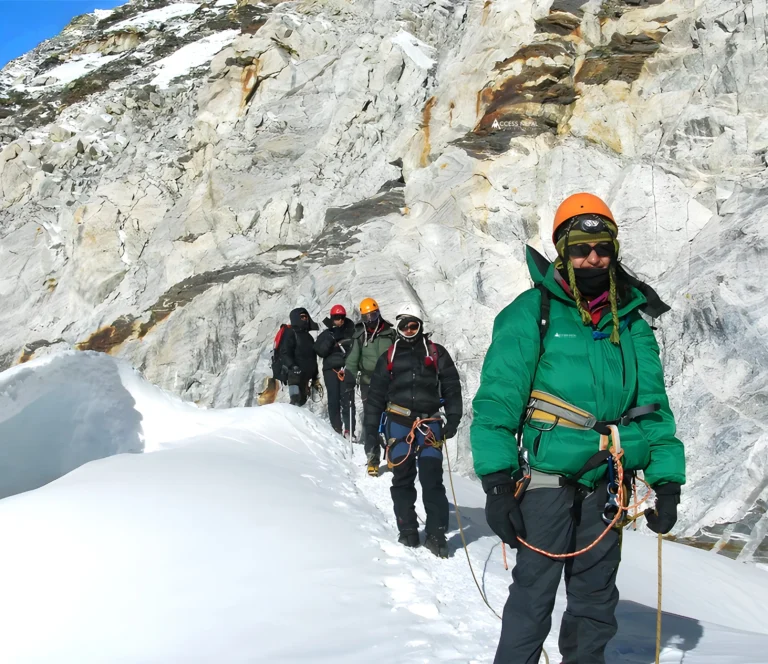
Trekking K2 involves a lot more sleeping in tents than trekking Everest. So the gear you have should be able to withstand extreme cold temperatures and difficult climbing sections.
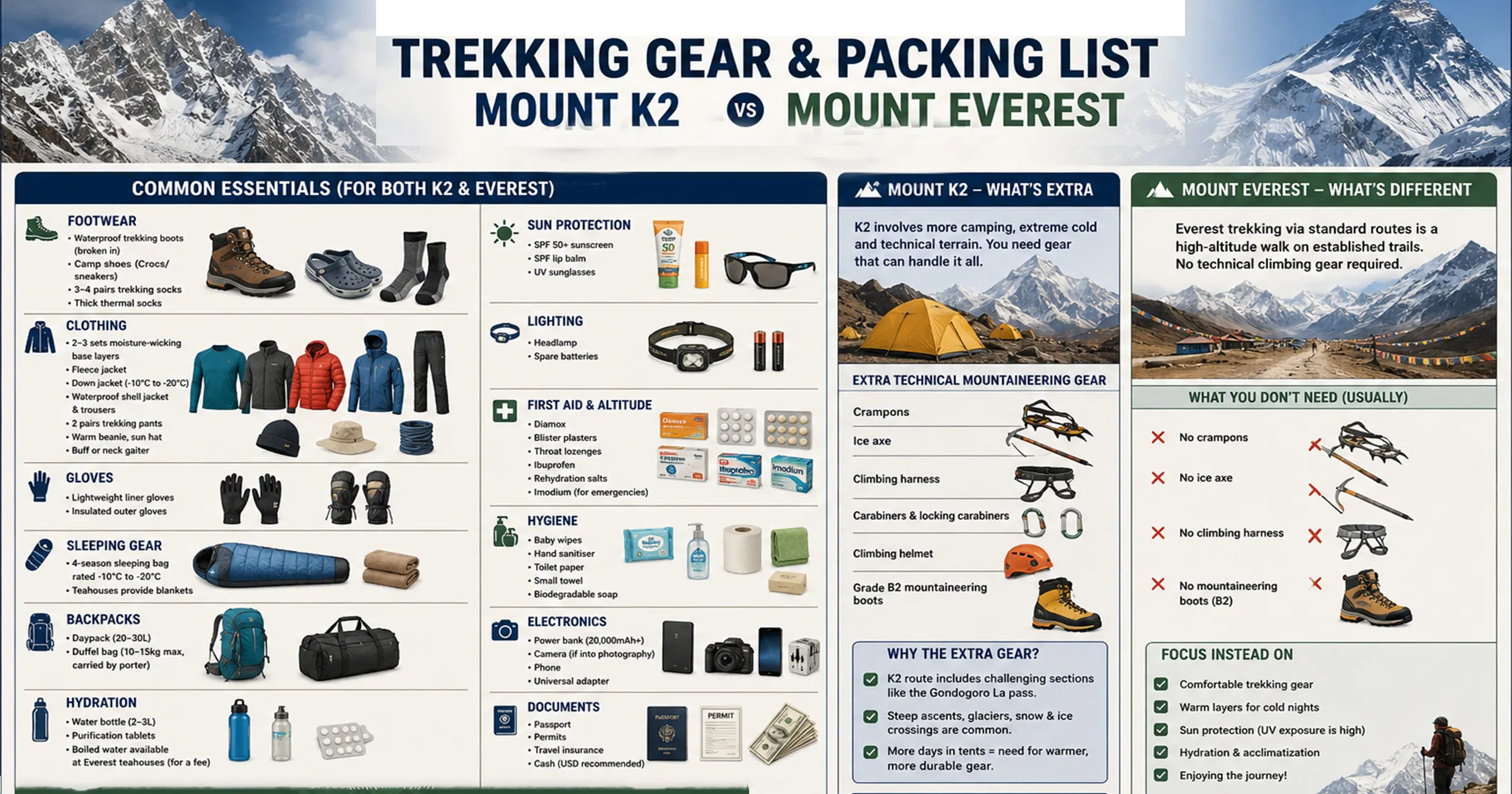
packing list for Mount K2 vs Mount Everest
K2 may also require extra technical mountaineering gear (crampons, ice axe, climbing harness, carabiners, climbing helmet, and Grade B2 mountaineering boots) for crossing difficult sections like the Gondogoro La pass, while Everest doesn’t require this because the standard route is a high-altitude walk on already established trails.
Everything else (including clothing layers, boots, headlamp, first aid, sun protection, power bank, and trekking pole) is nearly the same for both treks.
Best Scenery and Weather: K2 vs Everest
Scenery and landscape differences between Everest and K2
The major selling-point of the Mount Everest experience is the cultural immersion it offers. You trek through beautiful Sherpa villages like Namche Bazaar, get to walk through pine and rhododendron forests and visit many ancient monasteries like Tengboche along the way.
Kala Patthar, which is a major stop along the way, lets you see a beautiful close-up of Everest and the Khumbu Icefall. The overall experience is a wonderful mix of both seeing beautiful Himalayan scenery and getting engrossed in the local Sherpa culture.
K2, in contrast, has a stark, raw and overwhelmingly grand landscape with very few villages or lodges along the way. You see just rock, ice and wilderness most of the way.
The highlight of the entire trip is the Concordia, often called the ‘Throne Room of the Mountain Gods’. It is a glacial intersection where you are surrounded by four of the world’s 8,000-meter peaks (K2, Broad Peak and the two Gasherbrums).
You also experience trekking on the Baltoro Glacier itself, sleeping on ice in tents and camps. All of this makes the scenery feel rather otherworldly and remote.
The weather of K2 vs Everest is a different kind of harsh
Temperature and conditions
During the climbing season (May) on Everest, the summit temperature is an average of -26°C (-15°F). At Base Camp, daytime temperature usually remains around 0-5°C, dropping to a freezing -15 to -25°C at night.
Related Packages
Everest Expedition - 55 Days
 8,848m/29,029ft
 Extremely Difficult
 All
Inclusive Plan
All
Inclusive Plan
The weather at Everest is generally dry post-monsoon, although afternoon clouds and snow showers happen quite often in the spring season.
During K2’s peak climbing season (July), summit temperatures average to about -21°C (-6°F), which is actually warmer than Everest’s summit in May. However, as K2 is located 8 degrees further north, its winter feels much colder and harsher to bear.
So, despite its nickname as the ‘Savage Mountain’, K2 is slightly warmer on the summit during the peak climbing window than Everest.
Wind and risk of frostbite
K2 is notorious for sudden brutal storms and trekkers often face torrential rain and heavy snowfall on the way. Some trekkers have also reported to being submerged in ankle-deep snow even at the lower camps. Everest, while experiencing its fair share of wind and snowfall, is not as extreme.
A detail trekkers should know before climbing is that in May (peak season), at the Everest summit, the Wind Chill Equivalent Temperature (WCT) is -45°C. This means you can get frostbite in about 6 minutes. On K2 in July (peak season), the WCT is a little lower at -37°C. This gives you about 11 minutes before a frostbite sets in.
Again, while it is technically warmer at the top, the other factors of a K2 trek actually make dealing with weather changes much more dangerous than Everest.
Visibility
Everest has set optimal windows for peak visibility. Autumn, which is the months of October and November, has the best views with crystal-clear skies post-monsoon. Spring, the months from March to May, is warmer than autumn but a bit hazier with more afternoon clouds, which could block the visibility.
K2’s weather is much less predictable. Even in the peak July to August window, trekkers may face heavy snowstorms that can pin you down for days or force you to return mid-way. The visibility is not certain during specific months, as it is on Everest during autumn.

Mount K2 visibility
Accommodation in K2 vs Everest, which is better?
There is quite a bit of a difference in accommodation at K2 and Everest treks. The Everest route has loads of lodges and tea houses run by the local families along the way. Most stops until you reach the very top are actual villages where people have been living for years. As tourism in the area grew, naturally, many locals started a tea-house business.
Most of these lodges and tea-houses have basic facilities you will need during your trek, including hot water, bathrooms, Wi-Fi, and charging. Besides these, there are actually some more luxurious abodes in some specific towns like Lukla and Namche Bazaar.
K2, meanwhile, is more wilderness without many settlements on the way. You will rest in tents in campsites along the way, so the amenities you get are pretty limited. But before and after your treks, you can definitely rest in luxurious hotels in the major cities of Pakistan, where the treks begin and end.
Oxygen strategies at Mount K2 vs Mount Everest
The oxygen strategies for Everest and K2 are pretty similar, as both usually require supplemental oxygen only near the summit. Both mountains have a ‘death zone’ which is above 8,000 m. This is where the human body deteriorates rapidly, and supplemental oxygen is crucial for the climber’s survival.
Most climbers trekking both peaks use bottled oxygen, which is typically set at a flow rate of 2 to 4 litres per minute, during the final summit push.
Using supplemental oxygen increases your climbing speed, improves decision-making, which is crucial at such high altitudes with fatal consequences and helps prevent hypothermia as well as frostbite. The equipment, though, is quite heavy as you need dozens of cylinders to be carried up the mountain.
What are the needs and availability of guides and porters at Mount K2 and Mount Everest?
You need to hire licensed guides while climbing both K2 and Everest, as required by each country’s law. This rule has been strictly enforced in Nepal since 2023, and you cannot trek alone in the Everest region. You must compulsorily have a guide walking with you on the route, although you can hire a porter separately to carry your bags.
Most trekking agencies, like Access Nepal Tour, handle both for you.
In Pakistan, the rule is the same for K2 trekkers. You must have a licensed guide with you, and independent trekking is not allowed. The difference is that K2 expeditions may even include a full support team with guides, porters, and cooks, as part of the package itself.
On Everest, you have more flexibility to hire a guide only or a porter only, or maybe both–all depending on your budget and needs. The load-carrying limits for porters are similar for both mountains.
Rescue plan details in K2 vs Everest
Rescue plan for Everest
While climbing Everest, the first step of your rescue will be descending down the trail. Most trekkers’ problems are solved by this simple measure. However, if you need a helicopter evacuation, your guide will contact us, the agency, and we will get the insurance approval and contact a rescue helicopter company.
Helicopter rescues are common, with hundreds of trekkers being evacuated annually. You should note that the helicopters only fly during daylight hours and in good weather. There are medical aid posts at multiple places on the route (like the Himalayan Rescue Association clinic in Pheriche) where doctors can assess you before you call a helicopter.
Our guides are trained to spot altitude sickness early and are experienced in handling it. So you shouldn’t have much trouble with this.
Rescue plan for K2
On K2, rescue is more complex because of how remote the mountain is and the extreme technical difficulty due to the terrain. Helicopters are rarely able to land high on the mountain due to the steep terrain and unpredictable weather.
So, the main rescue plan is physical evacuation, i.e. fellow climbers and high-altitude porters carry or help the injured person down the mountain on foot. This is more dangerous and difficult.
For evacuations from base camp, the Pakistani military operates the helicopters, and this requires a $15,000 deposit. Your insurance must specifically cover this cost and coordinate well with the military.
The difference
The major difference is that Everest has a well-organised helicopter rescue system with medical support on the route, whereas K2 has difficult ground evacuations by climbers and porters, and military helicopters are available only from base camp after a large upfront payment.
Preparation and prerequisite differences for K2 and Everest treks
The Everest Base Camp trek is a challenging but not as technical a trek. You do not need much mountaineering skills, but you do need a good level of fitness. We recommend that you start training 3 to 6 months in advance and focus on cardiovascular exercises like running, swimming, and cycling to build stamina. This helps when you have to walk 5 to 8 hours a day for two weeks. Leg and core strength are also needed to survive the steep and rocky trails, and exercises like squats, lunges, and step-ups help that.
The K2 Base Camp trek is much more demanding than Everest, as it is one of the toughest treks in the world. The terrain is far more challenging to cross and often requires you to walk on steep, rocky, and icy moraines.
The prerequisites for this trek are also much more, as you need to be in excellent physical shape with strong endurance. Prior trekking experience is needed for the high altitudes. So, you’d better start a rigorous training plan 3 to 6 months in advance to complete this successfully.
A major difference in prepping for the two climbs is that you need to be comfortable with basic rope work and the use of an ice axe and crampons. Mental toughness is just as important as physical strength here because you will face unpredictable, harsh weather in remote locations.
Why you should book an Everest Trek with Access Nepal Tour
As one of the leading trek companies and travel agents in Nepal, we can assure you that your trip with Access Nepal Tour will be memorable, comfortable, and adventurous. We keep your safety and comfort at the forefront of our planning and give you the best experience in the Himalayas.
With over a decade of experience in the industry, we can customise your tour exactly to your liking. You just need to trust us and enjoy the trip; we will handle everything else.

Table: Summary of Comparison of Mount K2 and Mount Everest
Conclusion: Which is better between K2 and Everest?
There is no straightforward answer to this one. It depends entirely on your goal. If you want a safer, more well-travelled trip where you can rest more comfortably in between all the climbing, you should probably book an Everest Base Camp trip.
If you want an epic experience, living through almost extreme conditions while climbing a peak that feels almost surreal, pick a K2 trek.
So, the answer to which is better between K2 and Everest is subjective, based on what you want out of your trip.
Frequently Asked Questions
Which is more difficult, K2 or Everest?
Mount K2 is more difficult to trek than Mount Everest because of its extreme topography and lack of accommodation options along the route.
What is the success rate for the K2 and Everest Trek?
Everest has a success rate of about 60%, and K2 has a success rate of about 25%.
Is Everest higher than Mount K2?
Yes, Mount Everest, as the highest mountain in the world at 8,848 m, is slightly taller than Mount K2, the second-highest mountain in the world at 8,611 m.
Do you need oxygen for the Mount K2 and Mount Everest treks?
Up to the base camps for both mountains, trekkers generally do not need supplemental oxygen. The many days of climbing to get there and your acclimatisation practices naturally help your body adjust to the oxygen levels. However, as you reach the summit, many climbers require supplemental oxygen. The oxygen levels at that altitude are too low to breathe comfortably.
Why is Mount K2 famous?
Mount K2, often called the ‘mountain of the mountains’ or the ‘savage mountain, is famous for its difficulty due to harsh conditions and the low success rate.
Can I climb Mount K2 and Everest as a beginner?
We do not recommend that you climb either Mount K2 or Mount Everest as a beginner. Both are pretty difficult even for seasoned trekkers. The difficulties you face on each trip cannot be handled by beginners.
How many days does it take to climb Mount K2 vs Mount Everest?
This depends on the specific itinerary you pick and any customisations you may have made. So, confirm the exact days with your trekking agent. However, many standard itineraries of Mount K2 treks are between 18 and 22 days, and those of Mount Everest are between 14 and 16 days.
Which is cheaper to trek, K2 or Everest?
Mount K2 and Mount Everest treks aren’t considered very costly. The average range for both is between $2,000-$5,000. However, probably due to the fewer days it takes to climb Everest, it is a bit cheaper than K2.
What mountain range is Mount K2 in?
Mount K2 is in the Karakoram Range, which lies across Pakistan, China, and India. It is situated between Pakistan-administered Kashmir’s Gilgit Baltistan region and the Trans-Karakoram Tract of China.
What type of volcano is Mount K2?
K2 isn’t a volcanic mountain. It is a tectonic mountain, formed by the collision of Eurasian and Indian tectonic plates. It is made up of metamorphic and sedimentary rocks and not volcanic materials.
Where does K2 rank in height in the world?
Mount K2 is the second-highest mountain in the world, right behind Mount Everest.
Is K2 the Same as Kilimanjaro?
No, Mount K2 and Mount Kilimanjaro are two completely different mountains. The confusion could arise from both names starting with the letter ‘K’, but while K2 is on the Pakistan-China border in Asia, Kilimanjaro is located in Tanzania, Africa.
Where is Mount K2 located on the map?
Mount K2 is a part of the Karakoram mountain range, which lies partly in the Gilgit-Baltistan region of Pakistan-administered Kashmir and partly in the China-administered Trans-Karakoram Tract. On the map, you should find it in northern Pakistan.
What are some key facts about Mount K2?
K2 is the second-highest mountain in the world at 8,611 meters, which is located on the border between Pakistan and China. Its name comes from the Great Trigonometrical Survey of British India in 1856, where surveyor Thomas Montgomerie labelled it as ‘K2’. The K here stands for Karakoram and the ‘2’ was added because K2 was the second peak Montgomerie sketched that began with the letter K.
K2 doesn’t have a widespread local name, though it is sometimes called Chogori (which means the ‘Big Mountain’ in Balti). It was nicknamed the ‘Savage Mountain’ because of how dangerous it is. The route to K2 is steep and technical, and the unpredictable weather makes climbing it hard and risky–even more so than Everest.
The first successful ascent of K2 was made by Italian mountaineers Lino Lacedelli and Achille Compagnoni in 1954.
Get complete information about the Everest Base Camp Trek guide for female travellers, so that you can decide which trek to choose first, the Everest Base Camp Trek or Mount K2.

Nepal for Solo Travellers
Prev
Kami Rita Sherpa becomes the Only Person to Climb Everest 32nd Times!
NextAwards and Achievements
Access Nepal Tour and Treks has been recognized with TripAdvisor’s prestigious Travelers’ Choice Award for multiple consecutive years, reflecting our unwavering commitment to quality and clients’ satisfaction.













Leave Your Comment