- International airfare
- Meals in Kathmandu
- Customs for bringing any expedition goods
- Nepal Visa Fee
- Personal clothing and climbing equipment
- Insurance (Mandatory)
- Personal expenses
- Extra oxygen
Guaranteed Departures
From US$ 50500
US$ 44900 / Per Person
11%
OFF
OFF
Group Discounts
Discounts are solely based on your group size. We do not add anyone to your group.
- Best Price Guarantee
- Hassle-Free Booking
- Team of highly experienced Experts
- Your Happiness Guaranteed
Book Now. No Booking or Credit Card Fee
- Schedule Your Own Dates
- Group Discounts
- Guaranteed Departures
- Easy Cancellation
- 60% Repeated Customers
-

- Duration
- 55 Days
-

- Transportation
- Car / Hiace & Flight
-

- Trip Grade
- Extremely Difficult
-

- Max-Altitude
- 8,848m/29,029ft
-

- Accomodation
- Hotel / Lodge / Tent
-

- Primary Activity
- High Altitude Expeditions
-

- Meals
- All meals during trek & above
-

- Best Season
- Mar-May|Sept-Nov
-

- Distance
- 500 km
Overview
Just imagine standing at the top of the Mt Everest, the highest place on Earth, simply extending your arms to the fullest, the imagination itself creates a goosebump feeling. That same imagination can be turned into reality with the Everest expedition. The following mountain expedition tour package takes you to the highest altitude of 8848m (29029ft), the boss of all mountains.
Undoubtedly, Everest, being the tallest peak, attracts a lot of people all over the globe. The landscape, scenic views, and the immense natural appeal make it a climber’s dream. Having said that, it isn’t an easy job to climb the world’s largest mountains, as there lie several challenges and risks.
But don’t worry, we at Access Nepal Tour and Trekking make sure every part of your journey is carefully taken care of. Having been in the industry for more than a decade, we have created a perfect package of an expedition to Everest where safety is the first priority.
This Mount Everest expedition gives you a unique adventure, thrills, and cultural immersion that is worth experiencing once in a lifetime.
Highlights of Mount Everest Expedition
- Being on top of Mount Everest at the end of the day gives a surreal feeling.
- Get to experience traditional Sherpa culture from really close.
- Experience the Himalayan lifestyle and the warm hospitality.
- Amazing Lukla flight.
- You’ll see varieties of flora and fauna on the way to Everest.
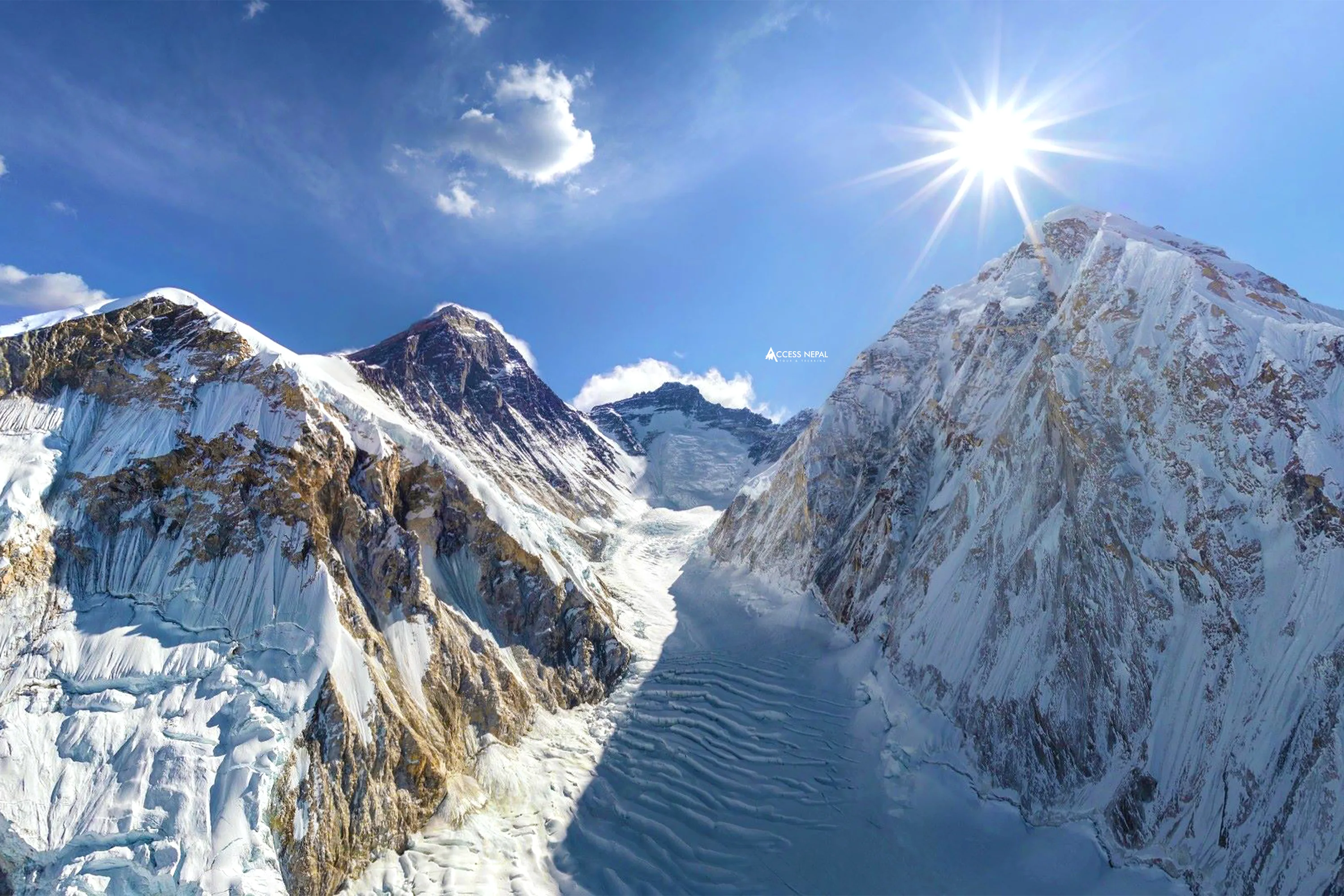
- Sightings of various beautiful peaks such as Mt. Lhotse (8,516m), Cho Oyu (8,201m), Mt. Makalu (8,463m), etc.
- One of the highest glaciers lies here, named the Khumbu glacier.
- Get a glimpse of Sagarmatha National Park.
- Different wildlife sightings like pheasants, musk deer, snow leopard, Himalayan tahr, etc.
Short Overview of Mount Everest
Mount Everest, which is the highest mountain in the world, stands tall at 8,848.86 m (29,031. 69 ft) high. In fact, it is estimated to be 50 to 6o million years old. Everest is named after George Everest, who was a former Surveyor General of India. The peak itself was declared as the highest peak in the world in 1856 after taking proper measurements.
This giant peak is situated on the border of Nepal and Tibet. It lies in the Solukhumbu district, which is exactly in north-eastern Nepal. Since holding the number 1 position as the tallest mountain, it has grabbed considerable attention worldwide.
History Related to Mt Everest Expedition
Many mountaineers and climbers have summited Mount Everest to date. The first to catch the attention of this historic peak was the British. In 1922, the first British expedition team set out to climb to the top of Everest. And that too without the use of bottled oxygen.
The following approach is very risky and was badly criticized by a scientist and mountaineer, Alexander Mitchell Kellas. He urged the fellow mountaineers to use bottled oxygen at such great heights. The first mountaineers to successfully climb Mount Everest were Tenzing Norgay Sherpa and Edmund Hillary. They were part of the ninth British expedition; they achieved this feat on 29th May 1953.
Timeline of Mount Everest Expeditions
1921
George Mallory and Guy Bullock were the main initiators of the reconnaissance expedition to Mount Everest in 1921. Alongside the two, the other mountaineers A.F.R. Wollaston, Charles Howard-Bury, Alexander Heron, Harold Raeburn, Henry T. Morshead, and Oliver Wheeler went on the expedition. The north of Everest was named the North Col by Mallory, Bullock, and Wheeler.
1922 Attempt
The expedition team, led by Brigadier General C.G. Bruce and 12 other members, decided to attempt the mountain. It ended in disaster as nine sherpas were swept by an avalanche, and seven of them were killed.
1924 Attempt
The expedition team, led by Brigadier General Bruce, headed for the climb again. After the illness of General Bruce, Norton went on to lead and reached a new height of 28,100 feet (8,565 meters), never been achieved before.
1933 Attempt
Hugh Ruttledge led a team with some new faces and went on to reach the same height that Norton reached. Following that, they had to return because of poor weather conditions.
1935 Reconnaissance
An expedition was led by Shipton with the aim of getting more information about monsoon conditions. They were able to put a camp on the North Col, but couldn’t continue further because of an avalanche.
1936 and 1938 Attempt
The 1936 expedition was led by Ruttledge. They went up to the North Col, but because of harsh weather, including heavy snowfalls, stopped them from reaching further. Similarly, the 1938 expedition was under Tilman, and they were able to reach Camp VI, at 27,200 feet (8,290 meters). Bad weather limited the journey to that altitude.
1951
In 1951, Shipton was the expedition leader, and under his leadership, the co-members went on towards the mountain from the south. Eventually, they were stopped by a giant crevasse just above the Khumbu glacier.
1952 spring attempt
E. Wyss Dunant led a team along with R. Dittert in the spring season of 1952. They managed to reach the South Col but were stopped at the track by the weather conditions and couldn’t go higher.
1952 autumn attempt
Another Swiss expedition was led by Chevalley. Just like the previous case, they got up to the South Col. And from there on, they only managed to climb 300 feet (90 meters) higher.
1953 (Historic ascent)
History was made in 1953 as the Mount Everest expedition team led by John and Baron Hunt successfully managed to reach the summit. The team was sponsored by the Royal Geographical Society. The two Edmund Hillary and Tenzing Norgay Sherpa set out early on the morning of May 29. And hence they reached the South Summit by 9:00 am.
Just below the Everest summit, there is a last hurdle, a steep section of rock and ice which is now referred to as the Hillary Step. Hillary and Tenzing tackled the barrier with the use of ice-climbing equipment. They reached the summit of Everest at around 11:30 am.
After the first successful summit of the Everest, several developments were made in the coming years, and the ascent to the summit became relatively easy. However, there are several disasters that have happened in the Everest region when trying to summit. Some of the popular incidents are Green Boots, Everest sleeping beauty, and the 1996 Mount Everest disaster.
Overview of Mount Everest Climbing Expedition
The total duration of our Everest expedition is 55 days, and the itinerary is created with precise planning, experience, and utmost attention to detail. The itinerary prioritizes maximum days, high-quality service, and highly talented guides. The route is kind of similar to the one that we follow in a standard 14-day Everest base camp trek. In between this journey, you’ll discover several rivers, waterfalls, glaciers, icefalls, and many more things.
From Kathmandu, we’ll head to Lukla via flight from there on the trek begins towards Phakding. Then from Phakding, we’ll head to Namche Bazaar. And the standard and most followed trekking route goes like this: Tengboche->Dingboche->Lobuche->Gorakshep->Everest base camp.
Once we reach the Everest base camp, rest, recovery, and further training are carried out. Then the next step begins, or in other words, we can also say our first acclimatization starts with a climb to Lobuche East. It also sets a perfect training pattern for the Everest. A pre-training session will be conducted at the base camp.
Climbing Lobuche East Peak ahead of the Everest climb also makes sure climbers don’t have to go through the Khumbu icefall twice. We also conduct a puja ceremony following Sherpa traditions so that god’s blessings be with us before we head for the Everest climb.
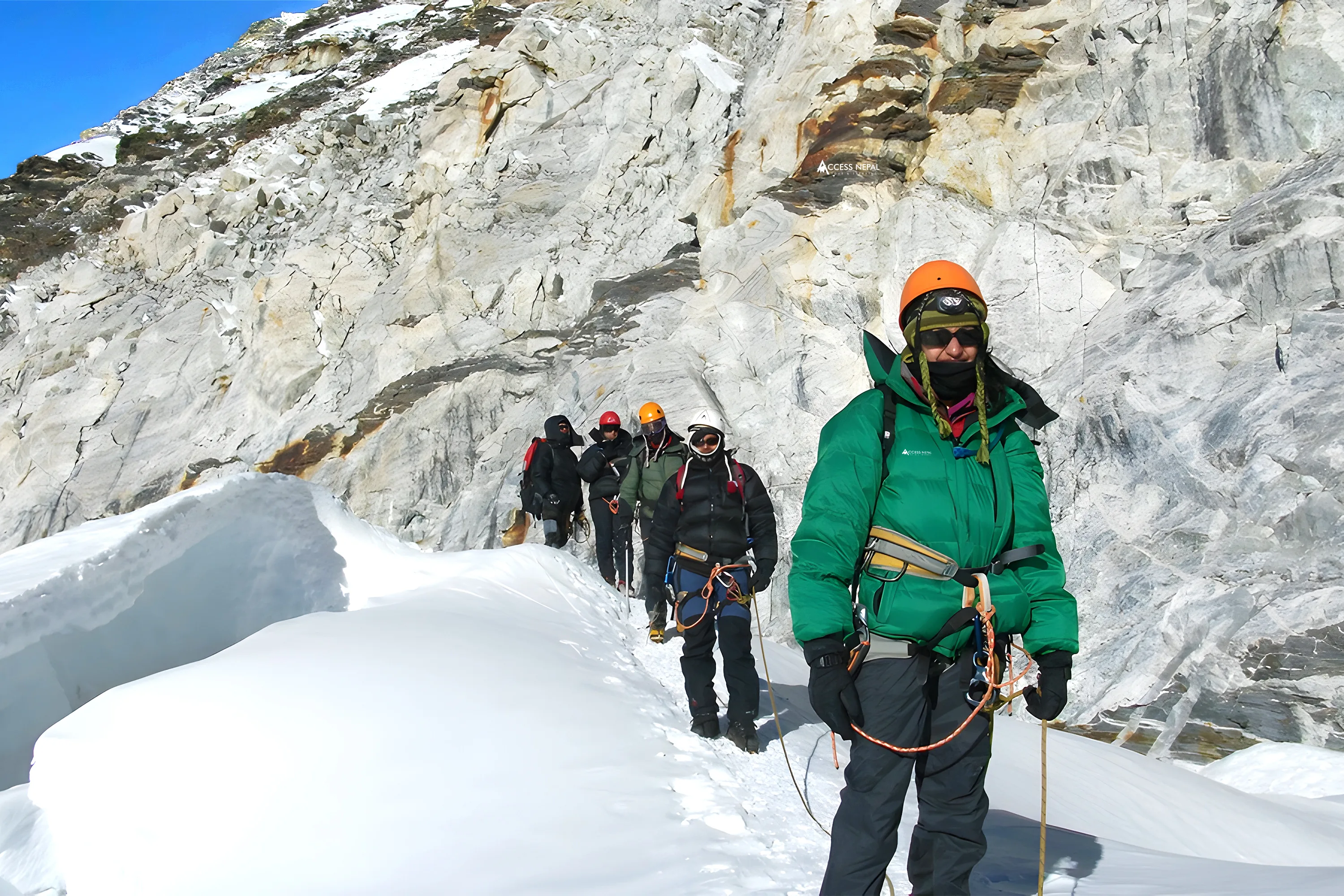
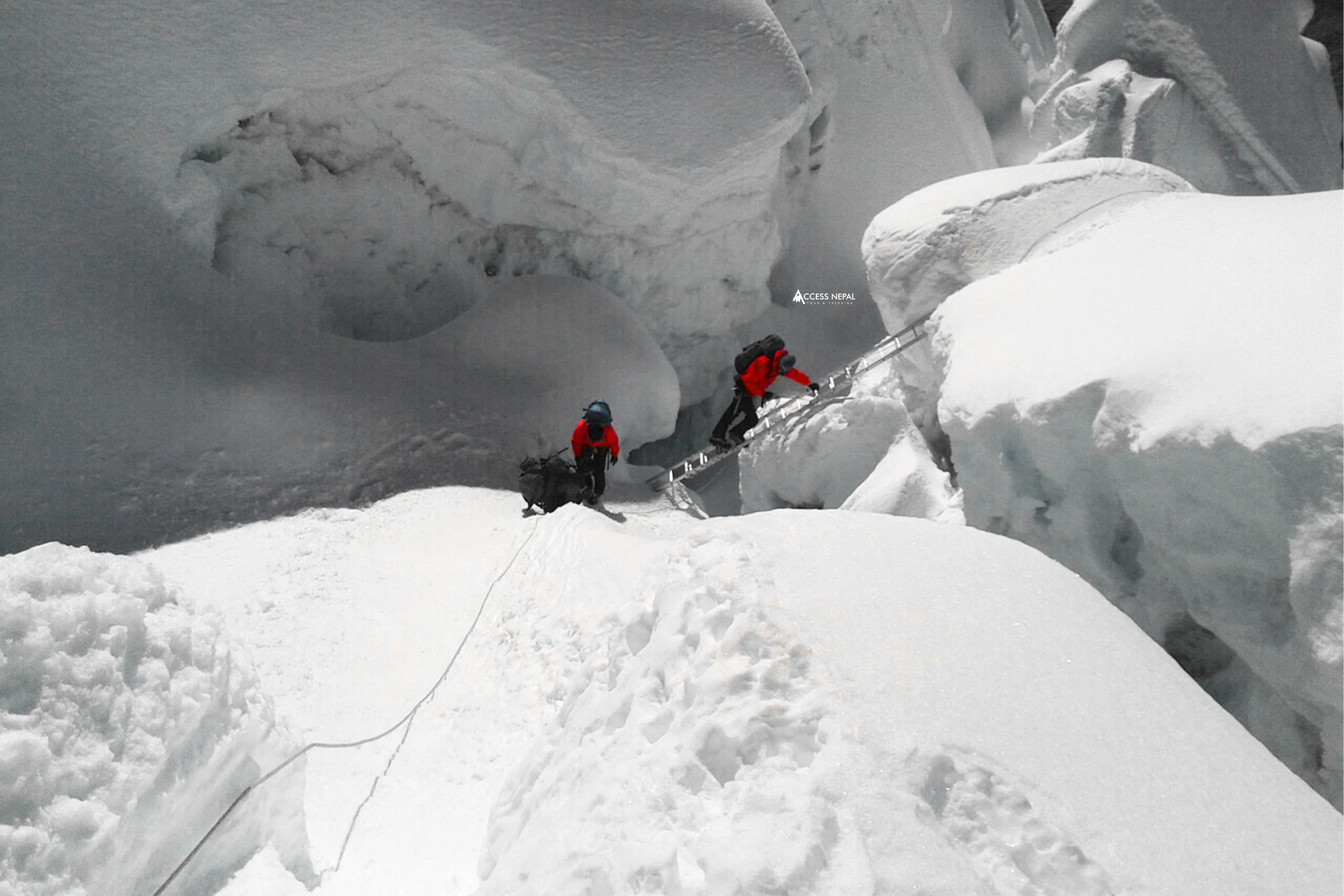
The second acclimatization starts by passing the deadly Khumbu icefall. There will be four camps set up above the base camp.
- Camp 1 (5,900m/19,500ft)
- Camp2 (6,400m/21,000ft)
- Camp 3 (7,300m/23,700ft)
- Camp 4 (7,900m/25,912ft), the final camp before climbing the summit
Your expedition guide/leader will be there for you always and will guide you too when the conditions get tough. There will be an acclimatization program at Camp 2, a night over there. The rest and recovery process takes place at the base camp. The use of oxygen cylinders will be after Camp 3, so that the ascent becomes easy.
We will head towards the South summit from Camp 4, from there on comes the Hillary step, and we will advance towards climbing the summit.
If 14 days also feel long enough for you, then we’ve Everest Base Camp short trek. Want a luxury aerial tour of Everest, where you can get the best Himalayan views with minimal effort? We’ve got an Everest Base Camp helicopter tour package (1-Day).
Things to Consider Before Heading for Expedition Mount Everest
- First and foremost, you need to realize that you’re heading towards the highest point on the earth, so you need to be sure.
- The main thing is you’ll only get a permit from the Nepal Government for this Everest expedition if you’ve already successfully climbed any of the 6000+ m peaks.
- You need to be fully confident in the budget, as expeditions are way more costly than a normal trek.
- To make the expedition successful, you not only need to be physically fit, but you also need mental toughness.
- As soon as you reach the base camp, the accommodation facilities won’t be of high quality. You’ll be staying in tents and having basic food for around 2 months.
Everest Expedition Itinerary
Day 01Arrival in Kathmandu
-
- 1,350m/4,430ft
Day 02Preparation and Checking of Equipments
-
- 1,350m/4,430ft
Day 03Fly to Lukla and Trek to Phakding
-
- 2,600m/8,531ft
-
- 3-4 hrs
Day 04Trek to Namche Bazaar
-
- 3,450m/11,319ft
-
- 6-7 hrs
Day 05Rest and Acclimatization Day in Namche Bazaar
-
- 3,450m/11,319ft
Day 06Trek from Namche Bazaar to Tengboche
-
- 3860 m/12,664ft
-
- 5-6 hrs
Day 07Trek to Dingboche
-
- 4,412m/14,475ft
-
- 5-6 hrs
Day 08Trek from Dingboche to Lobuche
-
- 4,910m/16,109ft
-
- 4-5 hrs
Day 09Rest and Acclimatization Day in Lobuche
-
- 4,910m/16,109ft
Day 10Trek to Gorakshep
-
- 5,164m/16,942ft
-
- 3-4 hrs
Day 11Trek from Gorakshep to Everest Base Camp
-
- 5,364m/17,559ft
-
- 2-3 hrs
Day 12-14Puja Ceremony and Climbing Training
Day 15-17Climb Lobuche East
-
- 6119m/20,070ft
Day 18Trek to Everest Base Camp
-
- 5,364m/17,559ft
Day 19-21Training and Preparation
Day 22-26Second Acclimatization Rotation
Day 27-32Rest and Recovery
Day 33-44Final Summit Push
Day Day 45-49Contingency Days
Day Day 50-52Trek to Lukla via Pheriche & Namche
Day 53Fly back to Kathmandu
Day 54Stay in Kathmandu
Day 55International Departure
Trip Includes
- Support throughout the Mount Everest climbing expedition
- Experienced lead guide with previous experience of leading in the Everest expedition
- 1:1 sherpa guide for each climber during the summit push
- 8 bottles of oxygen for each climber
- Provision of Mask & Regulator
- Mt Everest Expedition Permit and Fees, including Manaslu Climbing Royalty Fees, Trekking Permit, SPCC Icefall Route Charge, Local Permit Fee, and Lobuche Peak Permit
- Other Charges, including rope maintenance charges, garbage control, Liaison officer wages, and allowances
- Guide for the climb (1:3 guide to client ratio)
- Meals and accommodation for Lobuche Peak Climbing
- All-inclusive meals will be provided during the trekking period at the teahouse/lodges and at the Everest Base Camp
- Accommodation in Kathmandu (four nights with breakfast included)
- Accommodation at the teahouse/lodges throughout the trekking period
- Mountain tents on twin sharing
- Personal tent box at base camp
- Generator, Solar Panel to charge your devices
- Cooking stove and utensils
- Satellite phone in case of emergencies
- Radio Set / Walkie Talkie for communication
- Coverage of the Kathmandu to Lukla Flight and the Lukla to Kathmandu flight
- Rope for climbing
- Porter for each climber up to base camp
- All Airport pickup and drop-off
- Training at base camp
- Medical first kit at base camp
- Rescue team in case of emergencies
- Everest Summit certificate
- Drinking water bottles and water purification tablets.
- Access Nepal T-shirt, duffel bag, and trekking map as a complementary gift.
- Farewell dinner at a restaurant in Kathmandu.
Trip Excludes
Fixed Departure
Our groups are small with maximum 14 people. We create groups of independent travelers, friends and families which maintains close interpersonal connection, engage more and get into depth of the journey. Choose a date from the calendar to reserve your spot.
Year :
Everest Expedition Route Map

Altitude Chart
Altitude in: |
Useful Information
Everest Expedition Acclimatization Schedule
The First Rotation/Acclimatization will take place for three days:
–Climb Lobuche East Peak (6,119m/20,075ft)
Second Rotation/Acclimatization will go on for approximately 8 days:
– Climb to Camp 1 (6,065m19,895ft)
– Climb to Camp 2 (6,400m/21,000ft)
– Rest at Camp 2 (6,400m/21,000ft)
– Hit Camp 3 (7,200m/23,618ft) and spend the overnight at Camp 2 (6,400m/21,000ft)
– Descent to base camp (5,364m/17,559ft)
Acclimatization plan might change depending on the climbers progress and adaptation to the changing altitude.
March for the Summit Push
– Climb to Camp 2 (6,400m/21,000ft)
– Climb to Camp 3 using oxygen (7,200m/23,618ft)
– Climb to Camp 4 South Col using oxygen (7,920m/25,980ft)
– Summit push (8,848.86m/29,029ft), thereafter descent to Camp 4 using oxygen
– Descent to Camp 2 (6,400m/21,000ft)
– Descent to Base Camp (5,364m/17,559ft)
Difficulties that can be experienced during the Mount Everest expedition tour
Since it is the tallest mountain in the entire globe, reaching the summit will be filled with exhaustion, pain, and pure struggle. However, you also need to understand that the ideal preparation helps to overcome the obstacles a bit more easily.
A lot of climbers dream of hitting the summit of Mount Everest, as the feeling after that can’t be summarized in words. One of the hardest parts of the Everest expedition is getting by in the “death zone”. It is exactly at 8,000 metres above sea level.
The body begins to act differently when there is a lack of oxygen. Climbers may face strokes, heart attacks, or altitude sickness.
Preparation for the Expedition Mount Everest
Intense training is required before heading for the Himalayas. You’ve to do physical training for at least 6 months before heading for the expedition. And these can be low temperatures and a low-oxygen environment, especially in higher altitudes.
You can engage in cardio exercises like running, cycling, or walking up staircases. Take part in other treks too to improve your stamina significantly. Yoga and swimming are also equally good options.
We suggest hiring a professional personal coach to maintain fitness for the Everest expedition. There are three significant areas in which you need to be especially well-prepared before you embark on such a challenge as climbing an eight-thousander. Read on to find out what they are.
Here are some key physical areas that you should focus on, especially the legs, as you have to climb a lot. The main focus should be on building strong thighs and calves.
Mental preparation is equally crucial, too, especially when you’re climbing such massive heights. Practicing mindfulness and breathing exercises helps to build a calm mind that can be handy in the upcoming journey.
Climbers have to acclimate to the lower rate of oxygen in the air, which allows them to adjust to the conditions much quickly. This is a good practice before attempting to get to the peak. To be more precise, this way the body produces more haemoglobin that is responsible for carrying oxygen from the lungs to the rest of the body.
First and foremost, you should possess a good level of physical fitness. The other crucial thing is that you should have some level of experience in climbing high altitudes. Don’t forget to carry advanced technical climbing skills.
Incorporating cardio sets into your exercise plan is also a must: you need to build strength, but do not forget about stamina. A very effective way of training for such expeditions is trekking in the mountains with a backpack.
Gradually increase the distance, the weight of your backpack, and the altitude. Keep track of all the measures, at the same time recording how fast you recover.
Aside from all the physical and mental preparation, you should have some amount of knowledge and technical skills, too. If you’ve prior experience in climbing high-altitude peaks, then that helps a lot you’ll face many technical difficulties.
There will be ice sections over 45 degrees and narrow rock sections. This is why climbing experience is a must, as well as the knowledge of the gear and equipment. These include crampons, an ice axe, etc.
Our team members will guide you, too, passing on enough required knowledge so that you don’t have to face any kind of difficulties during the Mount Everest expedition.
Altitude Risks Overview
The first thing you need to keep in mind is that more elevation means less oxygen. The oxygen level at sea level is over 20%. Just as you go above 5000m, it might just be above 10%. Thereby, there are high chances of climbers suffering from Acute Mountain Sickness (AMS). Although it can be completely taken care of by taking proper acclimatization and rest days.
Tips Regarding Acclimatization
- Only a limited walk should be preferred once you go above 3000m.
- Walk at a normal pace.
- Stay hydrated; you must drink 3 to 4 litres of water every single day.
- Don’t smoke or drink.
- Quality sleep is a must.
- Track your oxygen levels at regular intervals.
You can carry much-needed medications as well for a successful and enjoyable climb. A pulse oximeter helps to track blood oxygen saturation. Diamox (Acetazolamide) is one of the handy medications that treat swelling caused by heart disease. Other than that, a first aid kit including headache and anti-nausea tablets can be useful too.
Full Acclimatization before the Everest expedition
Proper acclimatization is key to climbing Everest efficiently. Let your body adapt to the altitude. Our Mount Everest expedition package has been developed in such a way that it gives you exposure to low air pressure. This is possible as we go on different shorter treks at first.
The trek kicks off from the base camp. The altitude keeps increasing as we go up. The main thing to keep in mind is to descend a little bit and compare it to the point you have climbed. This way, your body gets much-needed rest.
Is the Everest Expedition right for you?
The Everest expedition is indeed one of the toughest climbs, requiring immense experience and fitness. Apart from that, you should be mentally strong and resilient, too.
- Nepal’s new rules for climbing Everest suggest that you should have reached the summit of any 7000-meter peak of the country Nepal.
- You should know how to use crampons and ice axes that especially on steep rock and ice. Additionally, you should have knowledge regarding using fixed ropes.
- Possess the skill in crossing difficult terrain, and have resistance to handle a high-altitude environment.
- You should have enough time, as the Everest expedition runs for 50 to 60 days.
- Alongside the time, you should have enough budget too, since the expedition costs over USD $40,000.
- Immense strength (core, upper body, lower body), stamina, and endurance are a must.
- Mental toughness, resilience, and positive attitude are key when climbing such high altitudes.
What types of problems can arise at higher altitudes?
Altitude sickness is one of the concerns that can bother anyone. It’s the situation where the body doesn’t have time to adjust to lower oxygen availability, which is mostly the case at higher altitudes.
As soon as a person reaches above 2100 meters (6,900 ft) above sea level, the level of oxygen starts to decline.
When trekking to the higher altitude regions, several medical problems can be experienced. From the mild symptoms of acute mountain sickness to a very fatal high-altitude pulmonary edema (HAPE) and high-altitude cerebral edema (HACE).
Eventually, the higher the altitude, the greater the risk.
What is Acute Altitude Sickness (AMS)?
Acute Altitude sickness is a kind of medical condition that catches you whenever you go to higher-altitude regions without proper acclimatization. The higher you go, the thinner the oxygen levels get.
It occurs when your body can’t handle the difference in oxygen levels. This happens since you’re not used to breathing at higher altitudes. Acute mountain sickness is one of the most common types of altitude sickness.
Whereas High altitude pulmonary edema (HAPE) and High altitude cerebral edema (HACE) are the most severe and serious cases of altitude sickness and need immediate medical attention.
Some of the symptoms of altitude sickness are headache, nausea, vomiting, loss of appetite, fatigue, difficulty falling asleep, etc. It can be completely avoided during the Mount Everest expedition by taking proper acclimatization and rest days.
Who can climb an 8000m mountain & who can obtain a climbing permit?
If you’re keen on doing an Everest expedition, then you must be over the age of 16. The government of Nepal does not allow climbing permits to a climber below that age. This is the one restriction that prevents you from climbing 8000m peaks.
Not only that, but for the Mount Everest expedition package, we take safety measures seriously.
Prior experience of climbing 6000m or 7000m peaks is mandatory for climbers who are looking to hit the summit of Everest. Without that, we can’t accept clients who don’t have any climbing experience.
Secondly, you should have a fair amount of knowledge & experience of:
- Ice/rock climbing
- Ascend/descend on fixed lines
- Ice axes and crampons
You should invest in good preparation and fitness for several months in order to achieve a very high level of physical fitness and sound health. It is absolutely vital for a climber seeking to climb 8000m peaks.
Is there any age limit for the 8000m expedition?
Yes, there is a certain age limit for the 8000m expedition in Nepal. The government of Nepal has put up a rule that climbers must be above 16 years old in order to climb any 8000 m peak in Nepal.
Climbers below 16 will not be provided the climbing permit, including the Mount Everest.
What is included in the Everest expedition?
We, Access Nepal Tour and Trekking, put immense effort both on-field and off-the-field into making the Everest expedition successful. We take care of the expedition members as soon as they arrive in Kathmandu for the package.
Members are accommodated in a fine restaurant in Kathmandu and teahouse/lodges during the trekking period. And further, the mountain tents and the tent box will be provided. A welcome dinner will be provided, where you will stay on the arrival night.
Just as the Mt Everest expedition concludes, the climbers will also stay in the hotel in Kathmandu the night before they return home. And lastly, there will be transfers from and to the airport as well.
Enrolled climbers for the Mount Everest expedition package may expect as following:
- A guide for each climber; the guide will be an experienced Sherpa (certified by Nepal Mountaineering Association) who has already summited the Everest.
- An assistant for each climber who will be responsible for carrying all food and needed equipment to the higher camps.
- We take care of the Kathmandu to Lukla Flight and the Lukla to Kathmandu flight.
- Every group of four members will be under the supervision of a certified Sherpa with lots of summit experience.
- Each climber will be provided a single tent, given lighting by solar power, a mattress, and a pillow.
- Each climber and assistant will be provided with high-altitude tents.
- Fuel will be there for higher camps.
- Meals will be prepared by a cook.
- Total of 8 CE-certified oxygen cylinders.
- British top-out mask and regulator.
- Essential equipment like ropes, ice bars, ice screws, etc.
- Climbing equipment will be carried throughout the trekking period by the porters.
- Restop toilet bags will be provided to all members, including the Sherpas.
- Solar panels for charging mobiles will be provided to climbers.
- There will be access to a satellite phone.
- Access to the Internet connection will also be there with a minimal extra charge.
- Mt Everest Expedition Permit and Fees.
- Radio Set / Walkie Talkie for communication.
- Training at base camp.
- Medical first kit.
- Rescue team in case of emergencies.
Mount Everest Expedition Cost
At Access Nepal Tour and Trekking, we offer an exclusive 55-day package of the Everest expedition for USD 44900 per person. Once you book our package, your safety is our responsibility, and we provide unmatched service throughout the duration of the Everest expedition.
Best Time to do Mt Everest Expedition
You need to book the Everest expedition package at the right time so that the summit dream becomes a bit easier. The right or the best time to go for it is from April to June. This specific time frame is also called as “climbing window”.
If you’re looking to attempt an ascent to the summit, then there is no better time than this. During this time, the sky also remains clear, and the views of the mountains will be surreal. May is also another ideal duration where the weather remains warm and cozy.
One thing is that it is very difficult to predict the weather in Everest region. The weather conditions can change in a moment. This is why almost all of the Everest expedition runs from April and ends at the end of May or the start of the June.
Total Duration for Climbing Mount Everest
Climbing Everest means you’re reaching the top of the world, so it’s definitely going to take long and lengthy duration. You can’t just go up consistently without taking a pause or a stop; it isn’t even possible for experienced climbers.
Acclimatization in the Base Camp is vital. And it may last up to 40 days. During that time, climbers are under the guidance of the Sherpas. The role of oxygen cylinders comes into play after this. Climbers can continue their journey freely from there.
50th day is referred to as the summit day, which is definitely the most difficult part. The weather should also be favourable. To be specific, for the climbers, the full Everest expedition lasts for about 55 to 58 days. Or, in other words, the total time it takes to climb Mount Everest. And this is from the arrival in Kathmandu to summiting the peak.
Gears and Equipment for Mount Everest Climbing Expedition
Here we’ve put up a list of the gear and equipment for the Mount Everest expedition. Please check the entire list of equipment, and don’t forget to try them out before heading. You can also buy these gears from Kathmandu with ease.
Upper body
- Waterproof jacket
- Fleece jacket
- Down jacket
- Hat
- Cap
- Balaclava
- Neck gaiter
- Thermal vest
- Waterproof gloves
- Insulated gloves
- Heavyweight gloves
- Down Mittens / Summit gloves
- Sunglasses/Glacier Glasses
- Headlight, along with spare batteries
- Base layers top
- Long-sleeved shirts
- T-Shirts
- Sweater
Lower body
- Trousers
- Hiking pants
- Fleece or Tracksuit pants
- Lightweight pants
- Base layers bottom
- Insulated down pants
Feet
- Thick warm wool hiking socks
- Thin inner socks
- Trekking shoes
- Camp sandals
- Mountaineering boots
- Down shoe
Climbing gears
- Helmet
- Harness
- GPS tracker
- Crampons
- Ice Axe
- Ascender/Jumar
- Descender
- ATC Guide
- Locking & non-locking carabiners
- Prusik loops
- Trekking poles
- Slings
Other Equipment
- Lightweight backpack
- Sleeping bag – 20C
- Sleeping bag – 40C
- Sleeping mattress
- Water bottle
- Swiss army knife
- Binoculars
- Two-pin charging plug
- Camera/Smartphone
- Pee bottle
- Duct tape
- Protein bars
- Thermos
- First Aid kit
Toiletries, Skin care & Hygiene
- Towel
- Moisturizer
- High SPF sunscreen
- Lipbalm
- Small mirror
- Toothbrush
- Toothpaste
- Body moisturizer
- Deodorants
- Soap
- Shampoo
- Hand sanitiser
Documents
- Passport with visa and validity of 6 months after your trip completion
- Photocopies of the Passport
- A few passport-sized photos
- Travel Insurance
- Flight tickets
- Credit cards in case of emergencies
Meals During the Mount Everest Expedition Tour
Meals play an equally good role in keeping the climbers fit, healthy, and energetic throughout the expedition. Any type of food is available from local to western, especially at Base Camp and Camp 2.
Our expedition chef is highly experienced and is proficient enough to prepare all kinds of meals. From above Camp 2 towards the higher camps, too, there won’t be a compromise in the quality of food.
Below base camp, all your meals will be served at the type of accommodation you stay in (teahouse/lodge). Daal bhat is a popular Nepali dish which is served which includes lentil soup, rice, seasonal vegetables, pickles, etc.
Besides that, they also have Western meal options like porridge, macaroni, spaghetti, pizza, momo, and bakery items.
If you got any special dietary requirements then please inform us in advance so that we can cater to your needs.
Accommodation on the Everest expedition
Below Camp 2, you’ll stay at the teahouse/lodge, which will include all the basic facilities. The hotel rooms will be on a twin-sharing basis. The rooms are pretty clean, cozy, and provide you comfortable place to rest after a tiring day.
You also have an option to upgrade the accommodation level at an additional cost. These lodges include electricity services, Wi-Fi access, and some even have hot showers.
We also offer a private box tent at the base camp. This box tent has a lot of space, includes comfortable mattresses, a carpeted floor, etc. After reaching even more heights, a weather tent will also be given for every 2 climbers, which keeps you warmer and manages to tackle harsh weather conditions.
There will be other options as well inside the base camp, such as a dining room, a tent for kitchen, toilet, and shower purposes.
Weather Forecast
We keep a regular eye on the weather patterns, especially during the expedition summit period. This way, we can march ahead after getting a clear picture of the weather forecast for the summit push.
Communication During the Everest Expedition
We will be in touch with each other with a satellite phone, especially during emergency situations. For normal conversations, we will be using a radio communication system between the camps.
The cell phone network is freely available throughout the trekking and the upper zones. During the trekking period, the network is pretty smooth, but as soon as we go up, it may not be that good.
Although you can use satellite internet if you want to, it comes at an extra cost. For making phone calls to your friends or loved ones, a sat phone is best, which charges you $3 per minute.
Group Size Info
Whenever going for expeditions like Everest, a small group is ideal. Considering the safety and other concerns in mind, we put together groups of 2 to 10 members. During the Everest expedition, you’ll be introduced to the Sherpa guide and other team members.
We have a bunch of experienced Sherpa guides who have all summited Everest previously.
Travel Insurance for Mount Everest Expedition Tour
It’s absolutely compulsory to get travel insurance for the Mount Everest expedition tour. Going on such a high-altitude expedition comes with a lot of risk in order to cover up in case of any emergencies an insurance is handy.
You should get insurance that covers up emergency helicopter evacuation. This way, even if you get caught with AMS (Acute Mountain Sickness), you’ll be treated much more fastly. Apart from that, it should also cover medical emergencies, delays, and cancellations of flights.
If you’re still confused regarding the travel insurance, you can check our insurance company suggestions.
Permits Required for Everest Expedition
There are altogether 5 different permits required for the Everest expedition tour. Sagarmatha National Park Permit and Khumbu Rural Municipality Permit are required to get to the Everest Base Camp while the others are essential for climbing Mt Everest afterwards.
These permits are:
1) Mountaineering (Climbing) Permit
The following permit is issued by the Department of Tourism (DOT), Government of Nepal. It is basically provided to the climbers as permission to climb Mount Everest. During the active or busy season of spring (March–May), the following permit costs you $11,000 USD per person.
Whereas in the autumn season (Sept–Nov), the price decreases massively, charging you around $5,500 USD per person.
2) Sagarmatha National Park Entry Permit
Sagarmatha National Park entry permit is required to enter the Sagarmatha National Park, which is a UNESCO World Heritage Site. All foreign trekkers (including SAARC countries) must mandatorily obtain this permit.
You can obtain it by visiting the Department of National Parks and Wildlife Conservation office in Kathmandu, or the Sagarmatha National Park counter in Monjo.
The following permit costs:
- NPR 3000 per person for foreigners
- NPR 1,500 for SAARC nationals
- NPR 100 for Nepali citizens.
3) Khumbu Pasang Lhamu Rural Municipality Entry Permit
The Khumbu Pasang Lhamu Rural Municipality Permit is needed for entering the Khumbu region. Khumbu Pasang Lhamu Rural Municipality Entrance Permit can be easily obtained from either Lukla or Monjo. It costs:
- NPR 3000 per person for foreigners
- NPR 1,500 for SAARC nationals
- NPR 100 for Nepali citizens.
4) Liaison Officer Fee
The following permit can be obtained from the Department of Tourism. Every expedition team must possess a government-appointed liaison officer. This way, only the climbing activities can be supervised and monitored. It costs around USD $3,000–$4,000.
5) Garbage Deposit
A garbage deposit is basically a refundable deposit that is collected with the purpose of proper waste management. The refund is only done after the climbers bring back their waste. It costs USD $4,000 per expedition team.
If you are climbing with Access Nepal Tour and Trekking, we will take care of all the permits for you so that you can enjoy your climb without any worry. All permit costs are included in this package.
Some of the essential documents required for these permits are:
- Valid passport (with a valid Nepal visa), and a photocopy
- Two passport-sized photos
- Carry few amount of cash in NPR
Visa
All visitors to Nepal for the Everest expedition (except Indian nationals), require an entry visa. You should get a visa that covers the whole length of your tour.
A 60-day visa is sufficient for the Mount Everest expedition tour. You can obtain a visa from your local Nepalese Embassy or consulate, or on arrival in Kathmandu.
Keep in mind, Asian and African nationalities are required to obtain a visa in advance. The best option is to get the visa prior to your arrival to avoid delays at the airport. The visa is valid for 6 months.
On-Arrival Visa Fee:
Multiple entry 15 Days – 30 USD
Multiple entry 30 Days – 50 USD
Multiple entry 90 Days – 125 USD
Visa Extension
There is also an option to extend your visa at the Department of Immigration in Kathmandu. A 60-day visa is enough for our Mount Everest expedition tour package.
For more information regarding the Visa and Passport requirements, you can check out Department of Immigration site.
Perks of Early Booking
There are many benefits of early booking for our packages. If you book our Everest expedition tour package at least 6 to 12 months prior, then you’ll have the following benefits.
- 100% guaranteed availability.
- High chances of obtaining early bird discounts and offers.
- Extra preparation time for the Everest expedition.
- Grab the best room options and accommodations.
- Added flexibility in selecting your trek dates.
Guide to Last-Minute Bookings for Mount Everest Expedition
Don’t worry if you’ve skipped the dates for booking, as we also have last-minute booking options for the Mt Everest expedition. To make a booking, you need to have your travel documents and insurance. You can reach out to us directly to check availability and confirm your booking.
Although keep in mind, full payment is required 24 hours before your departure.
For more information or to book, give us a call at +977 9841021636 or email us at [email protected].
In our tour packages, we do keep our fixed departure dates. Simply check these dates for the Everest expedition, and if it doesn’t work for you, you can let us know. We’ll easily change the dates to match your schedule.
Why choose the Everest Expedition Package of Access Nepal Tour and Trekking?
Our Mount Everest expedition tour is a very highly-rated package that gives you the closest possible view of the giant, Mt Everest. Every climber aspires to make this dream come true one day. Once you hit the summit, the feeling can’t be described in words.
At Access Nepal Tour and Trekking, our main priority lies in giving you the best Everest expedition experience with extreme safety. And that too, without having to spend heavily, client satisfaction is our ultimate goal.
So why should you choose our Mount Everest climbing expedition package?
- Satisfying acclimatization rotations to make you familiar with the high altitude conditions.
- We have heavily experienced and certified Sherpa guides and porters.
- Affordable expedition package that makes no compromise on safety and comfort.
- Customizable itineraries and services as per your needs and wants.
- Best accommodation services available to make the journey as comfortable as possible.
- Highly nutritious full-board meal options during the trek.
Everest Expedition FAQs
Everest Expedition FAQs
How long is Everest expedition?
Normally, an Everest expedition takes up to around 60 to 70 days to fully hit the summit and return. The whole duration includes trekking to the base camp, acclimatization, and the summit attempt.
How much does Everest expedition cost?
What is Everest expedition?
Where is Everest expedition?
How much does it cost to climb Mount Everest?
Has anyone ever climbed Everest out of season?
Why do you have to pay so much to climb Mount Everest?
How long does a Mount Everest expedition take?
What is the best age to go for Mount Everest expedition?
What is the best time to climb Mount Everest?
Do I need prior mountaineering experience to climb Everest?
What are the risks involved in climbing Everest?
What permits are required for Everest expedition?
How physically fit I need to be for Mt Everest expedition?
What training is recommended before attempting Everest?
How many days should I spend acclimatizing?
Does the expedition company provide equipments?
How do I prepare mentally for Everest?
Our Rewards
Awards and Achievements
Access Nepal Tour and Treks has been recognized with TripAdvisor’s prestigious Travelers’ Choice Award for multiple consecutive years, reflecting our unwavering commitment to quality and clients’ satisfaction.