


How Difficult is Ama Dablam?
- Places
- By Sanchita Pokharel
“Accept the challenges so that you can feel the exhilaration of victory.” -Ralph Waldo Emerson
Standing high in the mountains, Ama Dablam has captured the hearts of many adventure seekers. It’s all thanks to the expansive view it offers and being a challenging expedition. But, how difficult is Ama Dablam?
Ama Dablam, with its soaring peak and steep ridges, makes the expedition a difficult adventure. At a height of 6,812 m (22,349 ft), this peak is the gem of the Khumbu region. Who would have expected this 6,000 m peak to be more challenging than climbing Mount Everest?
Ama Dablam is also known as the “Matterhorn of Asia” due to its sharp pyramid-like shape. This also means it is technically demanding due to the rock, snow, and ice terrains, as well as very steep sections.
But you know what! Ama Dablam is the third most climbed Himalayan peak for an expedition. Due to the ama dablam difficulty, this peak is one of the must-try destinations for adventure seekers.
To simply answer, how difficult is Ama Dablam? It is a very challenging and technical expedition, but not impossible. An Ama Dablam expedition can be successfully done with good training, physical fitness, guidance, and experience. To reach the top of Ama Dablam, climbers need thorough preparation and skills. It requires sherpa support and acclimatization strategies.
So, if you love adventure and have excellent stamina and skills, then you can make it to the top. In this blog, “How difficult is Ama Dablam?”, we cover all the nuances a climber must know before joining. Altitude, technical difficulties, route, fatalities, preparations, and a lot more. This will help you picture how difficult is Ama Dablam and prepare accordingly.
How Difficult is Ama Dablam?
Ama Dablam is rated a technically challenging expedition. However, it is possible to climb it completely with good preparation, training, and skills. Due to the steep ascents and rocky, icy terrains, climbing this peak requires technical skills.
Besides, we are not talking about physical strength alone; a climber must also be skilled in using ropes, crampons, ice axes, and other climbing gear at high altitudes. The Ama Dablam expedition is suitable for experienced mountaineers and adventure tourists. This adventure is physically demanding; therefore, it requires a reliable guide, support, a meticulously planned itinerary, and an acclimatization strategy.
The challenging level up to the Ama Dablam Base Camp, located at 4,600 m, is beginner-friendly. Beyond the base camp, it gets difficult and technically demanding. Trekkers go up to the Base Camp only. Meanwhile, professional climbers set a tent at Base Camp for summit preparation and acclimatization.
To reach the top of Ama Dablam, the Southwest Ridge route is taken. Your guide will support you along the climb and install the fixed ropes up steep rock and ice.
Another difficult part of this adventure is altitude sickness. Ama Dablam’s height is 6,812 m, which means the oxygen level is very low. Thin oxygen increases the risk of altitude sickness. Climbing over technical terrain like rock walls, vertical pitches, and ice couloirs with a low level of oxygen in the air is extremely hard.
That’s why Ama Dablam demands a great level of physical fitness, technical skills, planning, and support. With good preparation, any experienced and physically fit climbers can climb Ama Dablam with ease. Despite being difficult success rate of this expedition is very high, so no need to worry. It is difficult to climb, but it is completely possible.
Related Packages
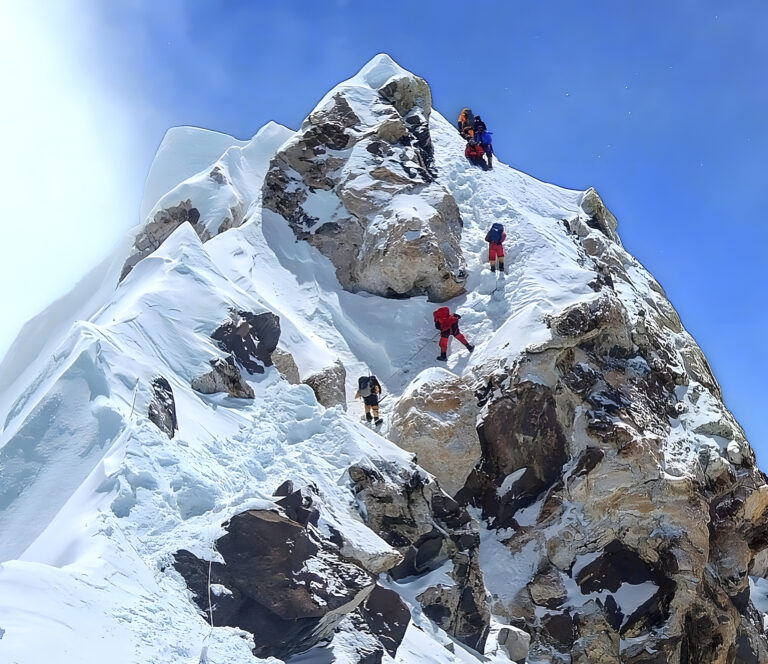
Ama Dablam Expedition - 24 Days
 6,812m/22,349ft
 Difficult
 All
Inclusive Plan
All
Inclusive Plan
Ama Dablam Height, Location, and Prominence
The elevation of Ama Dablam Mountain is 6,812 meters (22,349 ft) above sea level. Its beautiful pyramid shape with sharp ridges, and a hanging glacier make it a visually appealing peak. It is located in the Sagarmatha National Park of the Everest Region.
Ama Dablam peak is popular not because of its height. It is popular due to the technical challenges, expansive views, and thrills it offers. The steep terrain and technicality are the main highlights of this expedition. Ama Dablam has two peaks, with heights of 6,170 meters and 6,812 meters. Among them, the most frequently climbed summit is the main peak, which stands at 6,812 m.
Ama Dablam Expedition is also one of the third most popular permitted Himalayan expeditions after Everest and Cho Oyu. It gets quite crowded during the peak season, as the trail also follows the Everest Base Camp Trek route. Nevertheless, every step along the journey has jaw-dropping views.
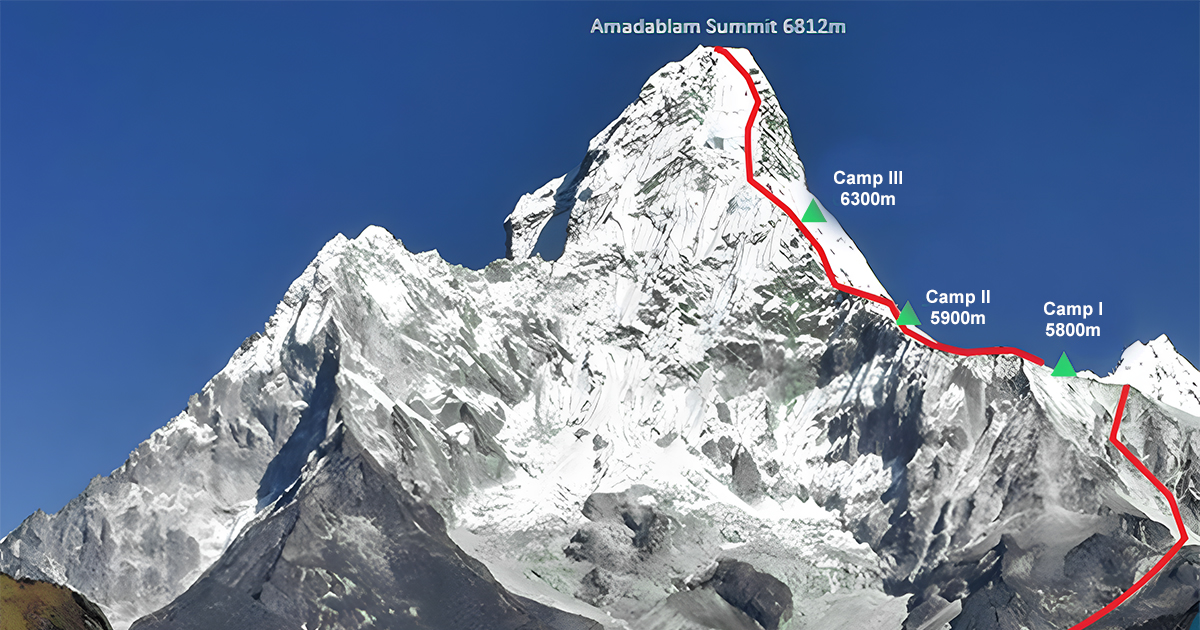
Ama Dablam has an altitude of 6,812 meters (22,349 feet)
The climbing route of Ama Dablam involves technical climbing on rock and ice. Due to the demanding skill requirements and high altitude, this expedition takes longer than other expedition peaks.
The Matterhorn of Asia is truly living up to its name, all thanks to the great visual and technical drama of this peak. This peak is visible if you are doing the Everest Base Camp too. Its distinct features of a pointed peak, sharp ridges, and a hanging glacier make it stand out among other giants.
To reach the summit, climbers have to pass through Camp I, Camp II, and Camp III. However, Camp III is mostly skipped since it is located in the risky zone.
Ama Dablam Expedition Itinerary
The standard Ama Dablam Expedition itinerary lasts between 24 to 20 days. The starting point of this trek is Kathmandu and followed by a short flight to Lukla (2,860 m). Then trekking begins towards Phakding, continues inside the Khumby valley and through the traditional Sherpa villages like Namche Bazaar, Tengboche, Pheriche, and finally to the Ama Dablam Base Camp.
The standard itinerary and route of this expedition are:
- Kathmandu Arrival and trek preparation (gear check, permits, travel insurance)
- Fly to Lukla (2,860 m), climb above the Dudh Kosi valley to Namche Bazaar (3,440 m).
- Acclimatization day at Namche Bazar and a short hike to the Everest hotel (one of the world’s tallest hotels).
- Trekking continues to Tengboche and Pheriche
- Passing via Tengboche (monastery) and acclimatizing at Pheriche (4,200 m).
- Finally reaching Ama Dablam Base Camp (4,600 m) and summit preparation.
- Climbing Ama Dablam in between 9 to 20 days.
- Return to Kathmandu following the same route.
The exact days taken to climb the peak are variable. It all depends on the climber’s physical conditions, pace, and weather status. Sometimes, unforeseen circumstances hinder the itinerary. Otherwise, till the Base Camp, itinerary and route are fixed: fly to Lukla and trek through the Everest Base Camp route. From Pheriche trail disperses toward the south, and you will arrive at Ama Dablam Base Camp.
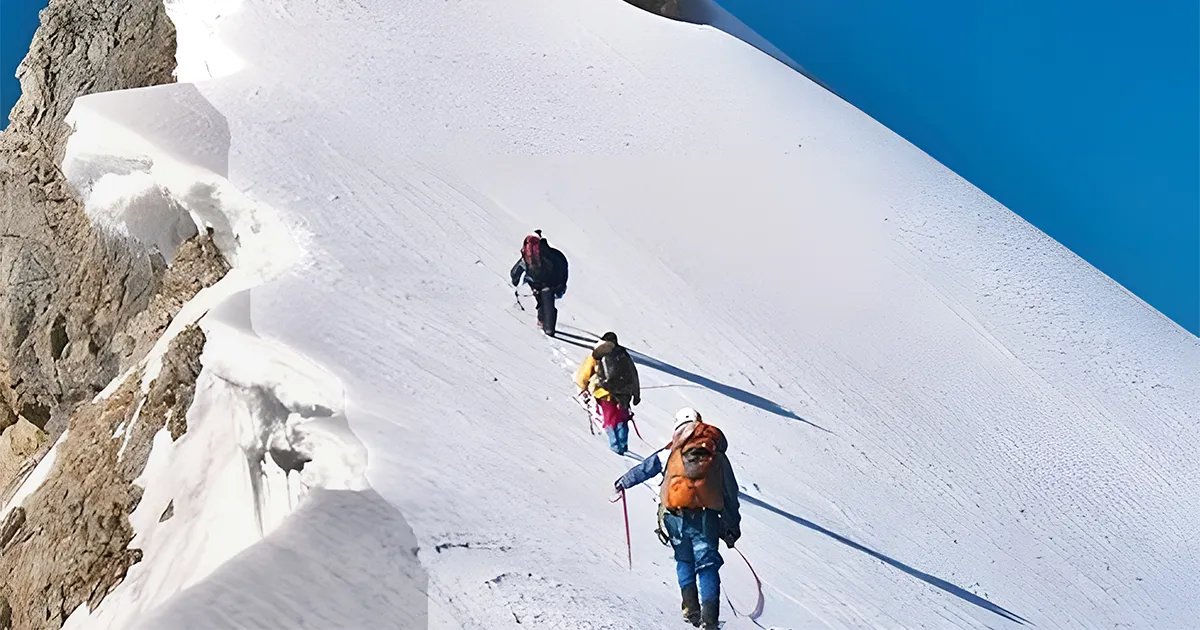
Climbing Ama Dablam Peak
Access Nepal Tours and Trekking provides the Ama Dablam Expedition map, so no need to worry. Our guides are also local and experienced; they will help you understand the route.
The Ama Dablam Expedition Itinerary may vary based on the tour operator you choose and the number of acclimatization days included. The maximum itinerary can last up to 33 days. Otherwise, 3 to 4 weeks are enough to climb Ama Dablam Mountain. These itineraries include trekking days, acclimatization rotations, and weather windows for the summit.
Base Camp and High Camps of Ama Dablam
Base Camp and High Camps of Ama Dablam are different. Ama Dablam Base Camp is located at an altitude of 4,600 meters, slightly lower than EBC. Many trekkers climb up to the Base Camp and return. Only the peak climbers stay here acclimatizing and preparing for the summit. Here, you can find a countable basic taehouse, but beyond the Base Camp, there is no human settlement or services available.
The Base Camp becomes quite crowded as all climbers stay here to practice technical skills, acclimatize, and gear check. As you carry the excitement of climbing, the view of the shining pearl white Ama Dablam adds more thirst to reach the top.
Enjoyment is there, but everyone should also be mindful of altitude sickness. At this height, you might feel the mild symptoms of altitude sickness already. Therefore, to prevent it, we climb the peak following the acclimatization rotations. After spending extra days at Base Camp only, the adventure moves to higher camps”.
Advanced Base Camp (5,400 m/ 17,716 ft):
Climbers use this Advanced Camp near 5,400 m/ 17,716 ft for the first summit preparation. It is mostly used for installing gears during rotation as they return to base camp for acclimatization. It’s a rocky saddle east of base camp.
Camp I (5,800 m/ 19,028 ft):
This camp is located at 5,800 m/ 19,028 ft and takes 5 to 6 hours of climbing from base camp. If climbers are physically fit and experienced, they skip the advanced base camp and stop here directly.
Prepare to climb over the boulder fields, exposed cliffs, and a loose rocky ridge. Guides mostly push you all the way to Camp I. However, in the past, most of them used to camp at Advanced Base Camp or Yak Camp. The flat surface for camping is limited here and only fits 10-12 tents. After fixing the ropes and all climbers return to Base Camp for acclimatization.
Camp II, the Yellow Tower (5,900 m/ 19,357 ft):
This high camp is one of the most popular on this route, all because of the steep outcrop known as the Yellow Tower. This camp is located at 5,900 m /19,357 ft and is one of the hardest sections of the southwest ridge.
Climbers have to climb over a vertical rock using fixed ropes. You must be extremely careful as you have to step on small ledges. From Camp II, it gets more technically challenging and requires mountaineering skills.
From here, you are not far from reaching the top of Ama Dablam. Every step taken here is calculated as the terrain below Camp II is extreme. There are small platforms for tents/camps.
Camp III (6,300 m/ 20,670 ft):
Camp III is an option because it is located in the most dangerous section just below the hanging Dablam serac at 6,300 m/ 20,670 ft. In 2006, a large icefall collapsed, resulting in several deaths and casualties. As of then, this camp is mostly skipped, and climbers instead do a long summit push. Some do stop at a temporary Camp III, but this is only possible during the spring season. Camp III fits only one or two tents, which are built on a small icy ledge just under the serac.
How difficult is Ama Dablam? And these high camps are another reason that makes it more difficult. The route here is almost exposed, rocky, and icy to the top of the Ama Dablam. Most of the high camps are also built at hard rock oitch. With limited space and exposed area, camps are carefully positioned. To avoid any risk, the climbers prefer to do a long summit push, which is also exhausting.
To reach from Base Camp to the High Camps of Ama Dablam is physically draining. Limited oxygen wears out the climbers once you reach Camp I (5,800 m). From Camp II (5,900 m), you will experience strong winds and bitter cold.
In simple words, the camps of Ama Dablam are very demanding and require advanced high-altitude camping skills. That’s the reason why this expedition is graded challenging and is suitable for experienced mountain climbers only.
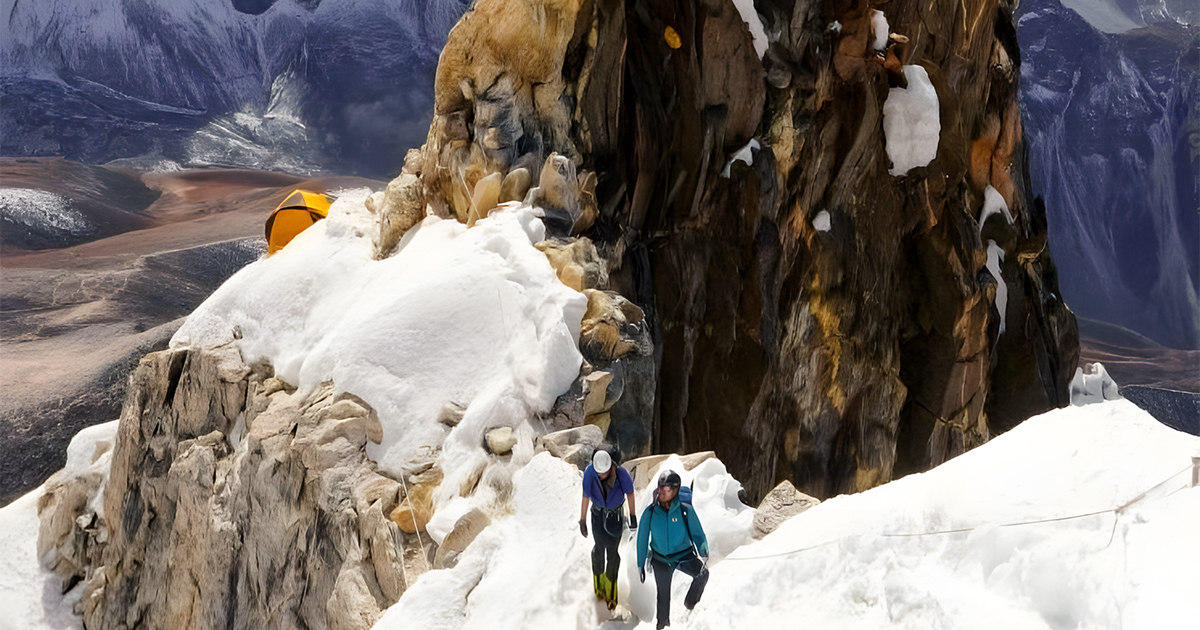
Ama Dablam Climbing Difficulty
Technical Climbing Difficulty of Ama Dablam
There are lots of challenges during the Ama Dablam Expedition. This adventure is rated as difficult, so climbers must be fully prepared. The southwest Ridge route is the standard route, which involves technical challenges due to steep snow slopes, rocky terrains, and ice walls. Given below, we have listed out some challenges during the Ama Dablam Expedition:
- Steep Rock Climbing: This is a major challenge of this journey. The lower half of the route has mostly steep rocks. It requires climbing using fixed ropes over a granite wall. The rock here is rated 5.7-5.10 (YDS) and V (Scottish IV-V) grades in places. As you climb higher, the trail gets steeper. Below Camp II, this section is regarded as the most challenging part of the journey. To pass it through, climbers have to use ascenders or cowstail lanyards. By clipping these on ropes, it gives support.
- Ice Climbing: As you pass over Camp II, the rocky terrain gives way to steep snow and ice. As you ascend, you will face ice cliffs of the Yellow Tower and gradually transition into the summit zone. This section requires the use of ice axes and crampons for climbing. Most importantly, climbers must be proficient on steep ice as the rope fixes end high on the ridges.
- Mixed & Alpine Terrain: The upper part of Ama Dablam is fully covered with snow, ice, and some amount of rock. Due to exposed landscapes, the snow becomes brittle ice or cornices. Using ice axes is most recommended due to the mixed ground, and in higher areas, fixed ropes are usually scattered. You must be able to climb despite the wind-blasted snow and ridge scrambles.
- Exposure and Route-Finding: Another major challenge of this expedition is its extremely exposed surroundings. We can’t afford a single step here because a single slip could cause us to fall down a cliff. Climbers have to be extra careful at the Yellow Tower section because the trails here are like steep scarps. Even with the help of a rope, climbing is very daunting. If you are afraid of exposed cliffs, then this adventure is not recommended.
The Ama Dablam Expedition is suitable for advanced climbers with great technical skills. Climbers must be comfortable with vertical ascending with ice tools on overhanging rock on glacier ice. The ama dablam difficulty level of this trek is high. Although the height ranges between 6,000m and 6,500m, its technical difficulty demands a high level of experienced climbers only. This adventure is not for the faint of heart.
Key Technical Requirements for Ama Dablam Expedition
Those joining on Ama Dablam Expedition mostly do prior training on Alpine rock (5.9-5.10 climbs) and water ice (WI4). Climbers are highly recommended to practice using fixed-rope ascents, crevasse ladders, abseiling, and carrying heavy packs in thin air. This training helps while climbing. If you are not comfortable using fixed ropes and can’t handle the exposed cliff, it’s better to wait to gain experience by doing a beginner-friendly expedition and join.
Climbers are also requested to practice climbing on rock walls and steep ice. This helps you to be familiar with the trails’ terrain. The route taken for climbing is Southwest Ridge, which uses fixed ropes up steep rock and ice. Practice makes perfect. So, don’t be afraid before climbing. Its steep peak makes you think twice, but it lot easier than it looks. Once you start climbing on the route, it’s not as daunting as you had thought.
Altitude, Acclimatization, and Fitness
It’s clear how difficult is Ama Dablam due to the altitude. The height of this peak is 6,812 m. At this level of height, there is a high risk of getting oxygen deprivation, especially above Camp I (5,800 m). Therefore, the summit is made in a rotation and strictly following a “Climb high, sleep low” rule.
During the day, climbers hike to 5,900 m (Camp II) and return to Camp I to sleep. This process helps your body to adjust to altitude and prevents from getting altitude sickness. Likewise, in the time of the summit push, climbing starts before dawn from Camp II.
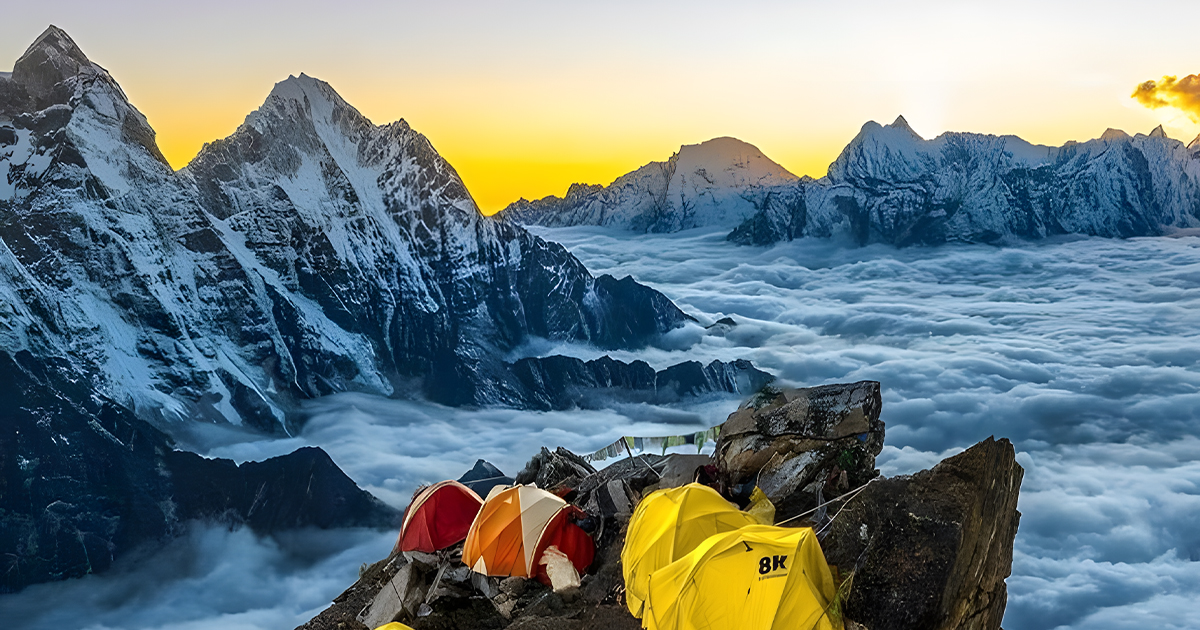
Tents during Ama Dablam Climbing
Cardiovascular fitness and acclimatization are the key solutions to tackle altitude. This is the main reason why we recommend training several months in advance of the expedition. Simple, cardio, long aerobic workouts, weight training, hills climbing with heavy packs, and core and leg strength exercises are very helpful.
Ama Dablam Expedition demands a high level of fitness and strength. Similarly, while doing a summit push, you have to climb vertically more than 1,000m on snow and rocky terrain, supported by fixed ropes in a single day. On the D-day of the summit, you have to climb for 10 to 15 hours. This requires extreme effort in cold, low-oxygen air for your body.
To undertake the Ama Dablam Expedition, a high-altitude experience is required. This adventure is graded as challenging even for seasoned mountain climbers. It’s better to be fully prepared than to regret it later.
Ama Dablam Safety, Risks, and Death Rates
As we are already aware of how difficult is Ama Dablam, safety is key for climbers. The view of sharp ridges, steep rocky cliffs, shudders the body. A single mistake can cause fatalities. Despite being a challenging trek, Ama Dablam death rates is very low. In comparison to other 8000 m giants, this peak is completely possible. The only requirement is experience and technical skills. Unlike Mount Everest, Ama Dablam has many rescue options.
The total number of deaths on Ama Dablam is about 32 climbers from 1961 to 2018. Beyond that, there is no recorded death, though risks and fatalities did occur. The number of deaths means 1 or 2%. In comparison, Everest’s death rate is around 1-2% of summit attempts. Though this is applicable if it’s climbed during good weather conditions only. Other peaks like K2 are higher by 25%.
To put it simply, if a total of 50 climbers climbed the Ama Dablam, all of them will return safe and sound.
The major risks at Ama Dablam are avalanches, falls on exposed ridges, rockfall from above, and severe altitude illness. However, climbing is operated during the suitable season and after monitoring the weather windows. So, the risks of getting caught in this disaster are very low.
The last recorded disasters at Ama Dablam were in 2006 when a large serac collapsed on the Dablam icefall, killing six climbers at Camp III. This resulted in a route change to avoid dangerous curves and ice. Sadly, in 2022, guide Mingma Wangdi Sherpa died at Camp 3 while fixing the rope.
Common Hazards:
- Avalanches and Serac Fall: The hanging glacier (“Dablam”) above Camp II can shed ice, and moving snow can avalanche onto climbers. The route change in 2008 aimed to mitigate this.
- Falls on Steep Terrain: The ledges and fixed-line sections are often icy or loose. A slip anywhere on the Southwest Ridge would be fatal.
- Altitude Illness: Above 6,000 m, climbers risk acute mountain sickness, HAPE or HACE if poorly acclimatized. Rapid weather changes can also trap teams.
- Extreme Weather: High winds and storms can occur even in spring, making the climb much harder (or impossible) for days.
Expedition logistics are designed to manage these risks. All climbers have a liaison officer and permits ($400). Guides fix ropes in advance on key sections, and teams carry emergency oxygen (though most summit without breathing bottles). Rescue helicopters can operate down to base camp but not much higher; this is another reason teams avoid sleeping above Camp II.
Overall, the phrase “Ama Dablam death rate” is often mentioned in climbing discussions. While hard statistics vary, guide sources note that “32 people have lost their lives attempting Ama Dablam” by 2018, and “over 20 people have passed away since the first ascent in 1961”. By either count, the death rate is roughly 1–2%. Climbers are advised to respect this: errors in equipment, complacency with ropes, or pushing too fast in bad weather can be fatal.
Ama Dablam Expedition Preparation and Gear:
As we are already aware, how difficult is Ama Dablam, preparation is a must for it. In the given list, we have listed out some guidelines for you to prepare, or you can go through the Ama Dablam Expedition guide for the preparation.
- Previous Climbing Experience: For Ama Dablam Peak climbing, you must have done a high-altitude and alpine expedition before. For safety, it is best to have experience of climbing the peaks above 6,000 me. Otherwise, experience of multi-pitch rock or ice climbs also works.
- A good rule of thumb is: This adventure is not recommended for novice climbers. It is suitable for those who have climbed Lobuche East or Island Peak. It requires the experience of climbing steep rock (5.7) or ice (WI3) in the mountains.
- Technical Skills: We know technically how difficult is Ama Dablam. It requires skills in using fixed ropes, ascenders (jumars), an ice axe, and crampons. Even with prior training, the guide will instruct and train you on the summit process for your safety.
- Physical Fitness: Climbers must be physically fit. We suggest you start exercising 1 or 2 advance. Doing cardiovascular exercises is very helpful. As well as going for practice hikes on the hill, carrying a weighted backpack. During the climb, you have to carry all the heavy weights at high altitude; therefore, core strength training is essential. Do exercises to build leg muscles, core, and arms.
- Acclimatization Plan: The key safety procedure to prevent altitude sickness during the climb is acclimatization. It’s a must to ascend slowly. The summit push is not done in one day; it is planned strategically, including extra rest days, which allow you to recover. It follows the rotation schedule like trek to BC, rotate to Camp I, then back, etc, so your body adapts to high altitude by strictly following the guide instructions, getting enough rest, eating nutritious meals, and keeping your body hydrated.
- Equipment: Climbing gear is mandatory for this adventure. Access Nepal provides all the required group climbing gear. Personal gear like climbing suits, double glacier boots, crampons, two technical ice axes, ice screws, rock protection (cams, nuts), etc, should be brought by yourself.
- Mental Preparation: This adventure is long, exhausting, and grueling. Knowing how difficult is Ama Dablam, climbers must prepare themselves mentally. Starting from Lukla to the end, this journey requires you to walk continuously for several days in severe cold, with little sleep (especially high on the summit push), and unforeseen challenges (such as storm delays, bad snow). A positive mindset not only motivates you but also uplifts the teamwork.
If you are thinking of climbing Ama Dablam, we recommend that you do so in a group with a travel agency. They provide good support, safety, and comfort. It is a challenging trek and not suitable for solo climbers. Joining a tour operator is very helpful as they will handle all the team logistics like transportation, gear, permits, medical backup, and tents. The only thing for you to do is to climb following the guide’s instructions.
Checklist before attempting Ama Dablam:
- Prior experience of climbing steep glacier ice and rock rated 5.7+.
- At least 1 month of Himalayan expedition training.
- Technical skills and know how to use climbing gear.
- Whole body check-up, consult with a doctor, and mandatory travel insurance.
- Choose an experienced and reliable travel agent.
Though Ama Dablam is a technically hard and dangerous expedition, the death rate is very low. With a good amount of support, training, and skills, there is little possibility of getting caught on these risks. Moreover, the rescue team is reachable. Unlike in Everest, helicopter evacuation and rescue are possible. Access Nepal Tours and Trekking provides a highly experienced team, carrying full rescue gear.
Similarly, the expedition doesn’t move forward without checking the weather conditions. Our team will monitor your condition throughout the adventure closely. With Access Nepal Tours and Trekkings’ reliable support and guidance, reaching the summit is be possible despite how difficult is Ama Dablam.
Awards and Achievements
Access Nepal Tour and Treks has been recognized with TripAdvisor’s prestigious Travelers’ Choice Award for multiple consecutive years, reflecting our unwavering commitment to quality and clients’ satisfaction.











Leave Your Comment