OFF
Discounts are solely based on your group size. We do not add anyone to your group.
- Best Price Guarantee
- Hassle-Free Booking
- Team of highly experienced Experts
- Your Happiness Guaranteed
Book Now. No Booking or Credit Card Fee
- Schedule Your Own Dates
- Group Discounts
- Guaranteed Departures
- Easy Cancellation
- 60% Repeated Customers
-

- Duration
- 17 Days
-

- Transportation
- Private and Sharing Jeep
-

- Trip Grade
- Challenging
-

- Max-Altitude
- 5,100m/16,732ft
-

- Accomodation
- Hotel/Teahouse/Tent Camp
-

- Primary Activity
- Trekking, Sightseeing
-

- Meals
- All meals during trek
-

- Best Season
- Mar-May|Sept-Dec
-

- Distance
- 480 km
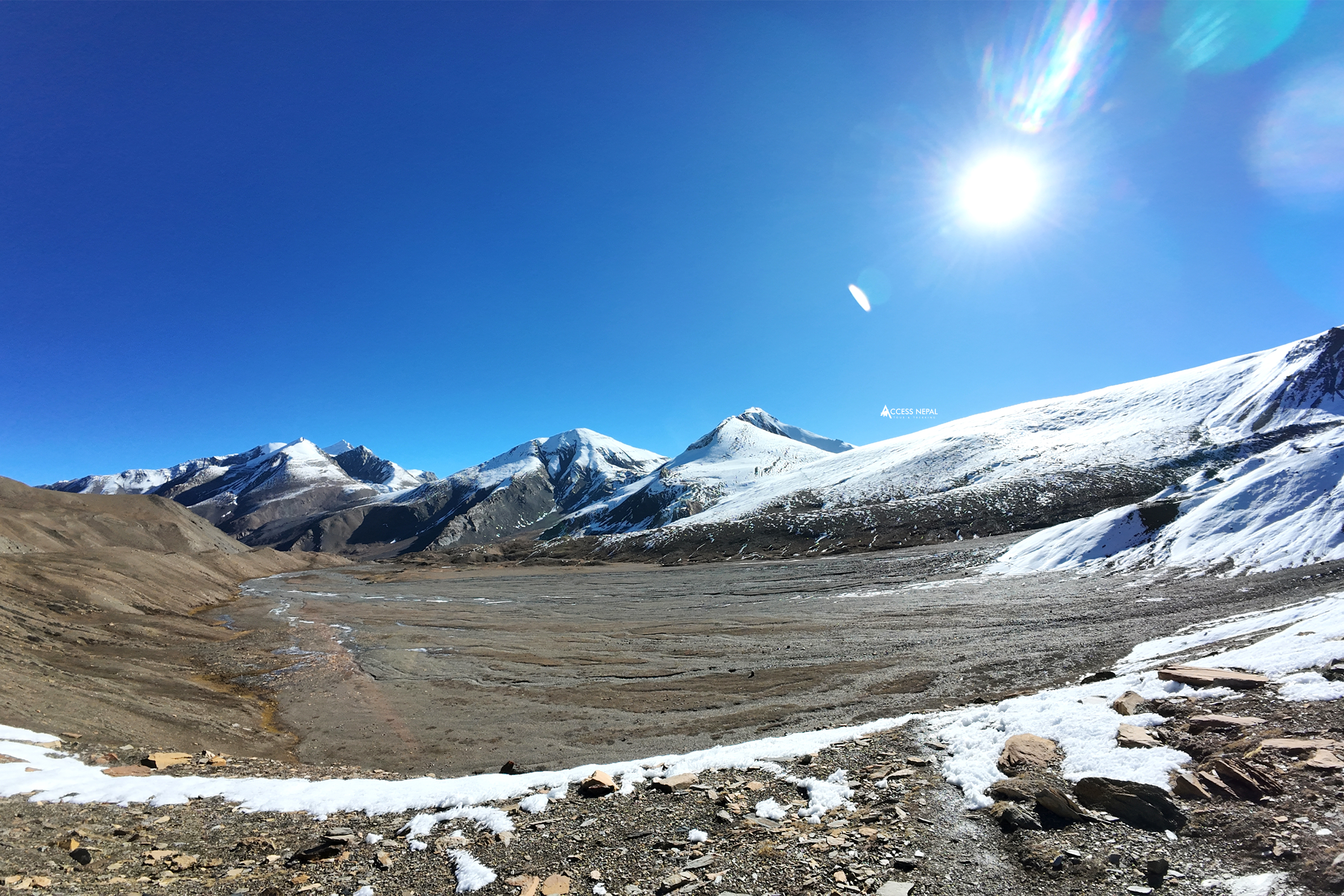
The Dhaulagiri Circuit Trek is one of Nepal’s most demanding and rewarding high-altitude trekking adventures, taking trekkers deep into the remote wilderness surrounding Dhaulagiri I (8,167m), the world’s seventh-highest mountain. This classic circuit trek is known for its extreme terrain, glacial valleys, high mountain passes, and minimal infrastructure, making it suitable only for well-prepared trekkers seeking a true Himalayan expedition experience.
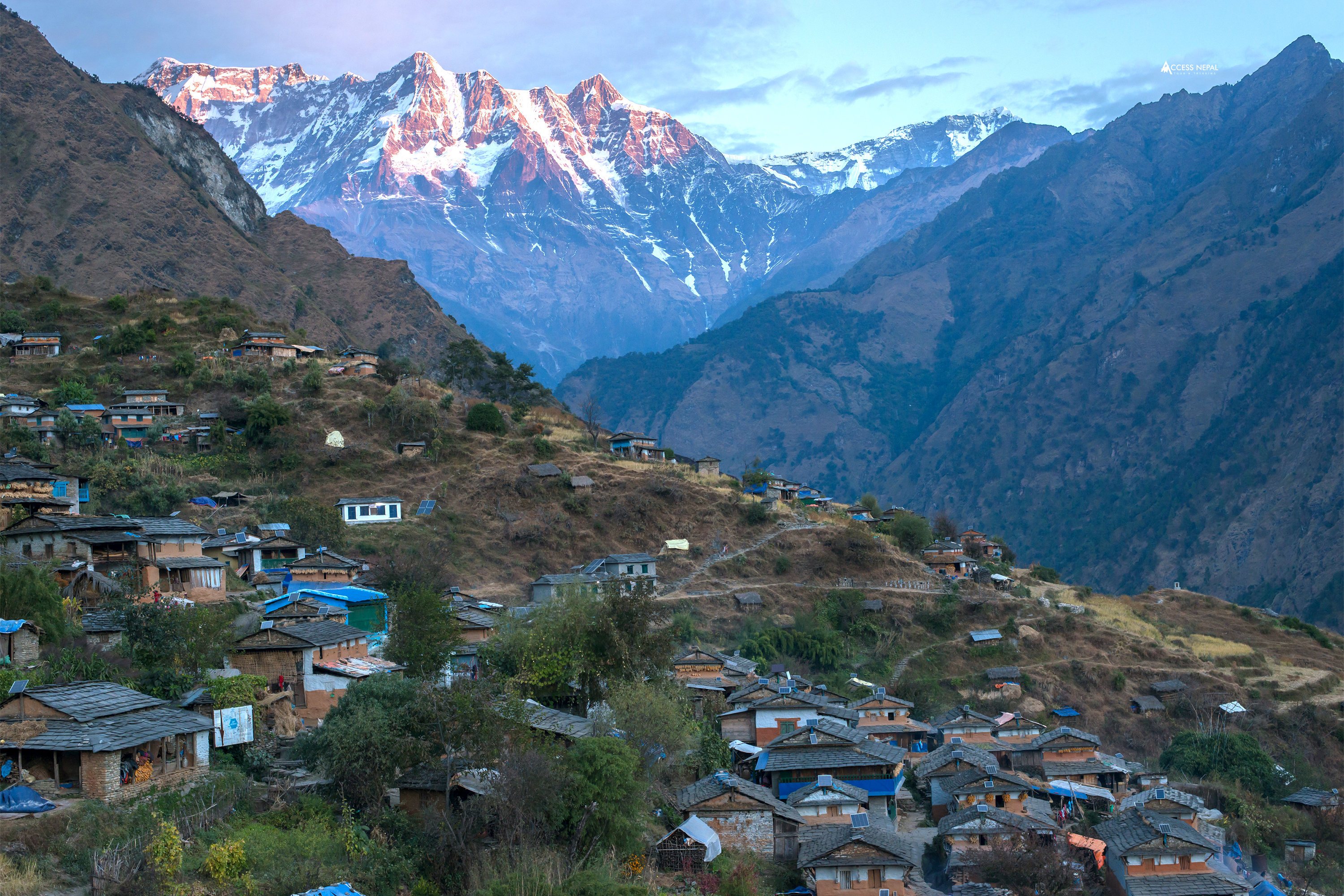
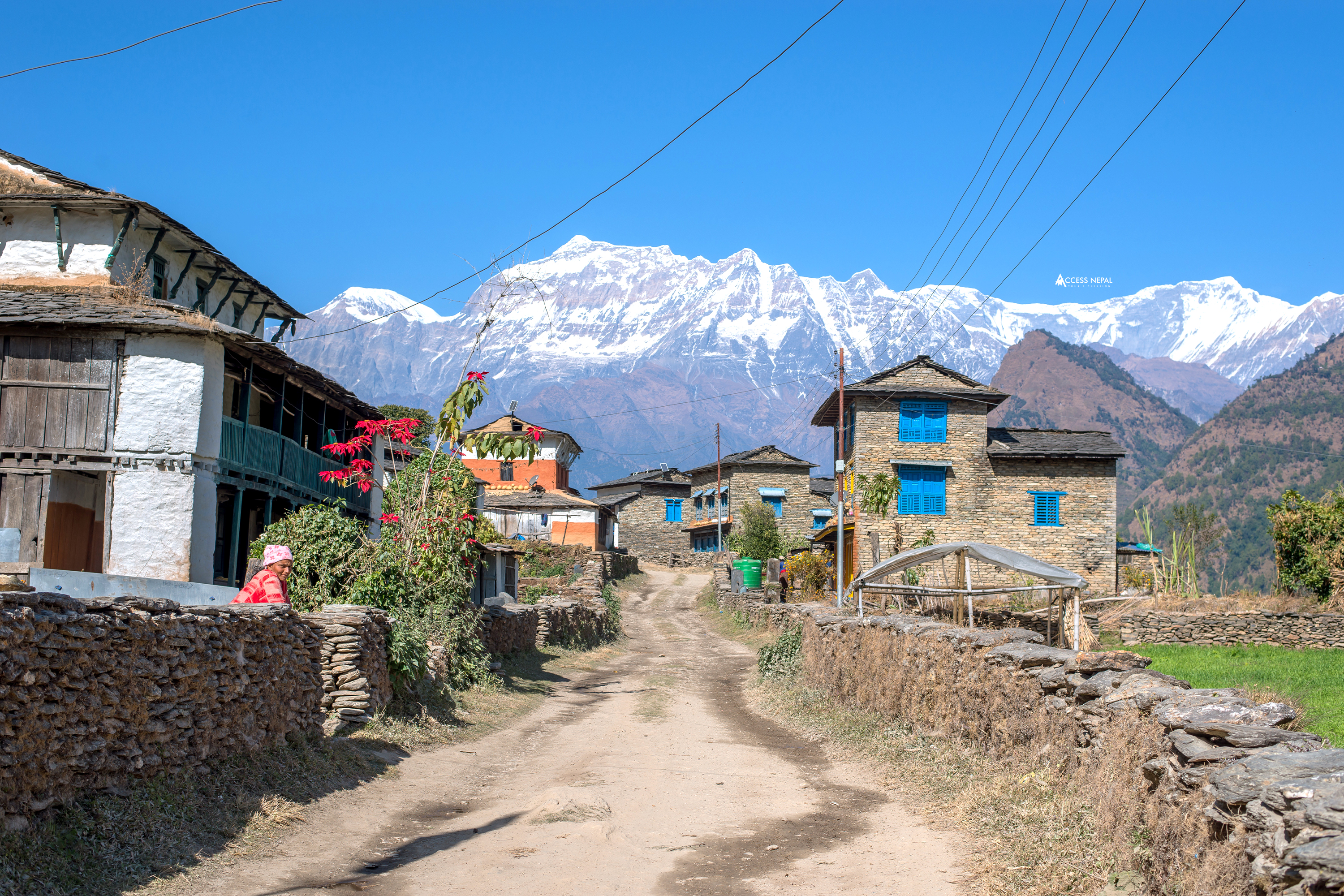
Starting from Beni in the Myagdi district, the trek gradually ascends through remote Magar villages, dense forests, and river valleys before entering the rugged alpine zone of the Dhaulagiri range. As the trail gains elevation, trekkers pass through isolated settlements such as Darbang, Muri, Boghara, and Dobang, eventually reaching the high camps near Italian Base Camp, Japanese Base Camp, and Dhaulagiri Base Camp.
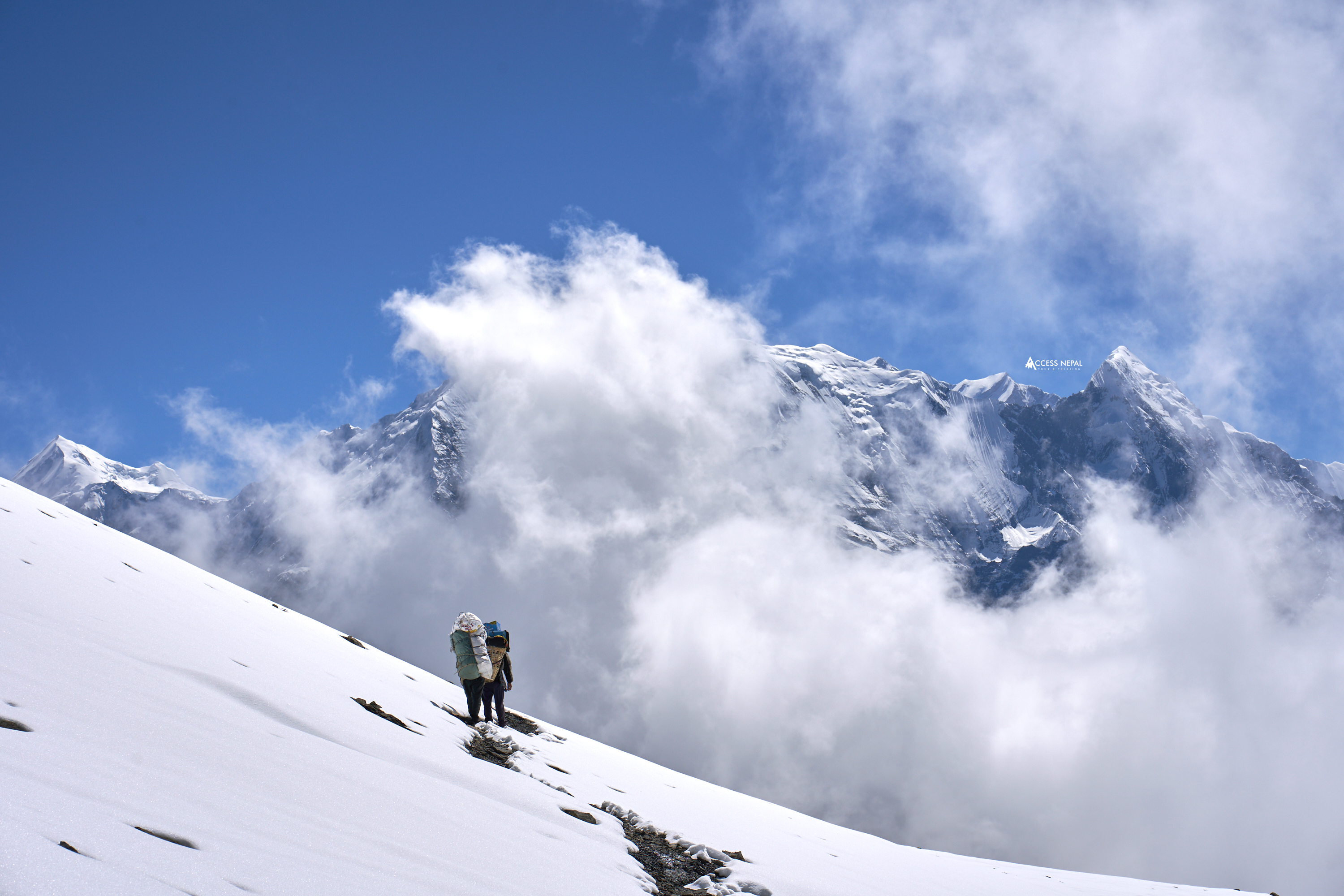
A major highlight of the Dhaulagiri Circuit Trek is the crossing of two challenging high passes: French Pass (5,360m) and Thapa Pass (5,250m). From these viewpoints, trekkers are rewarded with dramatic panoramas of Dhaulagiri I, II, III, and V, along with Annapurna, Nilgiri, Tukuche Peak, and Mukut Himal. The route also traverses the Kali Gandaki region, home to the world’s deepest gorge.
Unlike commercial trekking routes, the Dhaulagiri Circuit remains largely untouched and requires full camping support in the higher sections due to the absence of teahouses. The trek typically takes 17–20 days to complete, allowing for proper acclimatization and safe passage through high-risk zones.
With its combination of altitude, remoteness, and technical sections, the Dhaulagiri Circuit Trek is considered one of the most challenging treks in Nepal and offers an unparalleled adventure for experienced trekkers seeking solitude and raw Himalayan landscapes.
This trek is operated as a fully guided and supported expedition, with camping logistics and acclimatization carefully planned for safety and comfort.
Highlights of Dhaulagiri Circuit Trek
- Close, surreal glimpse of the 7th highest in the world, Dhaulagiri.
- Experience two mountain high passes, French Pass (5360 meters/17585 ft) and Thapa Pass (5250 meters/17224 ft).
- Get to explore Pokhara and the lakeside town.
- Explore Marpha and Jomsom village, which are widely famous for their tasty apples and stunning mountain views.
- Opportunity to camp between the stars and mountains in the remote region of Nepal.
- Get to experience local culture and understand their way of life.
- Experience diverse landscapes, including dense forests, terraced fields, and alpine meadows.
- Get to see several natural hot springs where you can relax fully.
- Chances to explore some of the most remote and untouched areas.
French Pass
- Height: 5360 meters/17585 ft
- Main Highlights: Provides stunning mountain views (Dhaulagiri, Annapurna, Tukuche Peak, Mukut Himal, etc).
Thapa Pass (Dhampus Pass)
- Height: 5250 meters/17224 ft
- Main Highlights: Picturesque mountain scenes, glacial valleys, diverse landscapes, and the Kali Gandaki Valley.
You need a good level of fitness and acclimatization. Since these passes includes steep and rocky terrain trekking poles and crampons are a must.
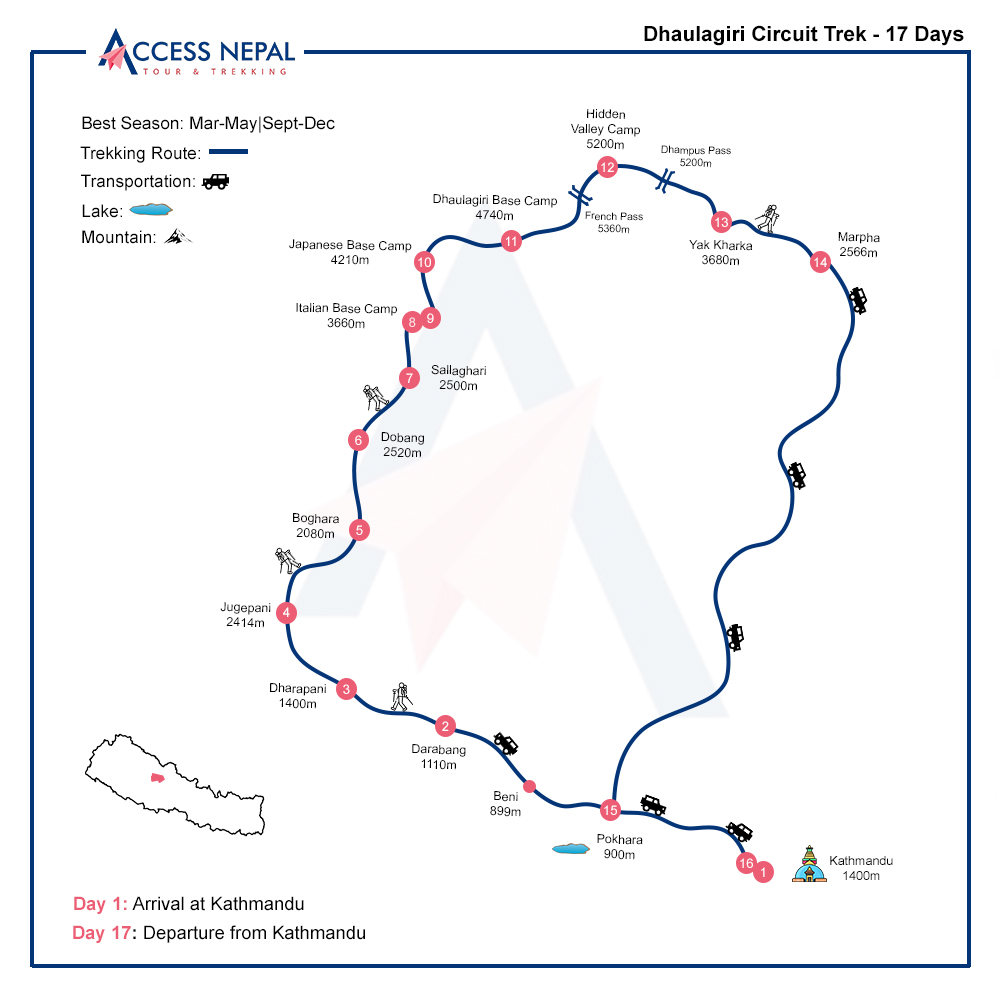
Day 01Arrival to Kathmandu
-
- 1400m/4593ft
Day 02Drive from Kathmandu to Pokhara and to Darbang
-
- 300 km
-
- 1100m/3608ft
-
- 10-12 hours
-

- 300m/984ft
Day 03Trek from Darbang to Dharapani
-
- 12 km
-
- 1400/4593ft
-
- 5-6 hours
-

- 300m/984ft
Day 04Trek from Dharapani to Jugepani
-
- 16 km
-
- 1300m/4265ft
-
- 5 to 6 hours
-
- 100m/328ft
Day 05Trek from Jugepani to Boghara
-
- 14 km
-
- 2414m/7919ft
-
- 5 to 6 hours
-
- 1114m/3654ft
Day 06Trek from Boghara to Dobang
-
- 15 km
-
- 2520m/8267ft
-
- 6 to 7 hours
-
- 106m/347ft
Day 07Trek from Dobang to Sallaghari
-
- 16 km
-
- 2500m/8202ft
-
- 5 to 6 hours
-
- 20m/65ft
Day 08Trek From Sallaghari to Italian Base Camp
-
- 12 km
-
- 3660m/12007ft
-
- 4 to 5 hours
-
- 1160m/3805ft
Day 09Rest Day at Italian Base Camp
-
- 3660m/12007ft
Day 10Trek from Italian Base Camp to Japanese Base Camp
-
- 10 km
-
- 4300m/14107ft
-
- 4 to 5 hours
-
- 640m/2099ft
Day 11Trek from Japanese Base Camp to Dhaulagiri Base Camp
-
- 8 km
-
- 4748m/15577ft
-
- 7 to 8 hours
-
- 448m/1469ft
Day 12Trek from Dhaulagiri Base Camp to Hidden Valley via French Pass
-
- 12 km
-
- 5360m/17585ft
-
- 6 to 7 hours
-
- 612m/2007ft
Day 13Trek from Hidden Valley to Yak Kharka
-
- 18 km
-
- 4100m/13451ft
-
- 6 to 7 hours
-
- 1260m/4133ft
Day 14Trek from Yak Kharka to Marpha
-
- 20 km
-
- 2670m/8759ft
-
- 4 to 5 hours
-
- 1430m/4691ft
Day 15Drive From Marpha to Pokhara
-
- 142 km
-
- 850m/2788ft
-
- 6 to 7 hours
-
- 1820m/5971ft
Day 16Drive from Pokhara to Kathmandu
-
- 200 km
-
- 1400m/4593ft
-
- 6 to 7 hours
-
- 550m/1804ft
Day 17Transfer to Tribhuvan International Airport
- Airport pick-up and drop-off
- Welcome dinner (Day 1) at a traditional Nepali hotel and cultural performances in Kathmandu.
- 2 Nights (Days 1 & 17) accommodation with breakfast at the 3-star Apsara Boutique hotel on a twin-sharing basis in Kathmandu. (Options to upgrade)
- Jeep drive from Kathmandu to Pokhara and to Darbang (Day 2), and return trip from Marpha to Pokhara (Day 15) & Pokhara to Kathmandu (Day 16)
- Standard 10 nights teahouse accommodation on a twin-sharing basis.
- Twin sharing tented accommodation during the trek (from Italian Base camp to Yak Kharka)
- Trekking equipment (two-man tent, dining tent, kitchen tent, kitchen utensils, and other necessary equipment during the trek)
- Hot showers and an attached toilet are available in some areas.
- Full board meals, seasonal fruits, and 3 cups of tea/coffee throughout the trek.
- 1 Highly experienced, government-licensed, English-speaking, first-aid trained guide for 6 people with insurance and expenses covered.
- 1 porter for every two people with insurance and personal expenses covered.
- Adequate Chlorine Tablets for water purification.
- As a souvenir, an Access Nepal duffel bag, a T-shirt, and Trekking maps.
- Provides sleeping bags and down jackets if needed.
- Adventure certificate.
- Basic First-aid kits with an oximeter included.
- Farewell dinner (Day 16) at the finest restaurant in Kathmandu.
- All required trekking permits and government charges.
- Assistance in arranging rescue operations during emergency cases.
- An oxygen meter to check your pulse and oxygen saturation.
- Nepal Visa
- Internet, travel insurance, and charging electric devices
- Other personal expenses.
- Meals in Kathmandu. (Welcome and Farewell dinner included)
- Tips for guides and porters.
- Extended stays and trips in Nepal.
Our groups are small with maximum 14 people. We create groups of independent travelers, friends and families which maintains close interpersonal connection, engage more and get into depth of the journey. Choose a date from the calendar to reserve your spot.
Altitude Sickness & Acclimatization for Dhaulagiri Circuit Trek
For the Dhaulagiri Circuit trek, we will be going beyond 5000 meters, and this significant altitude gain also increases the chances of altitude sickness. If proper acclimatization is not followed, there is a higher risk of altitude sickness.
Some of the most common symptoms of altitude sickness are headaches, dizziness, nausea, shortness of breath, and fatigue. Trouble falling asleep is also a sign of altitude sickness. Keep these symptoms in mind when ascending, as they can get worse if you don’t give enough time for your body to adjust.
Weather Conditions on Dhaulagiri Round Trek
Weather conditions during the Dhaulagiri Round trek are quite unpredictable. Weather conditions are constantly changing in high altitudes. Especially in the off-season, also referred to as not the ideal time for trekking, brings more challenges.
The weather during the winter (December to February) and monsoon (June to August) is the most difficult time to trek. During the winter season, the weather is freezing cold, with high chances of snowfall occurrences, and ice blocking the trails. Similarly, in the monsoon, the trail remains slippery, and rainfall brings cold as well.
Accommodation Available on Dhaulagiri Circuit Trek
For the Dhaulagiri Circuit trek, you will stay in teahouses mostly, but not for the entire trek. You will stay in tented camps once you reach the Italian Base Camp and until the Hidden Valley. The teahouses come up with basic facilities, with minimal services.
The rooms are well-maintained, and the beds are of good quality, including warm blankets, comfortable mattresses, pillows, etc. The majority of the rooms are available on a shared basis. The toilets are also traditional (Asian squat style).
Our team is also experienced in setting up camp. We provide high-quality tents that will handle any kind of weather. Altogether, two trekkers can sleep comfortably in a single tent (the space is quite big). We also offer a sleeping mat, a toilet tent, and a dining tent. These are all parts of a regular camp.
You can also get a hot bucket shower during the camping period; however, don’t take a bath on a daily basis, as it will be too cold up there.
The Dhaulagiri region takes you to glacial valleys and untouched alpine basins. Therefore, there aren’t many teahouses or lodges. Once you reach the Italian Base Camp, camping becomes the only option. The team will carry tents and food for this journey.
All the meals are prepared by the team members (who will be with you) in the mobile kitchen.
Tented Camps on:
- Italian Base Camp
- Japanese Base Camp
- Dhaulagiri Base Camp
- Hidden Valley via French Pass
Meals on the Dhaulagiri Circuit Trek
Meals on the Dhaulagiri Circuit trek will be healthy, nutritious, and delicious at the same time.
Breakfast options:
- Tibetan bread
- Biscuits
- Porridge
- Oats
- Eggs
Lunch options:
- Nepali Dal Bhat (Rice, Lentil, and Vegetables as a side dish)
- Thukpa (Hot Noodles)
- Chowmein
- Pasta
Dinner options:
- Nepali Dal Bhat
- Fried Rice
- Dhindo (Doughy porridge)
Drink Options are:
- Tea
- Coffee
- Fruit juice
- Hot chocolate
We recommend that you carry energy/protein bars for extra energy during the trek.
Most of our meals are vegetarian, with a vegetarian option and some non-vegetarian options too.
Drinking Water on the Dhaulagiri Round Trek
You should stay hydrated during the Dhaulagiri Round trek, and it is a primary rule. Drink plenty of water; 3 to 4 litres of water daily.
You can easily refill your water bottles in the kitchen tent (you’ll be provided with boiled water). In order to boil water, it takes an extra amount of fuel at higher altitudes (the fuel is quite limited). Therefore, the best is to refill the water from natural springs.
Drink spring water only after purifying it with the help of purification tablets. During the journey, you’ll find plenty of traditional taps, springs, and streams where you can refill your bottles easily. You can also ask your guide about the water sources, whether they’re clean or not (before filling).
How to communicate during trekking?
At your teahouse stay, the Wi-Fi services will be available. However, you might have to pay extra charges from USD $2 to $5. With the help of that, you can get in touch with your near and dear ones.
Dhaulagiri Circuit Trek Difficulty
The Dhaulagiri Circuit Trek is graded as a challenging trek and is not an ideal trek for beginners.
The weather conditions can change rapidly, with snowstorms and huge winds blowing at any time. There is no road access, so in case of any unforeseen events, emergency evacuation is only possible with the help of a helicopter.
In the glacial camp area, there is also the possibility of rockfall and the risk of avalanches. Once you surpass the French Pass, the risk of crevasses, slippery ice, and poor visibility makes the path very difficult.
The climb becomes technical too, with steep scree slopes needing technical gear like fixed ropes or ice axes. With the significant amount of elevation gain, there is also a high chance of getting exposed to altitude sickness.
Some amount of trekking experience is required, as there are plenty of high-risk zones in the Dhaulagiri region. Thereby, a solid physical & mental preparation is a must to achieve the Dhaulagiri Circuit trek.
Your guide will perform the emergency evacuation through helicopter in the worst possible cases (but your travel insurance must cover it).
Compared to the Annapurna Circuit trek and the Manaslu Circuit trek, the Dhaulagiri Circuit trek is highly remote and is one of the most isolated treks, which takes you deep into the wilderness of Nepal.
In the Dhaulagiri region, there is no proper mode of transportation. The primary ones are only yaks, mules, and porters.
Travel Insurance
Dhaulagiri Circuit trek via French Pass takes you over 5000 m elevation, so any unfortunate events might occur (even though we take care of proper safety throughout the trek). This is why purchasing travel insurance is a must, as you will have financial coverage even if an emergency case arises.
It becomes very handy whenever you’re doing moderate to challenging graded treks in the higher-altitude regions. They provide economic support when things go wrong, especially during the trekking period.
Thus, we recommend that you buy travel insurance before heading for the trek.
Our tour and travel packages don’t include travel insurance, hence this is something you need to rely on your own.
When you’re about to choose travel insurance, make sure it covers
- Altitude Sickness
- Accidents
- Tour Cancellations
- Helicopter Evacuation
Packing List for Dhaulagiri Circuit trek
For the Dhaulagiri Circuit trek via French Pass, you have to do heavy packing. Here is the list of all the essential gear and equipment. Here is the list of them:
Upper Body
- Waterproof Jacket
- Down Jackets
- Fleece Jackets
- Raincoat
- Thermal layers (moisture sucking base layers)
- Thick shirts
- Woolen hat
- Scarf/Buff
Hands
- Waterproof gloves
- Woolen gloves
- Sports Bra (for women)
Lower Body
- Rain pants
- Trekking pants
- Underwear
Feet
- Woolen trekking socks
- Trekking boots
- Camp sandals
Toiletries
- Soap
- Shampoo
- Toothbrush
- Towel
- Toothpaste
- Toilet paper
- Hand Sanitizer
First Aid
- Water purifying tablets
- Anti-nausea medication
- Mosquito and insect repellent
- Rehydration salts
Gears & Other Items
- Duffel Bag (complimentary gift)
- -20 Degree sleeping bag (available upon request)
- Water bottles (We provide free water purification tablets)
- Moisturizer
- Sun screen
- Lip balm
- Camera/Smartphone
- Two-pin charging plug
- Personal Medication
- Binoculars
- Swiss army knife or a multi-tool
- Daypack
- Trekking poles
- Headlamps
- Power Bank
Essential Documents/Materials to Carry
- A passport (with validity for at least six months)
- A few passport-sized photos
- Tourist Visa
- Photocopies of the Passport
- Dhaulagiri Circuit Trek Permits (We take care of these for you)
- Travel Insurance paper
- Vaccination Certificates
- Agency’s registration copy
- Booking Confirmation
- Copy of flight tickets with date of arrival and departure
Best Time for Dhaulagiri Circuit Trek
In order to get the best possible views and weather conditions, you’ve to do the Dhaulagiri Circuit trek via French Pass in this specific time period. This is from September to December and March to June.
Trekking during these times is best in terms of views, experience, and climate. You’ll experience mild and clear weather with blue skies, pure freshness of air, lush green grasslands, and majestic views of the Himalayas.
Other than that, blooming rhododendrons can also be experienced along with other wildflowers, and the visibility also remains crystal clear.
Dhaulagiri Region in Spring
Blooming rhododendrons are the main sight of attraction during the spring season. The weather conditions remain pretty perfect with mild climate, clear blue skies, making it an ideal time to trek.
Dhaulagiri Region in Autumn
The days are pretty mild, bright, sunny, and a bit chilly too. The skies remain clear, the visibility is good, and the sunset views are also pretty amazing. The gorgeous peaks look shiny, clearer, and offer the best experience.
Permits Required for Dhaulagiri Circuit Trek
If you’re thinking of doing the Dhaulagiri Circuit trek, you require two permits: these are Annapurna Conservation Area Permit (ACAP) and the Trekkers Information Management System (TIMS).
- Carry a first aid kit alongside you to remain safe in case of any unforeseen circumstances.
- Don’t forget to bring trekking poles as they help in the journey, maintaining balance, providing great stability, and mobility.
- Don’t roam here and there without informing your guide.
- Stay hydrated, drink at least 3 to 4 liters of water every single day.
- Eat healthy, nutritious food in good quantity to maintain energy levels.
- If your body feels uneasy, inform your guide asap.
- Make sure to purchase the travel insurance before heading for the trek.
- Pack all the required gear and equipment.
Dhaulagiri Circuit Trek Price/Cost
The price of your Dhaulagiri Circuit trek varies depending on different factors, such as the group size, tour operator, and many other aspects. We, Access Nepal Tour and Trekking, provide this 17-day Dhaulagiri Circuit trek package at a competitive rate of USD 2990 per person.
Since it is an all-inclusive package so you don’t have to worry about anything. It covers all the essentials, including meals, permits, accommodations, guides, and much more. We put all our energy and focus on making your trek enjoyable, memorable, and hassle-free by all means.
The following price also covers the private jeep drive from Kathmandu to Pokhara and Darbang, and return trip too of Marpha and Pokhara and Pokhara to Kathmandu.
Why Trek Dhaulagiri Circuit with Us?
Our experienced guide makes your Dhaulagiri Circuit trek journey amazing, enjoyable, and fully safe. We guarantee you a memorable experience when you walk into this remote region of Nepal.
Solo trekking in the Dhaulagiri circuit is too tough and costly at the same time. Thereby, we advise you to trek in a group, even if it may be a small one.
The best way to do the Dhaulagiri Circuit trek is by joining a group and hiring a guide/porter, or you can simply book our package to remove unnecessary hassles.
Alternative Treks in Nepal
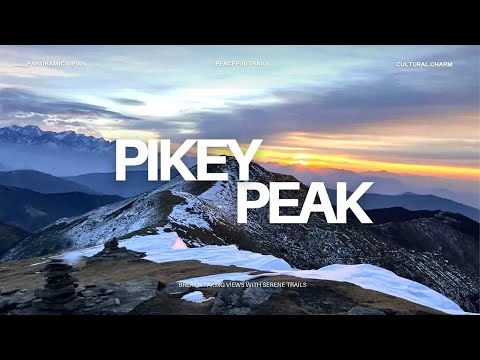
If you’re looking for a quieter trekking experience with stunning sunrise views over Everest and fewer crowds, the Pikey Peak Trek is ideal. Travelers short on time but still wanting Himalayan scenery may find the Kori Trek more suitable.
Is there a trek restriction in Dhaulagiri Circuit?
The Dhaulagiri Circuit isn’t restricted, but you need some compulsory permits, and these include the ACAP (Annapurna Conservation Area) Permit & TIMS (Trekkers’ Information Management System).
Where is the Dhaulagiri Circuit trek located?
Can I do Dhaulagiri Circuit trek without a guide?
What is the highest altitude of Dhaulagiri Circuit trek?
Can beginner trek to Dhaulagiri Circuit trek?
Do I need any permits for Dhaulagiri Circuit Trek?
Are the necessary permits included in the trekking package?
Where can I obtain the permits for the Dhaulagiri Round Trek?
What type of accommodation is available during the Dhaulagiri Round Trek?
Are teahouses equipped with modern facilities?
Will I have access to Wi-Fi services along the trek?
How difficult is the Dhaulagiri Round Trek?
What is the best time to do the Dhaulagiri Circuit trek via French Pass?
Is it safe to trek during the monsoon or winter seasons?
Is altitude sickness a concern on the Dhaulagiri Circuit trek?
How to prevent altitude sickness during this trek?
In case of emergency, what procedures are in place during the trek?
What are the necessary items I should pack for the Dhaulagiri Circuit Trek?
Is a sleeping bag mandatory for this trek?
Are trekking poles or other gear recommended?
Amazing time doing EBC trek with Access Nepal! I went with Access Nepal for my Everest Base Camp 14 day trek, and I had an incredible experience! From my very initial inquiry, Sadhana was quick to respond and answer any questions. She made me feel very comfortable and connected throughout the entire process, and provided me with all the relevant information leading up to my arrival. When we finally met in Kathmandu to discuss the trek, she was just as friendly and kind and made me feel at ease knowing I was starting the next morning. I was met by my guide Om Prakash at the Kathmandu airport. From there he was with me the entire time as we traveled to Lukla to begin our trek and until I returned to Kathmandu. Om Prakash was an excellent and friendly guide, with so much knowledge of the area, the culture, the route, where to stay and safe places to eat and drink, and he also took the best photos! It was very helpful to have a local speaking guide to handle flight and accommodation logistics on my behalf, making sure I have somewhere to stay and eat every night. Throughout the trek, he managed my health and recommended me the best course of action when I wasn’t feeling 100%. He set the trekking pace accordingly to ensure my best success. Our porter, Bidur, was also extremely lovely during the trek. He handled my things with proper care, always made sure to have it ready on time by the evening, was extremely friendly and nice to talk to, and provided excellent service and companionship. Overall I had a 10/10 experience with Access Nepal: the trip coordinator Sadhana, my guide Om Prakash and my porter Bidur. I would recommend going with Access Nepal if you are looking to conquer the EBC trek or any similar in Nepal!
Emmanuel Saulog Nepal
"The tour can be best described by me … "The tour can be best described by me as VALUE FOR MONEY. The tour covered many destinations..." Thank you very much for the team of accessnepaltours for providing me such a marvellous experience...
Ross Australia
Amazing experience on the Langtang… Amazing experience on the Langtang Valley Trek. I am not an experienced hiker but Naba, the Mountain guide and Access Nepal were amazing in all aspects( the organization of the trek, care of the group, knowledge of the área, English level etc.) I highly recommend this trek and this company to anyone looking to hike in Nepal, whether beginner or expert hiker. This trek is not so populated and you really get to experience the local lifestlye of the people. 10/10 in my opinion.
Jenn Brockert Spain
Awards and Achievements
Access Nepal Tour and Treks has been recognized with TripAdvisor’s prestigious Travelers’ Choice Award for multiple consecutive years, reflecting our unwavering commitment to quality and clients’ satisfaction.