OFF
Discounts are solely based on your group size. We do not add anyone to your group.
- Best Price Guarantee
- Hassle-Free Booking
- Team of highly experienced Experts
- Your Happiness Guaranteed
Book Now. No Booking or Credit Card Fee
- Schedule Your Own Dates
- Group Discounts
- Guaranteed Departures
- Easy Cancellation
- 60% Repeated Customers
-

- Duration
- 24 Days
-

- Transportation
- Private Vehicle & Flight
-

- Trip Grade
- Difficult
-

- Max-Altitude
- 6,812m/22,349ft
-

- Accomodation
- Teahouse & Hotel
-

- Primary Activity
- Trekking, Climbing
-

- Meals
- All meals during trek
-

- Best Season
- Mar-May|Sept-Nov
-

- Distance
- 150 km
The pride of Nepal, Mount Ama Dablam, is a peak in Koshi province, the Everest region of Nepal. The beautiful pyramidal shape and its sharp ridges have earned the nickname “Matterhorn of Asia.” In the native language (Sherpa), Ama Dablam means “Mother’s charm box.” The view of the long ridge on each side looks like a mother holding her baby, and the glacier looks like a Sherpa woman’s traditional double-locket.
The Ama Dablam height at 6,812 m/22,349 ft pierces the blue sky. Being part of the UNESCO World Heritage Site, the Ama Dablam Base Camp trek is one of a kind. This route not only brings you to the top of its summit, but also to the classic Everest Base Camp Trek routes.
Protected by Sagarmath National Park, the Ama Dablam Base Camp Trek takes you through rugged terrains and wilderness. Due to the technical climbing skill requirement, the Ama Dablam trek is the most sought trek by experienced climbers. Moreover, the 360° panoramic sight of Mount Everest, Cho Oyu, Makalu, Lhotse, Nuptse, and many more from the top of Ama Dablam peak is unforgettable.
Each second along the journey is worth beholding. Trekking into the wild, high-altitude valleys, watching the Sherpa people’s lifestyle, and rhododendron forests surrounded by majestic peaks is an experience you will never forget in your lifetime.
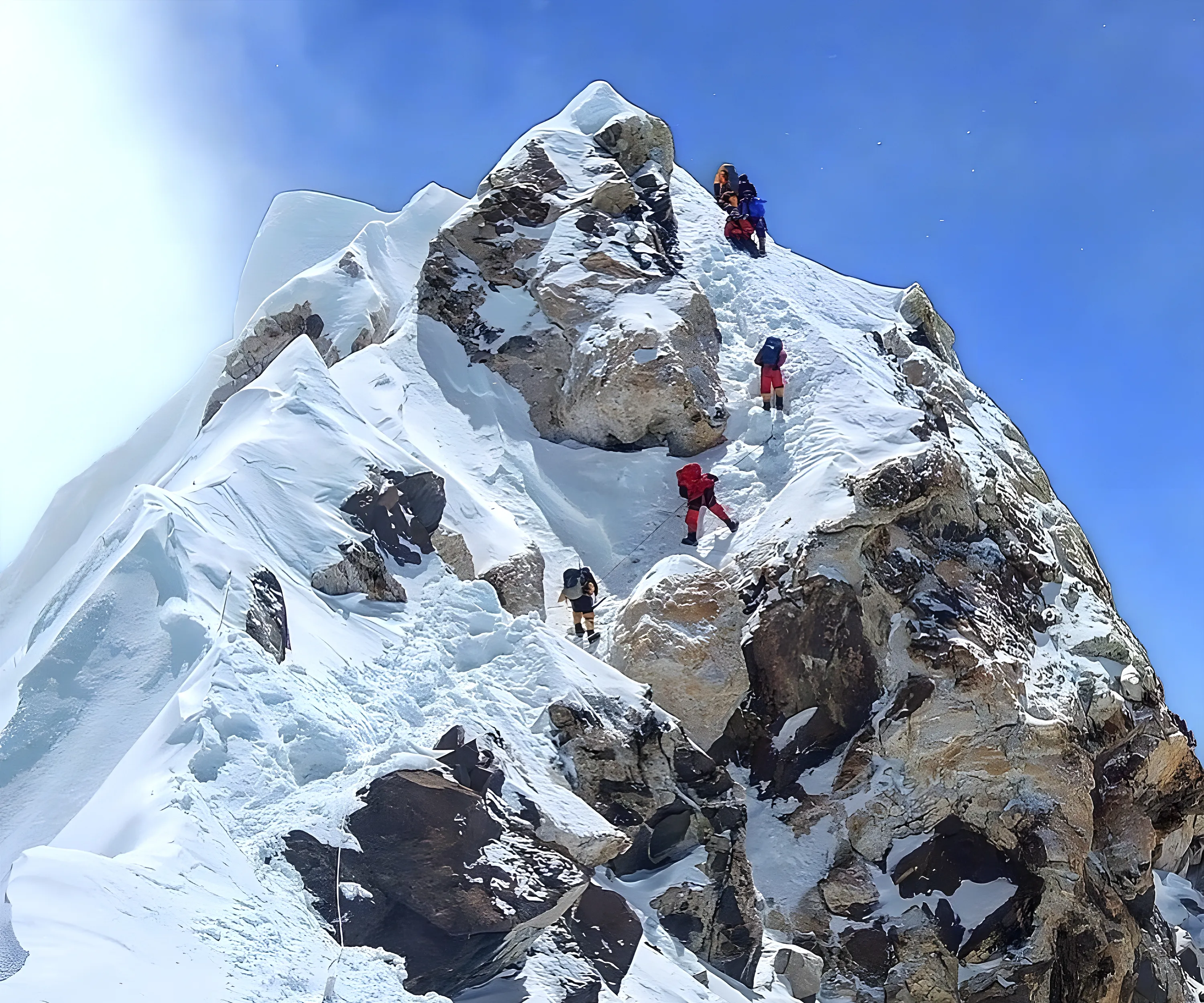
Ama Dablam Climbing is regarded as a challenging trek due to its technical difficulties. The southwest face and exposed ridges require climbers to have ice and rock climbing skills. This peak is known for having a narrow gully, a vertical route like Grey Couloir.
The Ama Dablam expedition package is made for professional climbers only. If you are a pro climber who loves Himalayan views, new adventures, and challenging yourself, no need to hesitate. It’s just made for you.
Ama Dablam Expedition Highlights
-
Climbing Ama Dablam Peak, which is 6,812 m tall.
-
Panoramic views of Everest, Lhotse, Cho Oyu, Makalu, and the entire Everest massif from Ama Dablam Base Camp and the summit.
-
Trekking inside the Classic Everest Base Camp route.
-
Rhododendron forests, Sherpa villages, and high alpine terrain along the Ama Dablam Base Camp route.
-
Adventure and technical climbing, and challenging altitude.
-
Ice and rocky climbing on Southwest Ridge routes with advanced mountaineering skills.
-
Pass through Sherpa villages ike Namche Bazaar, Pangbche, along with learning Sherpa culture and visiting ancient monasteries.
Ama Dablam Base Camp Route Overview
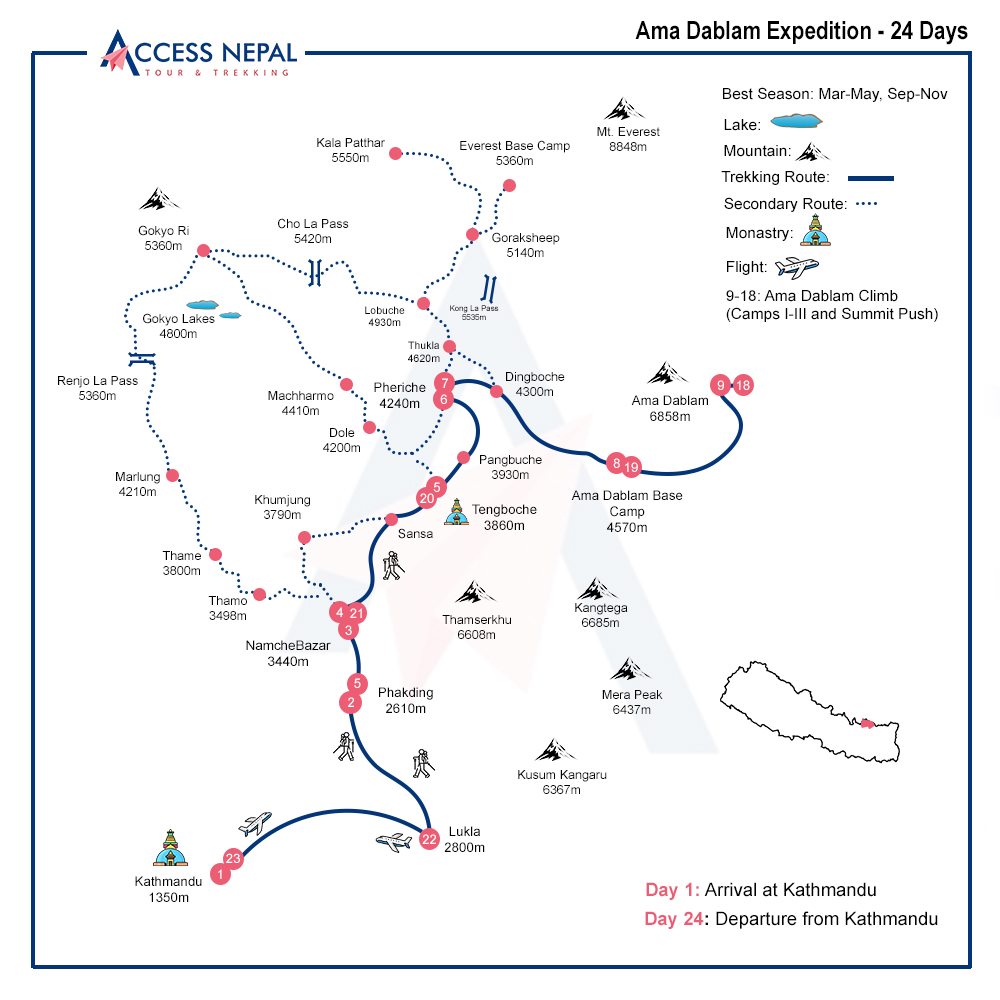
The Ama Dablam expedition starts from Kathmandu. After flying for 35 minutes in a thrilling flight, we arrive at Lukla (2,860). The route climbs into the heart of the Khumbu valley parallel to the turquoise Dudh Koshi River. Hiking continues through pine forests and suspension bridges decorated with prayer flags until reaching Phakding (2,610m).
On day 3 of the Ama Dablam climbing routes, we arrive at Namche Bazaar (3,440 m), a popular Sherpa village. Enjoying the surrounding mountain views and breathing cool, crisp mountain air, we rest for another day here as an acclimatization. The bustling Sherpa town, Namche, also has another short hiking route Everest Hotel (3,880m), one of the highest located hotels in the world, for a first glimpse of Everest and Lhotse.
On day 05 of the Ama Dablam Base Camp Trek, it continues toward the Tengboche (3,860 m), another famous Sherpa village known for having the largest monastery in the Everest region. Journey beyond Tengboche is a little tough due to altitude gain and thin air.
Walking over the rocky paths and through alpine meadows, along with the glimpses of the Ama Dablam summit, we arrive at Pangboche (3,930 m). The journey continues to move forward on day 06 until reaching Pheriche (4,240 m). There is no time getting tired because each step you take offers more expansive views of Ama Dablam’s south face. After another acclimatization day in Pheriche, the Ama Dablam Base Camp Trek starts getting more fun from here on.
After 5 to 6 hours of walking, we reach Ama Dablam Base Camp at an elevation of 4,570 m. The journey to the Ama Dablam Base Camp is moderate. Many trekkers who can’t climb the Ama Dablam Peak, trek to the base camp only. Still, prepare for rugged terrain and altitude gain.
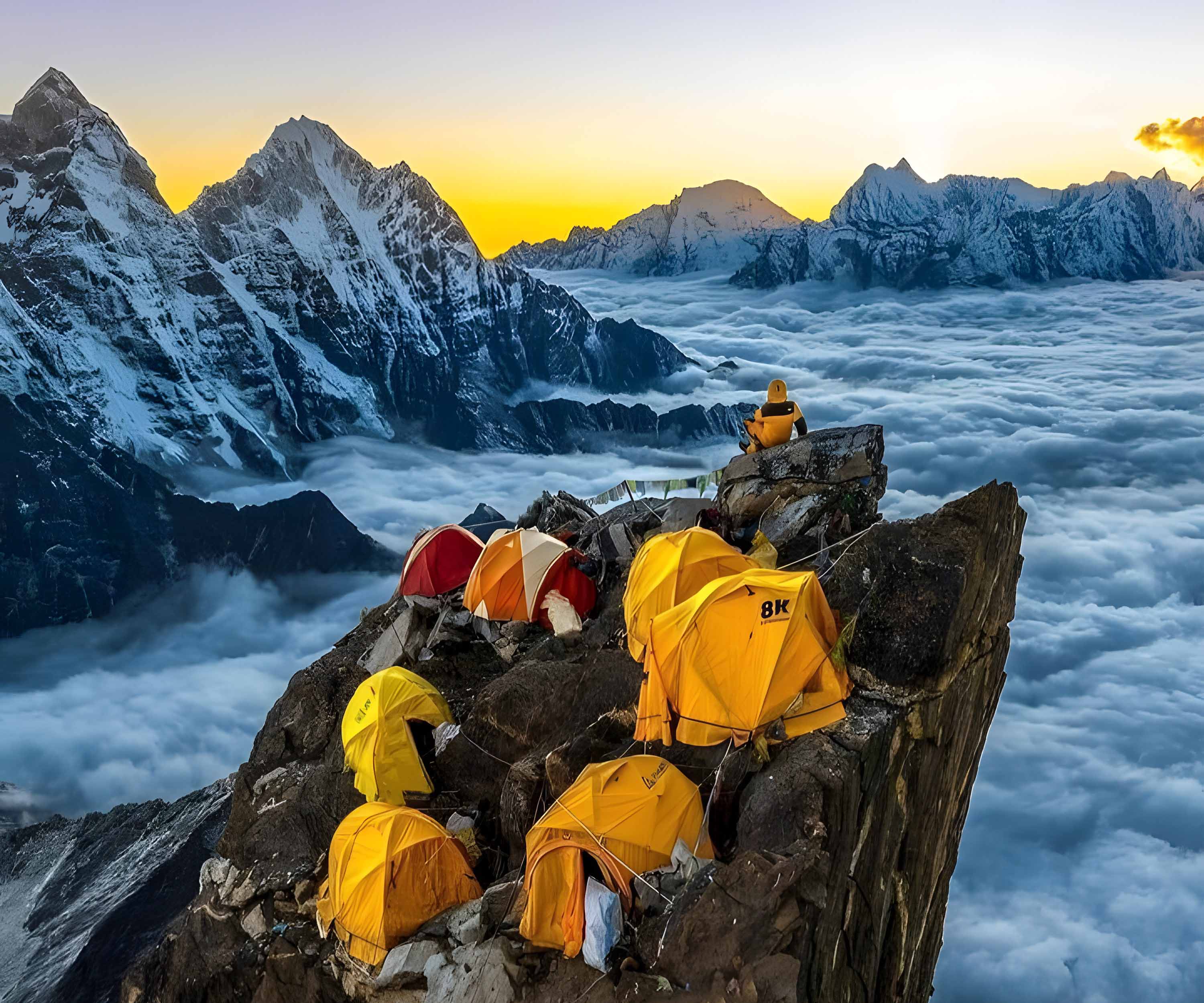
Finally, after a tiresome hike, we arrive at the base camp. The surrounding landscapes at the Ama Dablam Base Camp mostly show barren rocky slopes, pyramidal peaks, and ice-fluted cliffs. It will already be afternoon by then, so we will set up a camp and rest for a night here. Sharing stories with fellow climbers and sipping coffee under the pitch black sky covered with glittering stars is mind-blowing.
The first thing you see when you wake up is a literally breathtaking view of golden Ama Dablam bathing in sunlight. There is more, as just across the valley, you can see Mount Everest (8,848 m) and Nuptse (7,861 m) looming over the sky. Pack warm clothes as nights are especially cold at Base Camp. You can explore the Ama Dablam expedition guide before the real adventure begins.
Ama Dablam Climbing Routes
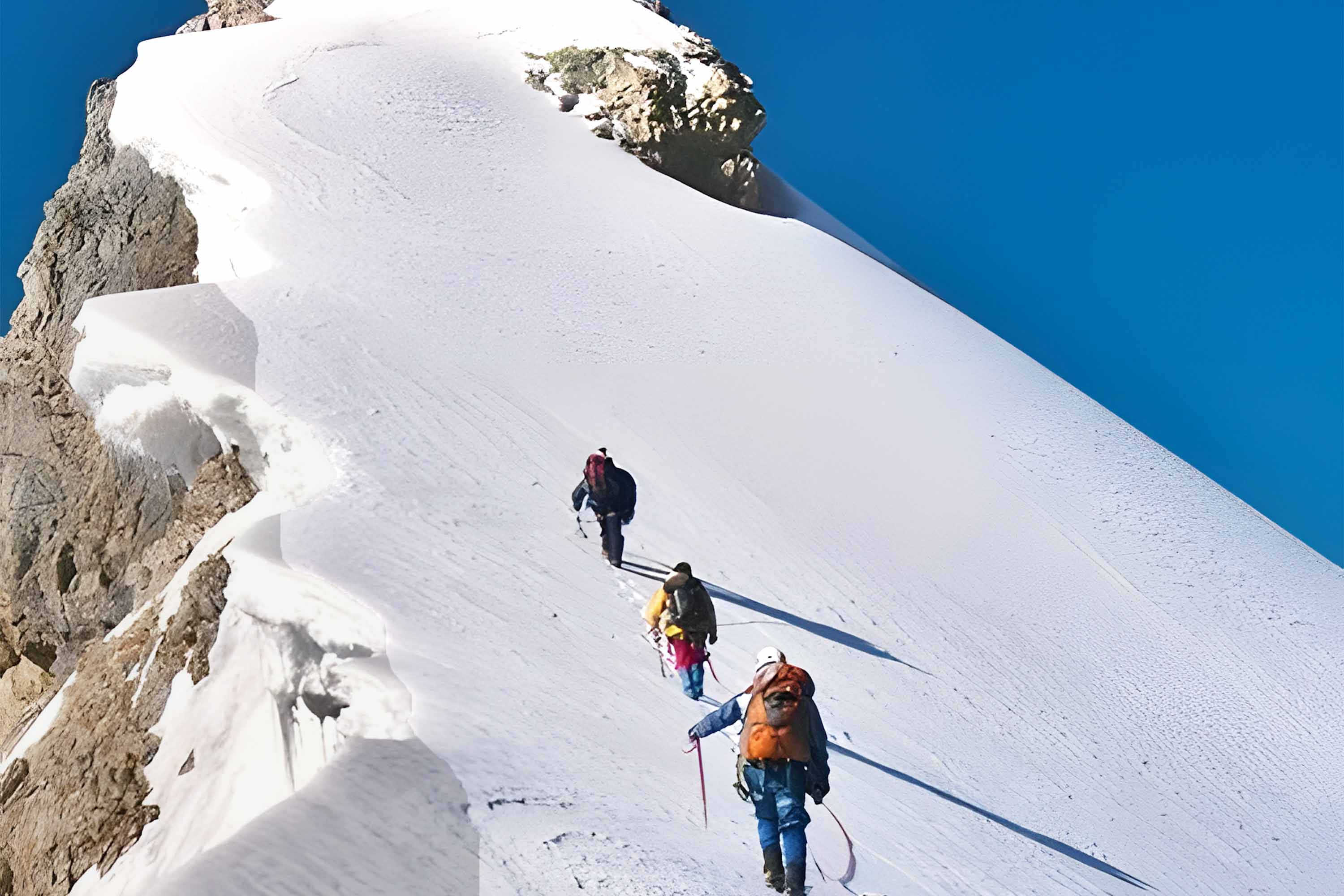
The Ama Dablam climbing expedition officially begins on day 09. We will summit the Ama Dablam following the most commonly taken route on the Southwest Ridge. There are a total of eight routes to reach the summit, varying in difficulty.
Our standard choice is the least difficult and dangerous, Southwest Ridge. Because of the technical challenge and the great summit views, this route is very popular among climbers and guides.
Due to more complex routes, other routes like North Ridge, East Ridge, and the Lower route on the South Face are mostly taken by professional climbers. The Southwest Ridge is available for commercial use. Throughout the Ama Dablam Climbing expedition, professional Sherpa guides will closely watch you for your safety. Guides will assist you throughout the climb by fixing ropes and placing.
Climbers ascend on this route under the watch of Sherpa guides and are instructed by them during the climb. The best time to do the Ama Dablam Climb is in Spring and Autumn. Though challenging and technically demanding, with Access Nepal Tours and Trekking’s professional Sherpa guides, it is completely possible.
Day 01Arrive in Kathmandu and Ama Dablam Trek Preparation
-
- 1400m / 4593ft
Day 02Fly to Lukla then Trek to Phakding
-
- 8 km
-
- 2850 m / 9,350 ft
-
- 35 min flight, 4 hrs of trek
-

- 2,610 m/ 8,562 ft
Day 03Trek from Phakding to Namche Bazaar
-
- 10 km
-
- 3,440 m/ 11,286 ft
-
- 5 to 6 hrs of trek
-
- 2,610 m/ 8,562 ft
Day 04Acclimatization Day in Namche Bazaar
-
- 3,880 m/ 12,729 ft
-
- 3 hrs of hike
-
- 3,880 m/ 12,729 ft
Day 05Trek from Namche Bazzar to Tengboche
-
- 12 km
-
- 3,867m / 12,687 ft
-
- 5 to 6 hrs of trek
-
- 3,870 m/ 12,696 ft
Day 06Trek from Tengboche to Pheriche
-
- 9 km
-
- 4,371 m / 14,340 ft
-
- 5 to 6 hrs of trek
-
- 4,371 m / 14,340 ft
Day 07Acclimatization Day in Pheriche
-
- 5 km
-
- 4,371 m / 14,340 ft
-
- 2 to 3 hrs of hike
-
- 4,371 m / 14,340 ft
Day 08Trek from Pheriche to Ama Dablam Base Camp
-
- 5 km
-
- 4,570 m / 14,993 ft
-
- 5 to 6 hrs of trek
-
- 4,570 m / 14,993 ft
Day 09 - 18Ama Dablam Climb (Camps I-III and Summit Push)
-
- 6,812 m / 22,349 ft
Day 19Ama Dablam Base Camp: Rest and Pack Up
-
- 4,570 m / 14,993 ft
-

- 4,570 m / 14,993 ft
Day 20Trek from Base Camp to Tengboche
-
- 7 km
-
- 4,570 m / 14,993 ft
-
- 3 to 4 hrs of trek
-
- 3,870 m / 12,696 ft
Day 21Trek from Tengboche to Namche Bazaar
-
- 9 km
-
- 3,870 m / 12,696 ft
-
- 5 to 6 hrs of trek
-
- 3,440 m / 11,286 ft
Day 22Trek from Namche Bazaar to Lukla
-
- 19 km
-
- 3,440 m / 11,286 ft
-
- 6 to 8 hrs of trek
-
- 2,840 m / 9,318 ft
Day 23Fly from Lukla to Kathmandu
-
- 138 km
-
- 1,400 m / 4,593 ft
-
- 30 min flight
-
- 1,400 m / 4,593 ft
Day 24Departure from Kathmandu
-
- 1400m / 4593ft
- Airport Transfer via private tourist vehicle (pick-up and drop-off).
- 2 Nights (Days 1 & 23) accommodation on a twin-sharing basis at Apsara Boutique Hotel with breakfast (Accommodation upgrade available at extra cost).
- Traditional Nepali-style welcome dinner (Day 1) with culture and performances.
- Domestic flight tickets (Kathmandu → Lukla → Kathmandu) with airport tax and transfer included. (Ramechhap → Lukla → Ramechhap) and transportation (Kathmandu → Ramechhap → Kathmandu) during peak seasons only.
- Standard twin-sharing accommodation for 9 nights during the trek (Accommodation upgrade available at extra cost).
- 11 Nights in the tent/camp during the summit climbing on a sharing basis (Limited accommodation upgrade available at extra cost).
- Hot showers and private toilet bathrooms in Kathmandu.
- Full board meals throughout the Ama Dablam Expedition, seasonal fruits, and 3 cups of tea/coffee.
- Waste Management fee.
- Tents for the climber and guide, kitchen supplies, and gear at high camp.
- Heater, solar panels, and a generator for electricity and charging during camping.
- 1 Highly professional, government-licensed, first-aid trained, English-speaking expedition guide per climber, with fees and insurance covered.
- 1 Porter per trekker with fees and insurance covered (30 KG weight limit) till Base Camp.
- 1 liaison government officer with fees covered.
- All the necessary equipment at Base Camp, High Camp, and all the group’s climbing gear.
- Farewell dinner (Day 23) at the finest restaurant in Kathmandu.
- Sufficient chlorine tablets to purify water and hot water throughout the camping.
- T-shirt, route map, and duffel bag as a souvenir.
- Sleeping bag and down jackets (must be returned after finishing the expedition).
- Adventure certificate.
- Basic first aid kit with oximeter.
- Emergency helicopter evacuation (covered by your travel insurance).
- Satellite phone (available to use for $4 per minute).
- Oxygen cylinder for emergencies.
- All required climbing permits and government taxes.
- Tourist visa.
- Meals in Kathmandu (Welcome and Farewell dinner included).
- Costs for Travel insurance, porters, extra luggage, internet, charging, and personal expenses.
- Tips for guides and other staff.
- Additional trips or days in Nepal.
Our groups are small with maximum 14 people. We create groups of independent travelers, friends and families which maintains close interpersonal connection, engage more and get into depth of the journey. Choose a date from the calendar to reserve your spot.
Ama Dablam Expedition: Arrival & Preparation
Once you land in Tribhuvan International Airport, Kathmandu, an Access Nepal Tours and Trekking representative will be there to pick you up. We transfer you to your hotel via private tourist vehicle.
After check-in, we meet for a pre-trek briefing on the Ama Dablam expedition. On this day, we check the climbing gear and finalize paperwork. If you choose to have extra days in Kathmandu, it will be postponed to day 2.
During the pre-trek meeting, we will mark the checklist of required items like gear, equipment, passport, insurance, permits, etc. We will also go through the route, itinerary details, and safety procedures.
In the evening, we will have a welcome dinner at a traditional Nepali hotel along with some cultural performances. During that time, you can introduce and exchange greetings with fellow climbers.
Ama Dablam Expedition Accommodation
Accommodation during the Ama Dablam itinerary is all-inclusive in the trip. Lodging services vary in Kathmandu and during the trek.
During the stay in Kathmandu, the rooms are comfortable and standard (often 3-star) on a twin-sharing basis with an attached toilet and bathroom.
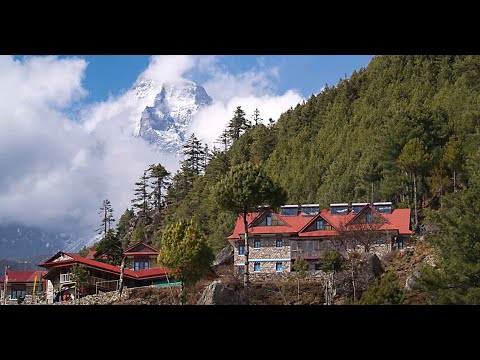
The accommodation during the trek is in simple teahouses with basic services. The rooms are mostly on a twin-sharing basis or in dorm rooms. Bathrooms are available on a shared basis, which are usually squat toilets. As you climb higher from Namche Bazaar, teahouses get simpler.
Sleeping Arrangements During the Ama Dablam Summit
After reaching the Ama Dablam Base Camp, sleeping arrangements completely change from hotel rooms to tents. We will sleep in tents as there are teahouses and settlements in the mountains.
During the climbing journey from the Ama Dablam Base Camp (4,600 m) to Camp I, II, and III, you will sleep in expedition tents. These tents have features to handle extreme weather conditions like rain, winds, and snow, and are water-resistant. Sleeping bags are provided for free if requested.
Those who prefer more comfort and luxury accommodation are availabe to upgrade with an additional cost. Likewise, during the expedition private single tent can also be arranged with added fee.
Meals during the Ama Dablam Expedition
The food during the Ama Dablam Expedition is all included. The package includes breakfast in Kathmandu and full board meals (breakfast, lunch, dinner) throughout the journey. During the trek, it also includes 3 times coffee/tea and seasonal fruits.
The meals provided during the trek are organic, nutritious, and locally sourced. It gives you enough nutrition for the energy needed during the trek. The staple dish during the trek is Dal Bhat Tarkari. Varieties of food options are available mostly at lower altitudes. They include: Mo: Mo, noodles, thukpa, oatmeal, eggs, pasta, soups, and many more.
During the summit, fresh hot meals are cooked at camp by our staff as teahouses are not available at high camp. For drinking water, we provide sufficient purification tablets to purify the water.
Why Ama Dablam?
If you are into adventure, then Ama Dablam Mount climbing is the one. Also known as the “Matterhorn of Asia,” the climbing and expedition to Ama Dablam is most sought by climbing lovers. Its name is derived from the “Ama” (mother) and “Dablam” (a pendant worn by Sherpa women).
During the expedition to Ama Dablam, you can see one of the best jaw-dropping mountain views. From the top of the summit, you can see the panoramic views of Everest (8,848 m), Lhotse (8,516 m), and surrounding peaks.
Due to the technical demand, the climb to this mountain is mostly done by experienced climbers. Reaching an altitude of 6,812 m is not an easy task. Thanks to that challenge, climbing Ama Dablam Mountain has become one of Nepal’s most popular expedition peaks.
Another interesting fact is that Ama Dablam is the third most popular mountain peak in the Himalayas. If you are looking for a journey that challenges you and your skills, do not hesitate.
Book the Ama Dablam Expedition
If you want to taste the thrill of climbing a peak, Book the Ama Dablam Expedition with Access Nepal Tours and Trekking. Our booking process is simple. To book the Ama Dablam expedition package, go through our official website and select the Ama Dablam Expedition from the menu bar.
Once the package opens, on the top right side, you can see a green “Book this Trip” button.
Click there and fill in all the required details. Once done, you will be contacted by the company via email or WhatsApp for more details.
To reserve the spot, you have to pay 30% as an advance. Other remaining amount must be paid after your arrival in Kathmandu via cash or online.
Once booked, we will take care of everything. Your only focus is to train your body for the expedition. The best time to book the Ama Dablam Expedition is in the spring (Apr–May) season. Try to book two or three months prior for convenience.
or
You can just click Book Ama Dablam Expedition if you want to book the Ama Dablam package.
Who can join the Ama Dablam Expedition?
Can a beginner climb Ama Dablam? No, Only Experienced and professional mount climbers can join the Ama Dablam Expedition. This climbing trip is not recommended for a novice. To complete this adventure, climbers have to be in great shape, excellent level of physical fitness, have prior mount climbing experience, and have technical skills. This adventure is not suited for beginners with climbing skills.
To do this trek, you must know how to trek on steep terrain with fixed ropes and exposed sections. Climbers need to be comfortable using climbing gear and equipment like crampons, ice axes, and ascenders. This expedition is rated as 5.7 rock difficulty. The journey is tough and involves climbing on steep rock and ice. So, you have to be mentally and physically prepared.
To put it, it’s mandatory to have a Himalayan or high-altitude climbing experience. If you have previous climbing experience above 6,000 m altitude.
For the best experience, we recommend that you start training 2 or 3 months ahead. Doing exercises like cardio, endurance training, aerobic training, and strength training is helpful.
The age limit for the Ama Dablam climbing is between 18 to 65 years old. However, it can vary depending on the physical fitness and experience of the climbers. The key to success is rigorous training and acclimatization during the trek.
How the Ama Dablam Expedition Itinerary is Prepared?
Keep the climber safety in the first place, the Ama Dablam Expedition itinerary is designed by our professional and experienced guides. The package itinerary simply goes by the trek to Base Camp and is followed by a multi-week climbing. The itinerary includes extra days and acclimatization.
After reaching the Base Camp (4,600 m), the itinerary includes several days for acclimatizing and practicing rope skills. It follows the rotation like: climb to Camp I (5,700 m) for one night, then return to Base Camp to rest. This rule is key to preventing altitude sickness. It gives your body enough time to adapt to altitude and balance the oxygen level of the body.
When creating an itinerary, we have given a big priority to rest days, like at Namche and Base Camp. Summit climbing is done in rotation for acclimatization. The summit push is also done after monitoring the weather conditions.
Therefore, no need to worry about safety. Our veteran climbers will guide you throughout the expedition. The total days are not fixed because they heavily rely on the climber’s conditions and team readiness. Depending on the group fitness and weather, extra days will be added or removed by guides without compromising your safety.
The Ama Dablam Expedition itinerary is flexible. It doesn’t ahve day-to-day itinerary during the summit push because it will be easily influenced by the weather and physical conditions of climbers. For safety, climbing to the summit is done in a rotations. During the rest days at base camp, guides will teach you to use gears, climbers will practice, and acclimatization before climbing.
Can a Beginner Do Ama Dablam Expedition? How Difficult Is Ama Dablam?
No, the Ama Dablam Expedition is not recommended for beginners. The expedition is technically demanding and challenging. The highest point of this trek is 6,812 metres (22,349 ft), the peak of Ama Dablam. It has a high risk of getting altitude sickness.
Besides the risk of altitude, steep rocky steps, snow, and icy slopes terrain adds more physical challenge. To reach the top, climbers have to use fixed ropes. The route we are taking is Southwest Ridge, which is regarded as “HVS” (Hard Very Severe). Another dangerous part is exposed with steep drop-offs. Especially in the upper mountain, regular hiking is impossible.
From the difficulty point of view and skill requirement, this expedition is out of reach for beginners. Prior climbing experience on alpine rock is needed because you have to be comfortable using crampons, ice axes, and ascenders/descenders.
On an average day, you have to walk for 8 hours in strenuous terrain carrying a heavy backpack (10 to 15 kg) up to 6,000+ m altitude. It is best to do this trek after doing beginner-friendly climbs. If you have solid mountaineering training, then you can join.
Travel Insurance
Travel insurance is mandatory to climb Ama Dablam Mountain. Due to the high-risk nature of the adventure, insurance is a must for every climber. Similarly, your insurance must cover high-altitude mountain and rock climbing. The general insurance doesn’t cover these things. Therefore, be sure to buy after carefully reviewing their coverage policy.
Requirements for the insurance to do the Ama Dablam Climbing are given below:
- Must cover the high-altitude mountaineering and adventure.
- Rescue coverage for above 7,000 m and medical problems.
- Emergency helicopter evacuation above 7,000 m.
For more details regarding the travel insurance, click [Nepal Travel Insurance].
How High is Ama Dablam?
The elevation of Ama Dablam is its summit at 6,812 meters (22,349 feet). Though this peak falls below 8,000 m, it is still very high and demands expedition-style climbing. It has two other peaks, but the main summit is the most popular one for climbing.
Similarly, this altitude means you are entering the “death zone.” It has a high risk of getting altitude sickness as the oxygen level is critically low near the summit push.
Ama Dablam Expedition Route Map
This Ama Dablam Expedition package follows the Southwest Ridge route. Till Ama Dablam Base Camp (4,600 m), you will trek through the classic Everest Base Camp route: Lukla → Namche Bazaar → Tengboche → Ama Dablam Base Camp.
After reaching the base camp, it climbs the southwest spur of the mountain. Resting along the Camp I and II, the summit is made. Till the base camp route requires only hiking. Afterwards, you have to use fixed ropes and other climbing gear.
- Ama Dablam Base Camp (4,600 m): It’s a rocky moraine where climbers stay for acclimatization. Tents/camp are set here, including the Kitchen.
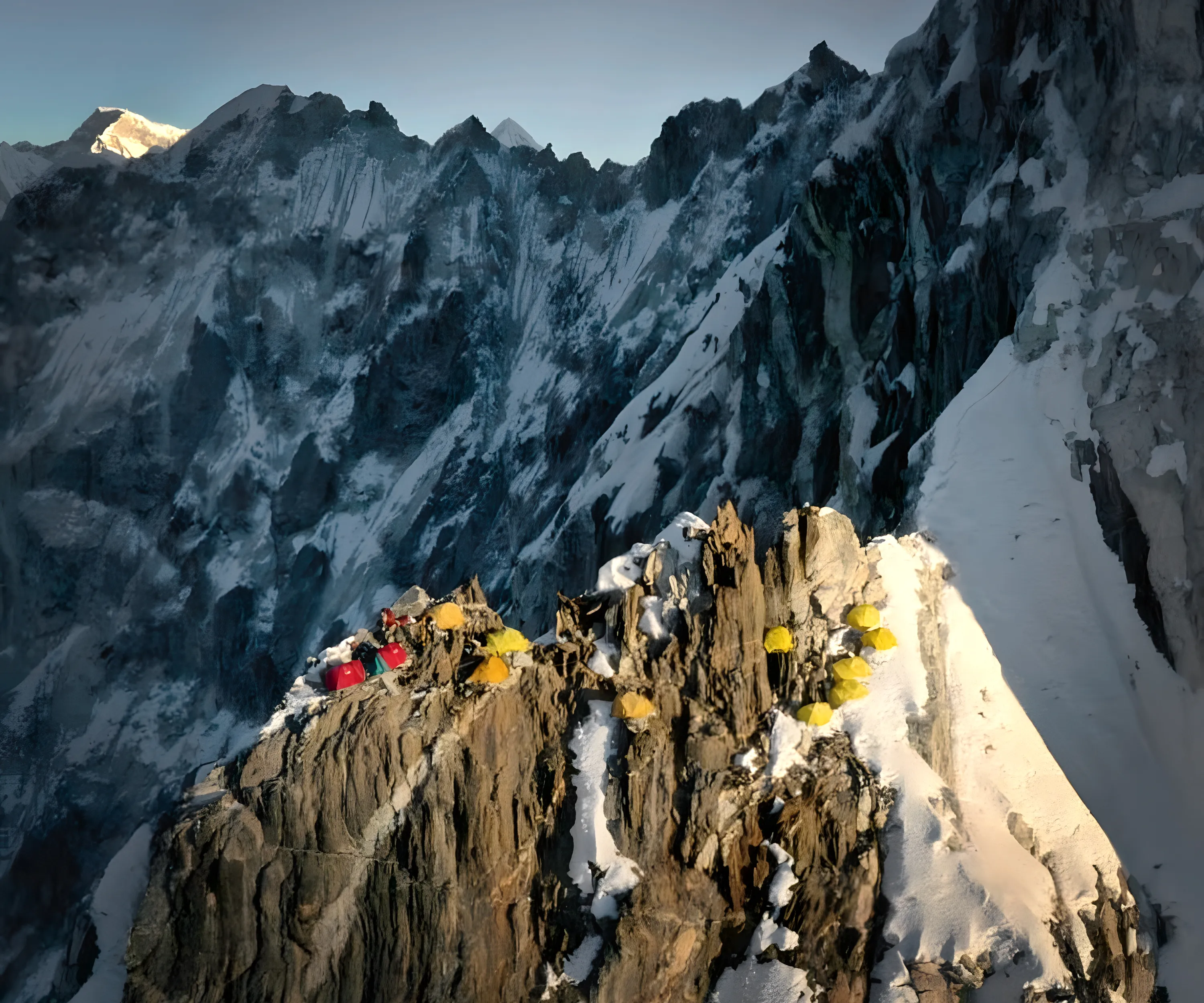
- Camp I (5,700 m): It is on the crest of the Southwest Ridge after a steep snow slope. Only 4 to 5 tent platforms are there, but most climbers return back at base camp to sleep.
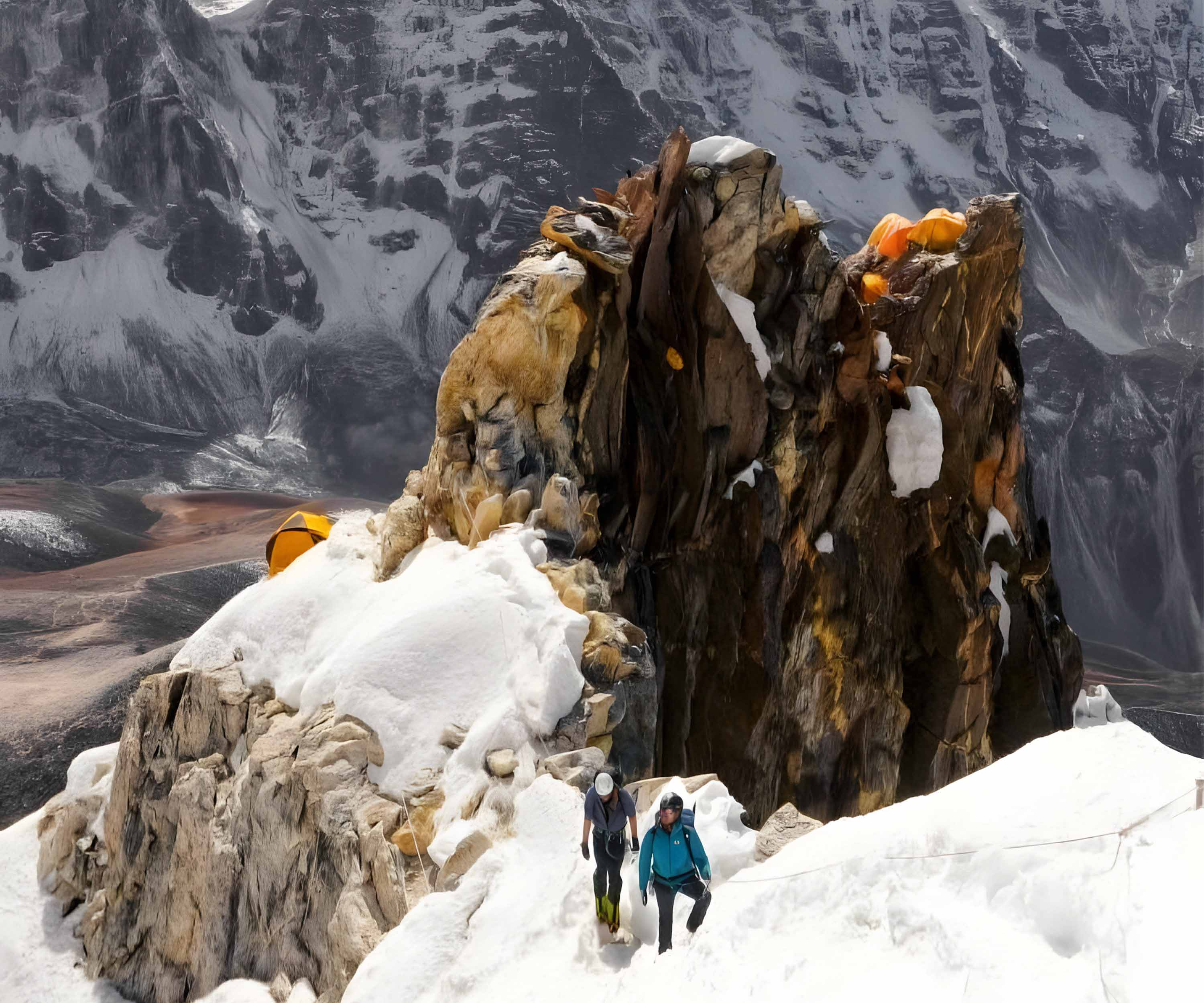
- Camp II (6,000 m): It is on the ridge just above a rock outcrop called the Yellow Tower. Due to the limited space, climbers directly go to Camp III and return to base camp to rest.
- Camp III (6,300 m): It is on a small snowy saddle just below the hanging Dablam glacier. Climbers rarely set up the tent here because of the high danger.
- Summit (6,812 m): The route starts getting more dangerous. You have to climb through steep ice and snow, glaciers, traverses, and to the summit. The summit climb is mostly done at midnight, around 2 am, and reach the top by morning to watch the sunrise.
Weight Limit of Luggage
Weight limits are strict since it’s an expedition. During the flight from Lukla to Kathmandu, travelers are allowed 15 kg per person. This includes 10 kg of checked baggage and 5 kg of hand carry.
If the weight exceeds 15 kg, you have to pay an extra amount of $10 per extra kg. Therefore, we suggest you pack your duffel bag and backpack smartly.
Similarly, during the trek, Porters will carry your large duffel bags up to 40 kg. Porters are included in the package. It covers your duffel bag of gear, which will be carried from Lukla to Base Camp. However, if the baggage carried by the Porters exceeds 40kg, you have to pay an additional amount.
In your ahnd carry, pack your documents, camera, meds, etc. In your check-in bagage carry clothing and some personal items. We provide duffel bag as complimentry which will be carried by porters.
Facilities and Essentials during the Ama Dablam Expedition
The Access Nepal Tours and Trekking works best to provide comfort and safety throughout the journey. The facilities and essentials during the expedition are mentioned below:
- Tents: Accommodations are provided in a tent at base camp. It also includes a mess (shared kitchen) tent and shared toilet tents at Base Camp. These are movable and handled by the team leaders. Sleeping tents come in expedition-style 2-man or 3-man on raised platforms. They are waterproof, and thick foam mattresses are included.
- Dining and Cooking: A cook is provided during the stay at Base Camp, and all necessary Kitchen items are also included. They will prepare meals during the climbing journey. Full board meals, along with tea/coffee, are included.
- Water: Using a purification tablet, drinking water is taken from melting snow. We provide sufficient tables for free. Do not drink water without purifying it.
- Electricity/Charging: There is no electricity available beyond the base camp. Charging headlamps, cameras, and a portable generator is available in the evenings at Base Camp. Till Tengboche, electricity is available but limited. For charging, you may be required to pay some amount. Electricity is not reliable at high altitude; the best option is to bring your own power bank and rechargeable batteries.
- Toilet Facilities: At high camps, shared tents and toilets are available. These portable toilet comes in a bucket-style. Please bring your own toiletries such as toilet paper, soap, and hand sanitizer. From Lukla to Namche Bazaar, toilets are shared, while in Kathmandu, they are private.
- Safety Equipment: A First aid kit is included in the package, which the guide will carry. Emergency oxygen cylinders are available at extra cost. Our team will also arrange the emergency helicopter evacuation, which will be covered by your insurance.
- Communications: Guides carry a satellite phone or a walkie-talkie for communication or emergencies.
- Other: Weather forecasts are monitored by guides at Base Camp. During the briefing, we will provide a route map.
Best Time for Ama Dablam Expeditions
The best seasons for the Ama Dablam Expedition are spring (March to May) and autumn (September to November). These months are the peak season for expeditions and climbing in Nepal. The stable weather conditions and warm temperatures make it an ideal time. Spring and Autumn have the highest summit success rates. It also has less risk.
- During the spring season, skies get clear, offering great visibility along with trekking-friendly temperatures during the day. Most of all, the trails get colorful with rhododendron flowers. The sweet scent of flowers and breathtaking surrounding views is unforgettable.
- During Autumn, the air gets crisp and has clear visibility. Starting right after the monsoon, the rains clear dust from the air.
By contrast, it is best to avoid the monsoon (June to August) and winter (December to February) for climbing. Trekking to Base Camp is possible throughout the year, but climbing is very dangerous.
- During monsoon time, you can expect heavy rainfall, cloudy weather, and slippery/ muddy trails. Due to the bad weather, it increases the risk of the flight from Kathmandu to Luka getting cancelled increases.
- During winter, temperatures at high altitude are extremely cold and frigid. It has brought heavy snowfall and creates the risk of avalanche hazards.
For a better experience and safety, we suggest you book the expedition to Ama Dablam Mountain during spring and autumn.
A Typical Day During the Ama Dablam Expedition
The typical days can be different till Base Camp and after Base Camp. However, they all follow the general routine. The standard typical day starts with breakfast, trekking, resting at lunch, trekking till reaching the destination or teahouse. On an average day, you have to walk between 8 to 12 km.
After arriving at Ama Dablam Base Camp, the routine slightly changes suitable for climbing. The typica during the Ama Dabam Cimbing are:
- Wake up early (3-5 am) and eat hot tea and porridge for breakfast. Prepare the climbing gear by 6-7 am. Packing and double-checking the gears and equipment
- Climb slowly using fixed ropes to the next camp. Along the climb, we take brief rest to drink water or energy snacks and continue. From one base camp to another, it takes between 3 to 5 hours, so we climb accordingly.
- Take a lunch break along the route. It is usually done around midday.
- Reach the destination camp by early afternoon. Enjoy the view, resting in your tent, and have tea/snack.
- Return to base camp in the afternoon to eat (kitchen staff will prepare meals). Drink water, rest, practice training, or go for a short walk.
- Eat dinner by 5 to 7 pm and go to sleep early, so you can wake up early for the next climb. Nights are extremely cold at high elevation.
In between the itinerary, there are extra days for acclimatization, like at Base Camp and Namche. During the rest day, we will take you for a short hike. You can also do exercise, rest, or explore around instead. These rest stops are included to help your body adapt to high altitude.
Drink lots of water and eat all meals throughout the journey. Bring energy bars, snacks, and nuts to eat along the route. Most importantly, avoid smoking and alcohol, especially during the summit preparation.
Access Nepal Tours and Trekking strictly follows the principle of “Climb High, Sleep Low.” This is the key solution to prevent altitude sickness and increase the summit success rate.
Hiking and climbing for multiple hours exhausts your body. Please, prepare yourself mentally and physically.
Guides and Porters during Ama Dablam Expedition
Access Nepal Tours and Trekking Package provides both guides and porters. Guides are professional, experienced, first-aid trained, and government licensed. The insurance of Guides and Porters is also covered in the package.
- Porters: We provide one porter per two people. They are all local people who know the place well. They will carry the equipment and food supplies. The weight limit for the porters is about 40 kg. They will carry your baggage till base camp, as their duty is to support up to Base Camp only.
- Guide: After the base camp, only highly experienced Sherpa climbers will continue with you. They will be accompanying you from Kathmandu. They are here to assist you in climbing, carrying emergency gear, fixing ropes on the route, and guiding you. We provide one guide per 6 people.
- Guide-Client Ratio: New government-imposed rules say only 15 foreign members for an expedition. However, for Ama Dabam 4-8 travelers, plus guides have been practiced. The recommended ratio is up to 3:1. During the stay in Base Camp, climbers have to share a tent with team members due to limited space. Throughout the journey, the guide will closely monitor your physical condition and help you in cimbing fr yur saftey
- Duties: Sherpa guides’ primary responsibilities include leading you, showing the route, safety, and supporting you during the climb. Guides will only carry the group gear provided by the company. Trekkers should carry their personal gear from the base camp to the higher camps themselves. This method helps the journey go smoothly and minimizes the danger.
- Team Roles: Before the trek starts, the guide will brief you each morning on that day’s itinerary. For meals during the climb, all meals are provided at Base Camp. Only the guides will be there during the climb.
Throughout the Ama Dablam Expedition, you are supported by highly professional team members. Your safety during the journey, as well as the logistics, are all taken care of by us. So, you can continue the adventure with peace of mind.
Permits for Ama Dablam Expedition
To climb the Ama Dablam, permits are needed. Access Nepal Tours and Trekking covers all the required permits for this expedition. The permit fees vary depending on which season you are traveling. The Ama Dablam permit fees are $400 USD per person in spring and autumn. During the summer, it is $200. These fees are paid to the Nepal Government, Ministry of Tourism. This fee is paid for permission to climb. Therefore, there are other permits that should be paid.
- Sagarmatha National Park Permit: Ama Dablam is inside the Sagarmatha National Park. Therefore, it requires you to obtain another permit to enter. They cost you around US$30 (winter) or $50 (summer) per person, valid for 10-15 days. It is also included in the package.
- TIMS (Trekkers’ Information Management System) Card: This permit is required to track you during emergencies.
All mentioned permits will be arranged by Access Nepal Tours and Trekking in Kathmandu. If you are going without a travel agency, then expect the budget for climbing permits to be US$400 per person. You can pay using USD or NRS. It’s best to carry cash for a smooth process. These permits are validated by the NMA (Nepal Mountaineering Association) or Dept. of Tourism upon arrival.
What is the meaning of Ama Dablam?
The meaning of Ama Dablam is “mother’s necklace” in the Sherpa language. Ama means “mother,” and Dablam means “traditional pendant worn by women in the Sherpa community.” This mountain was given the name Ama Dablam due to its image, which looks like a woman carrying a child wearing a necklace.
Why is Ama Dablam so famous?
What is the height of Ama Dablam?
Is Ama Dablam harder than Everest?
Is climbing Ama Dablam difficult?
Can a beginner climb Ama Dablam?
What is the hardest part of Ama Dablam?
What is the difficulty rate for Ama Dablam?
How much is it to climb Ama Dablam?
What is included in the Ama Dablam Expedition package cost?
What is not included in the Ama Dablam Expedition package price?
Are guides and porters included in the package cost?
Will the total Ama Dablam package price change after booking?
Are there any discounts available for group bookings?
How much cash should I carry cash during this expedition?
Are permit fees included in the package cost?
How many days to climb Ama Dablam?
What is the success rate of Ama Dablam?
How much does a permit cost to climb Ama Dablam?
Is the ama dablam route safe?
What is the standard climbing route for the Ama Dablam Expedition?
How many camps do we encounter while climbing Ama Dablam?
Is the ama dablam route difficult?
Which is the most dangerous section of the Ama Dablam Expedition?
Amazing holiday trekking the Manaslu circuit with Access Nepal! Amazing holiday trekking the Manaslu Circuit with Access Nepal! This was for us the second time we went trekking in Nepal with Access Nepal, and we are once again 100% satisfied with the amazing service. Sadhana is always available and incredibly kind, we had a long email exchange in order to organize the trek according to our needs. We decided to have a modified itinerary for the trek and Access Nepal has been amazing in accommodating our wishes. Moreover, our guide Giri was incredibly helpful during the trek, making sure we would always get the best rooms on the trek, the best service, and he was always very flexible regarding changing plans depending on our needs or weather forecast. The holiday was super smooth from the moment we step foot in Nepal to the moment we left. Access Nepal has 100% attention to the client needs, has an incredibly helpful and happy staff, we are so happy to be trekking with them and we will do it again. The Manaslu circuit trek is absolutely stunning, it was so much better than we expected, and we are incredibly happy to have witnessed the amazing views the trek has to offer. There`s a road in construction on the trek, and I think if you`re planning on doing this amazing trek you should do it NOW, before the road construction goes too far into the valley. The side treks to Pungyen Gompa and the Tibetan border were highlights of the holiday, if you have time please make sure to add a couple of nights in Samagaon and Samdo to take the side treks, you will love them. Access Nepal and Sadhana are super helpful in customizing your trek, you will not be disappointed. Overall, for the second time top scores to Access Nepal team, we are incredibly pleased with the service, the friendship, the professionalism and the feeling of being in good hands that come with trekking with Access Nepal. We recommend them wholeheartedly!
Moro Norway
Awards and Achievements
Access Nepal Tour and Treks has been recognized with TripAdvisor’s prestigious Travelers’ Choice Award for multiple consecutive years, reflecting our unwavering commitment to quality and clients’ satisfaction.