

A Complete Guide To Tilicho Lake
- Information
- By Sanchita Pokharel
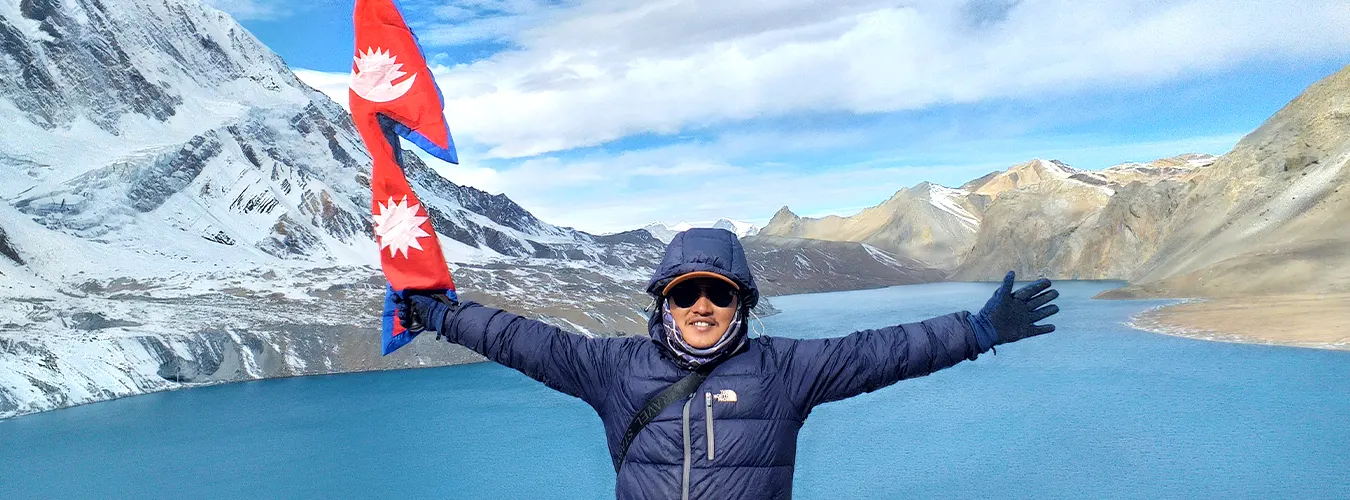
Tilicho Lake is one of the highest located lakes in Nepal. Located in the heart of the Annapurna range of Nepal, this destination is one of must visit among trekking enthusiasts and adventure seekers. The major charm of Tillicho Lake is its shimmering glacial lake just below the giant snow-capped mountains.
Tilicho Lake height is 4,919 m (16,138 ft), making it a must-visit place for thrill lovers. A journey to this Alpine lake is not an easy feat, but it is worth every drop of your blood, sweat, and tears. Travellers from all over the world come to get a taste of this natural beauty. However, just an interest won’t take you there. It requires good and strategic planning.
Therefore, if you are planning to try some adventure, Tilicho Lake is an ideal choice. To make your journey safe, memorable, and adventurous, we have a complete travel guide to Nepal Tilicho Lake.
The beauty of Lake Tillicho shocks you, but it gets more interesting and tasteful because of its emerald-blue waters, religious lore, and challenging trek routes.
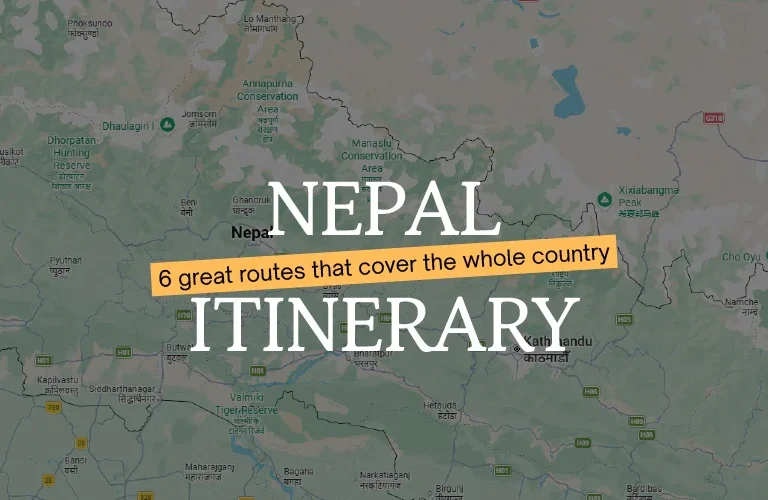
Where is Tilicho Lake? (Tilicho Lake in the Map of Nepal)
Tilicho Lake is located in the Annapurna Conservation Area, Gandaki Province, in north-central Nepal. The popular Himalaya region is known for having the top trekking destination.
Travellers can reach Nepal Tilicho Lake by travelling 54 km north of Pokhara, a beautiful lakeside city. From Kathmandu to Tilicho Lake is about 130 km (81 miles).
In the Map of Nepal, Tilicho Lake is found just off the route of the Annapurna Circuit Trek trail in Manang District. The route of Tilicho Lake circles Thorong La Pass (5,416 m) and passes between Manang and the Mustang (Muktinath) region.
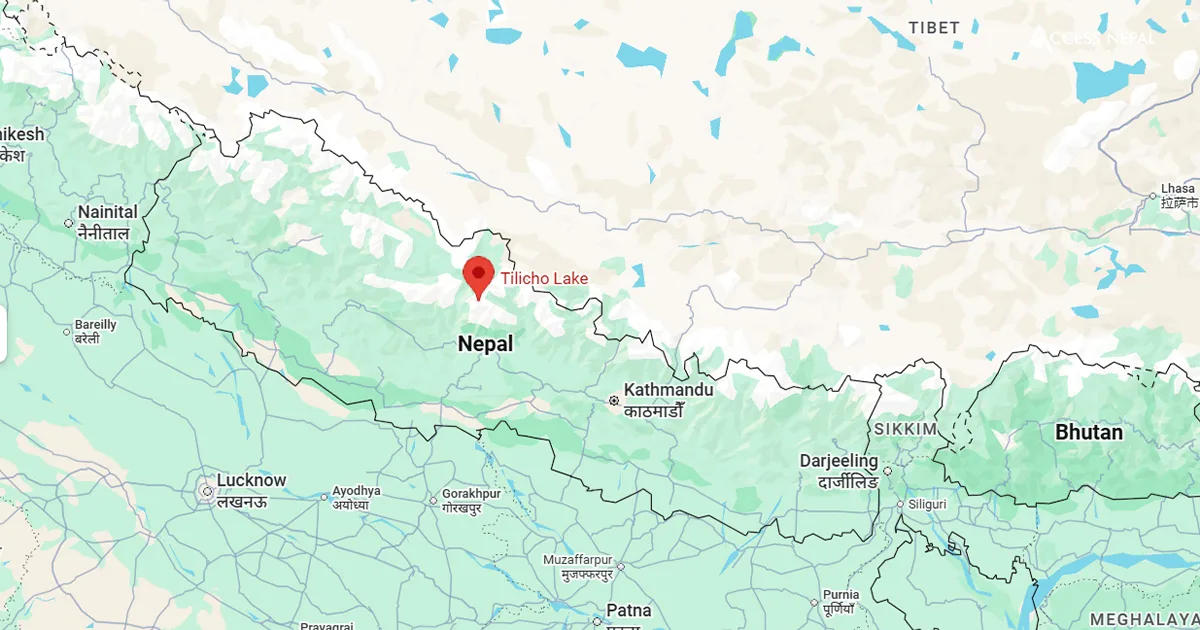
Tilicho Lake in the Map of Nepal
To be more precise and easy to pinpoint, its coordinates are 28.69°N, 83.85°E. Through this, you can easily spot it on GPS or topographic maps. The standard starting point is from Kathmandu or Pokhara, since these cities only has international airport in Nepal.
Trekking officially starts from the villages of Dharapani or Chame, depending on the itinerary you choose. From here it moves toward the north side, passing by Pisang and Manang.
To visit Nepal Tilicho Lake, you will need permits like the ACAP permit and the TIMS card because it is inside the Annapurna Conservation Area. Similarly, it’s a remote location that offers a very new experience. Peaceful environment surrounded by mountains like Tilicho Peak (7,134 m), Nilgiri, Annapurna I, and many more, and in front of you is a deep greenish blue or turquoise color that is out of the world.
Tilicho Lake Altitude
When talking about Tilicho Lake, we can’t help but talk about its height. This alpine lake is very high, and to reach it is very challenging.
Tilicho Lake elevation is 4,919 meters (16,138 ft), making it one of Nepal’s highest lakes. If we compare it to the Everest Base Camp, it’s not very far right. At this altitude, the air is thin, the oxygen level is low, and the temperature is harsh.
Due to the Tilicho Lake elevation, the lake freezes in the winter season and is flanked by glaciers and permanent snow. Seccluded from the outside world, it feels like a winter magical world from the Frozen movie. Reaching here is truly a remarkable feat and worth bragging about. Not only in Nepal, but Tilicho Lake is one of the highest situated lakes in the world.
If you are an alpine lake lover, Kajin Sara Lake (also called Singar Lake). It is located in Manang, at roughly 5,020 m, and is among the highest lakes in Nepal. As of the recent discovery of Kajin Sara, it is second highest lake in Nepal, and it is accessible by trek. Even so, Tilicho still has bragging rights: it’s one of the largest high-altitude lakes and has the longest diameter (about 4 km).
Tilicho Lake Depth
Besides being one of the highest sitted lake, Lake Tilichi is also big in size. The diameter of Tilicho is 4 km in length and 1.2 km across, covering roughly 4.8 square kilometers.
Similarly, Tilicho Lake depth is around 85 meters (279 ft). Yes, it’s deep, deep, and can bury a 20-story building under water! Unlike the polluted city lakes, this lake is fresh and clear. Its classic turquoise color is due to glacial minerals and snow melt.
Fun Fact: There is no fish or large aquatic life because it’s glacially fed. It’s due to the harsh cold temperature and extreme environmental conditions.
Likewise, water volume is enormous; it is said to be more than 41 million gallons (about 156×10^6 liters). This wide lake is surrounded by high peaks, and its shoreline is rocky and barren. You will rarely find any vegetation around the lake area. Many people trek there and stay for a night camping at shore under the starry night. The whole atmosphere is magical at this height and view.
If you visit Tilicho Lake in peak seasons, you can see the reflection of Annapurna I (8,091 m), Dhaulagiri (8,167 m), Thorong Peak, and other giants. It is highly suggested to trek to Lake Tilicho in Nepal and stay for a night. The view of sunrise and sunset turns the lake pink and orange, which is otherworldly. At night, camping by a fire, along with a guitar and sipping warm coffee, is a must-try.
Is Tilicho Lake the Highest Lake in the World?
Honest answer: Almost, but not exactly. Tilicho Lake is one of the highest lakes in the world, not the one. Its height of 4,919 m made it popular for being the highest lake in the world for many years. But after recent discoveries, the crown was taken by Kajin Sara Lake. This lake is located in the remote Nar-Phu region at an altitude of 5,020 m.
Still, Tilicho Lake falls in the top 10 list of the highest lakes in the world. Most of all, debating on which lake is the highest is pointless because, at the end of the day, beauty surpasses the facts.
The accessibility to trekkers makes it even more famous among trekking enthusiasts. Lake Tilicho of Nepal is the true gem and the real wonder.
Fun fact: In 2000, team of Russian divers did a world’s highest-altitude scuba dives.
Tilicho Lake Trek Route and Itinerary
Just say you are interested, and Access Nepal Tours and Trekking is here to guide you to the top of one of the highest lakes in the world. Though moderately challenging with good planning and an itinerary, anybody can reach Nepal Tilicho Lake.
How to reach Tilicho Lake from Pokhara?
Classic Tilicho Lake itinerary starts with a drive or by taking a public bus from Pokhara to Besisahar (about 1,430 m). Besisahar is the starting point of the trek, where trekkers head north into the Marsyangdi Valley. Along the route, trekkers pass through villages like Bhulbhule and Ngadi, paralley walking along the Marsyangdi River.
On day 4 or 5, you reach Chame (2,670 m), a small village and the district headquarters of Manang. From here on, the route gradually climbs to Upper Pisang (3,300 m), and you eventually cross the Marsyangdi to villages like Ngawal and Braga.
After more stops, you finally arrive at Manang (3,540 m). You rest for another day in Manang as an acclimatization. It’s a key stop included in the itinerary because it gives your body enough time to adjust to the altitude and low oxygen level. During a rest day, trekkers go for a short hike to Gangapurna Lake or explore around the Kali Gandaki river (another sacred place).
From Manang, the Tilicho Lake route moves to Khangsar (3,810 m) and moves higher to Tilicho Base Camp (4,150 m). As of now, you can already notice the change in landscapes and temperature. Surrounding here are more barren, sparse settlements, cold temperatures, and high-altitude vegetation.
At Tilicho Base Camp, you rest overnight at one of the teahouses. The following day, carrying only important baggage and gear, the adventure moves forward. Hiking to the lake takes about 6 to 7 hours of round trip. The distance it covers is about 12-14 km from the base camp.
The final push of the lake route incudes steep scree slope. During winter, it also gets covered with a few inches of snow. Finally, after passing through this hurdle, you reach Tilicho Lake’s emerald shores at 4,919 m. Sme stay here for a night camping at the ake shore. It is a popular activity among travelling enthusiasts. Others with limited time jsut enjy few hours at the lake and return to the base camp.
Adventure seekers continue ahead and extend the circuit by continuing trekking on past Manang to Thorong Phedi and cross Thorong La pass (5,416 m) into Muktinath and down to Jomsom. This route is only advised to physically fit and experienced trekkers.
From Jomsom, retracing the same route to Chame and back to Besisahar, they arrive at Pokhara. The standard Tillicho Lake Trek itinerary is 10 to 12 days. Adding the Annapurna Circuit trek stops makes it roughly a 12-16-day journey from Pokhara.
How to go to Tilicho Lake from Kathmandu?
The Kathmandu to Tilicho Lake route is the same as the one from Pokhara. The only difference is that the drive is added from Kathmandu to Besisahar. It takes 5 to 6 hours drive covering a 180 km distance.
From there, take a bus or jeep/car west to Besisahar (1,430 m), the starting point of the trek to Tilicho. You can go to Gongabu Bus Park and take public buses, which cost about NPR 750-800 (about $6-7) for the 9-10 hour trip. Tourist buses (AC buses) cost more (NPR 1,500-2,200).
Most of the trekkers usually take a local jeep on a sharing basis from Besisahar. Jeep tickets can cost you NPR 18,000-25,500 / $180-240. The drive will take you to Dharapani or Chame. Though skipping trek can save time, it is still risky because it increases the risk of getting altitude sickness.
Key Route (via Manang): Kathmandu/Pokhara → Besisahar (1430 m) → Dharapani → Chame (2670 m) → Upper Pisang → Ngawal/Braga → Manang (3540 m, acclimatize) → Khangsar → Tilicho Base Camp (4150 m) → Tilicho Lake (4919 m) → return via Base Camp.
Backpackers can choose bus drive from Kathmandu or Pokhara to Besisahar, because bus fare is cheapest. For those who prefer comfort and have limited time can take flights from Kathmandu to Pokhara. From Besisahar or Chame onwards, the rest of the journey is on foot. Remember that roads only go as far as Chame; beyond that, it’s all trekking.
Tilicho Lake Trek Difficulty
Tilicho Lake is a moderate to difficult level trek. Since this lake is a high-altitude alpine lake, the environment here is different. The trek to Lake Tilicho is accessible for trekking, but requires good preparation. Things like altitude, harsh temperature, remote location, and rough trails make the journey physically demanding.
The adventure to Tilicho is different. You have to walk for 4 to 7 hours per day. The trekking route includes narrow mountain trails, steep uphill climbs, and rugged paths. Continuously walking exhausts your body physically and mentally.
The most difficult section of the Tilicho Lake Trek is the final steep section near the lake. To acclimatize, trekkers include extra nights between 3,000 and 5,000 m and cross the Thorong La (5,416 m) if doing the full circuit.
However, diffuclt doesnt mean impossible. Trekkers with good physical fitness and preparation can complete this adventure successfully. Trekkers are recommended to do cardiovascular exercises like walking, jogging, running, swimming, or cycling 1 or 2 months ahead.
Challenge of altitude is unavoidable, even though Tilicho Lake (4,919 m) is a few hundred meters lower than Thorong La, you’ll still be “in oxygen debt” territory. But attitude risks can be controlled by acclimatization, eating nutritious food, drinking lots of water, and waking on a slow pace.
The Tilicho Lake Trek itinerary mostly has acclimatization days in Manang. If you are going with Access Nepal Tours and Trekking, we follow the Climb High, Sleep Low rules. It’s the key prevention method to reduce altitude sickness. These extra rest days help your body adapt to altitude and low oxygen levels in the air.
Moreover, if you feel any of the altitude sickness symptoms like headache, weakness, dizziness, or nausea, immediately descend or inform your guide. The trek to Lake Tilcho requires persistence. But these hardships are all worth it. The magical landscapes and views gives youa lifetime memory.
Tilicho Lake Landslide Area (Trail Safety)
As we already know, how diffuclt is the journey to Tilicho is, another notorious part is the landslide area on the trail up to Tilicho. This section has a risk of rockfalls and small avalanches after snowfall due to the loose shale and gravel terrains. For safety, a rope or a makeshift fence is built here. In this section, trekkers have to move through it quickly.
Trekkers are not recommended to visit Tilicho Lake during the monsoon and winter seasons. Avoid moving forward if conditions are bad. Otherwise, Tilicho Lake is safe to trek. With guide instruction and preparation, it is completely possible. Hundreds of trekkers complete this adventure every season.
Tilicho Lake in Winter
Tilicho Lake in winter is a feast to the eyes. The frozen lakes surrounded by snow-covered areas and mounatins feels magical. But the challenge is the extreme cold temperature in winter. This glacial lake completely freezes from December through February. The sheet of ice reflecting the mountains like a mirror is so beautiful. The lake and the surrounding environment looks pristine white paradise.
The average temperature at Tilicho in winter during the day is 0°C (32°F) and at night drops to below freezing point. Especially in February, the route to Tilicho accumulates meters of snow, and snowstorms are common.
The best time to visit Tilicho Lake is in spring (March to May) and autumn (September to November).
The landscapes and views feel magical, but trekking becomes more difficult in winter. It creats the challengs like unstable weather, snowstorms, altitude sickness, and route blockage. High passes are mostly closed in the winter season due to snowstorms.
Visiting Tilicho Lake in winter is only suggested for highly experienced trekkers and mountaineers. Trek to Tilicho in winter requires full cold-weather gear (warm layers, crampons, etc.). So, if you are a brave and experienced trekker, trekking experience during December-February offers a magical experience.
The whole Annapurna region is blanketed in snow. Lucky ones can even spot winter animals like Himalayan blue sheep or even (rarely) snow leopards. For photographers, it’s paradise. The whole area’s waterfalls get frozen, ice crystals, and sunrise glows off the ice are just mesmerizing.
Can You Swim in Tilicho Lake?
The question does sound fun (slightly crazy), but no. You can swim in Tilicho Lake, but it’s not recommended. There are no regulations or rules that say you can swim in Tilicho. However, it is still not a great idea to swim in Tilicho.
The lake is located at 4,919 m, and its water is glacially cold year-round. The icy temperature of water can cause shock or hypothermia almost instantly. Moreover, Tilicho’s shoreline is rocky and slippery, and there are no lifeguards!
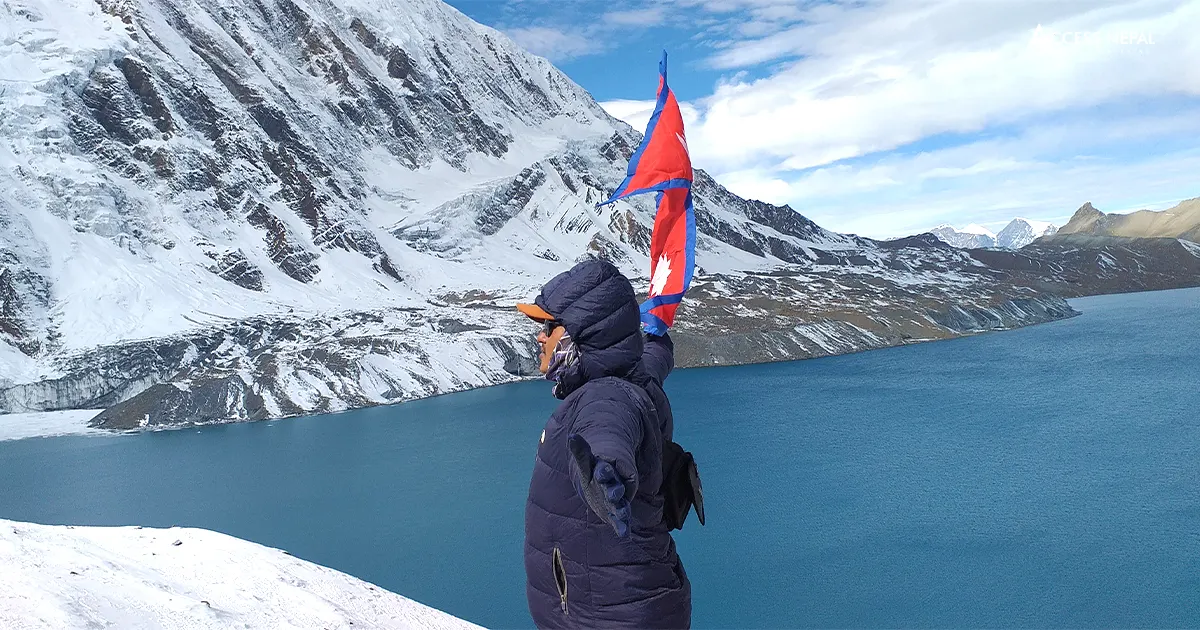
Tilicho lake
Swimming in Tilicho is dangerous due to the low temperature of the water and the unsafe shoreline. Similarly, it also increases the risk of altitude sickness. Trekkers are highly suggested to wear thick winter clothes and avoid getting wet. The turquoise color and clean water look pretty and make you go inside, but it’s basically an ice-cold mountain glacier water in a lake.
Moreover, even if you insist on a dip (not recommended!), you’d quickly regret it. Glacier waters are no joke. Instead of swimming, you can enjoy camping, make some TikTok videos, and drink a warm cup of coffee. It can only be your imagination as well, because at this altitude, you will be worrying about keeping your body warm, not thinking of diving. You can just stand on the shore and maybe wet your face or hands, but swimming laps is a very, very bad idea.
Where to Go from Here?
The journey doesn’t just end in Tilicho Lake. As we said, it region of trekking paradise. From here on, the adventure can continue to other expeditions.
Trekkers looking for more profit mostly continue beyond Tilicho and head toward Thorong La Pass (5,416 m). For the return journey, they circle down to Muktinath Temple (3,800 m), one of the most respected temples in the Hindu religion. From Muktinath, they return to Jomsom.
Advanced trekkers even add the adventure of the remote Nar-Phu valley. It is another classic route of 20-25-day duration. However, if you want just adventure till the lake only, you can simply reverse course after visiting the lake.
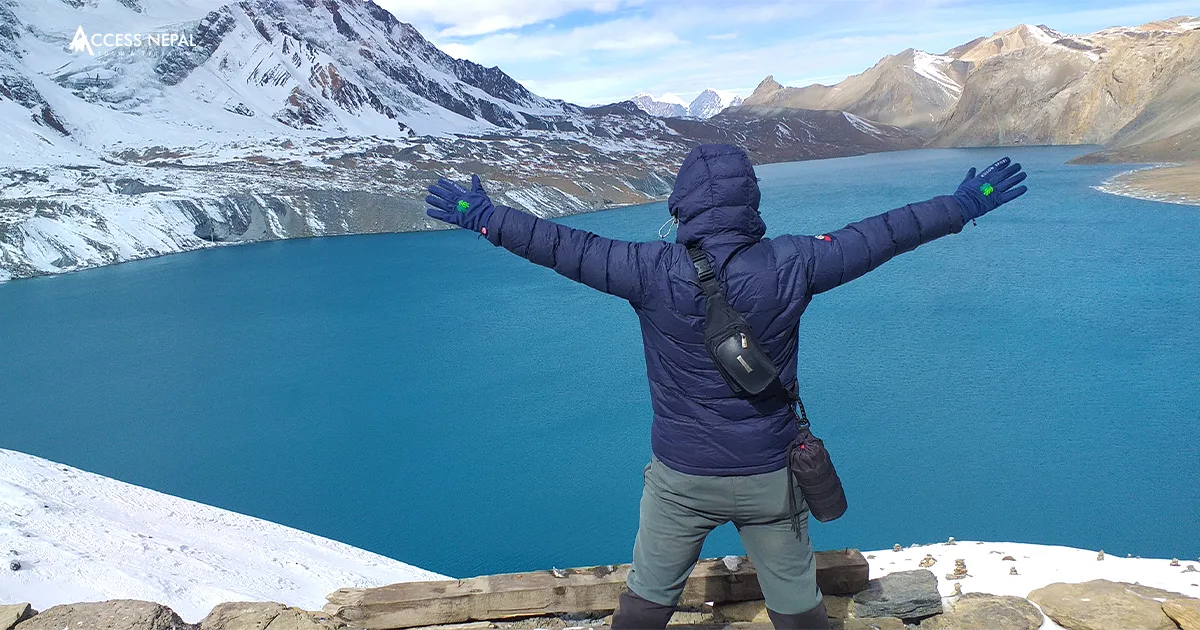
Tilicho Lake in Winter
And we want to be clear with you, regardless of any route you choose journey to Tilicho Lake is breathtaking. It is completely achievable after adding extra days (acclimatization), carrying altitude meds (like Diamox), and good physical fitness. The adventure is physically demanding and exhausting, but all worth it.
Cultural Significance of Tilicho Lake
Besides being known for its beauty, Lake Tilicho is culturally significant. It is a revered lake among Hindus devotees. It is believed this lake is the ancient Kak Bhusundi Lake from the Ramayana epic. A sage named Kak Bhusundi, who took the form of a crow, narrated the Ramayana to Garuda on the shores of this very lake.
Similarly, the Sanskrit name Kak Bhusundi means “crow Bhusundi.” Due to this ancient religious history, Tilicho is a sacred pilgrimage spot among Nepalese and Hindus followers. Pilgrims from all over the place visit to perform puja (religious ritual) on the shore of this lake. Despite the harsh cold, some even dip in the water with the belief of cleansing their sins.
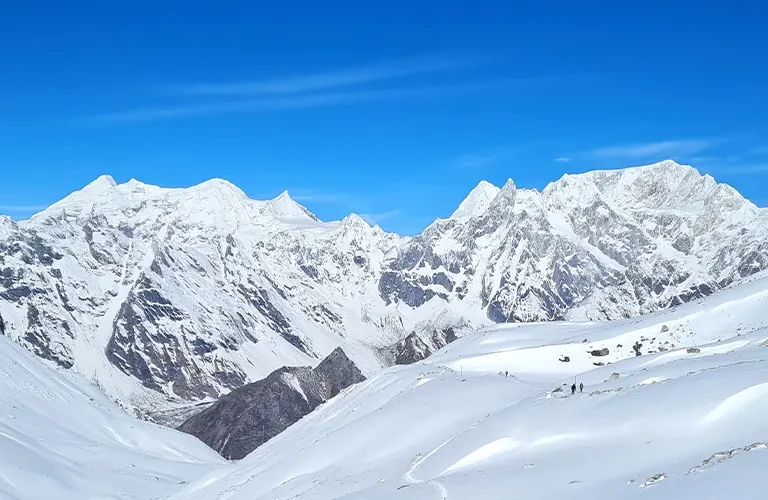
Tilicho Lake
Other than the Hindu, Tibetan Buddhist, and local Tamang/Gurung communities, they also respect Tilicho. Here, you can notice prayer flags and monasteries along the trail. Wheater, its religious significance or not, the beauty of this lake and people’s respect towards it make it more special.
If you love some adventure and mystical beauty, join our Tilicho Lake Trek, and to add more adventure, the Annapurna Circuit Trek with Tilicho Lake.
Tilicho Lake FAQ’s
Is Tilicho the highest lake in the world?
Tilicho Lake is one of the highest lakes in the world. Located at 4,919 m (16,138 ft), it is a popular trekking destination among trekkers all over the world.
Is the Tilicho Lake trek difficult?
Tilicho Lake Trek is moderately difficult. However, it is completely achievable with good preparation, planning, physical fitness, and guidance.
Which month is best to visit Tilicho Lake?
Spring (March to May) and Autumn (September to November) are the best times to visit Tilicho Lake. These seasons are the peak trekking season in Nepal. It offers great visibility and weather conditions.
How to reach Tilicho Lake from Pokhara?
You can reach Tilicho Lake from Pokhara by drive Manang, and trekking up to Tilicho Base Camp, hiking to Tilicho Lake, and returning through the same route.
How much does the Tilicho trek cost for Nepali?
The Trek cost for Nepali is from NRS 35,000 to 40,000 per person. The cost may vary depending on the itinerary, services, and other factors.
Awards and Achievements
Access Nepal Tour and Treks has been recognized with TripAdvisor’s prestigious Travelers’ Choice Award for multiple consecutive years, reflecting our unwavering commitment to quality and clients’ satisfaction.











Leave Your Comment