

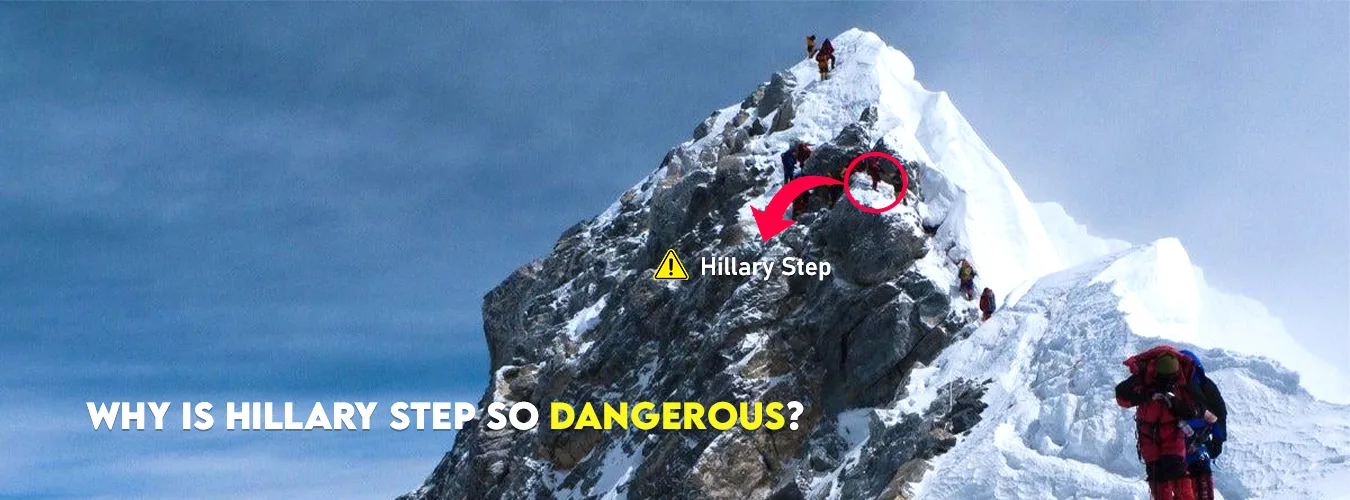
Hillary Step: Why is Hillary Step So Dangerous?
- Places
- By Sanchita Pokharel
Hillary Step, a legendary foot trail embedded near the top of Mt. Everest (8,848 m), the world’s highest peak. It is located on the southeast ridge of Everest. It is a steep vertical 12-meter rock wall just below the summit of Everest. It is the final and one of the hardest sections of the classic South Col route on Everest.
The name Hillary Steps is named after Sir Edmund Hillary as an honour. He was the first person to climb Everest with Tenzing Norgay Sherpa in 1953. Due to its near-vertical rock face at 8,790m (28,839 ft), it is the most demanding section and final challenge of the Everest climbing expedition.
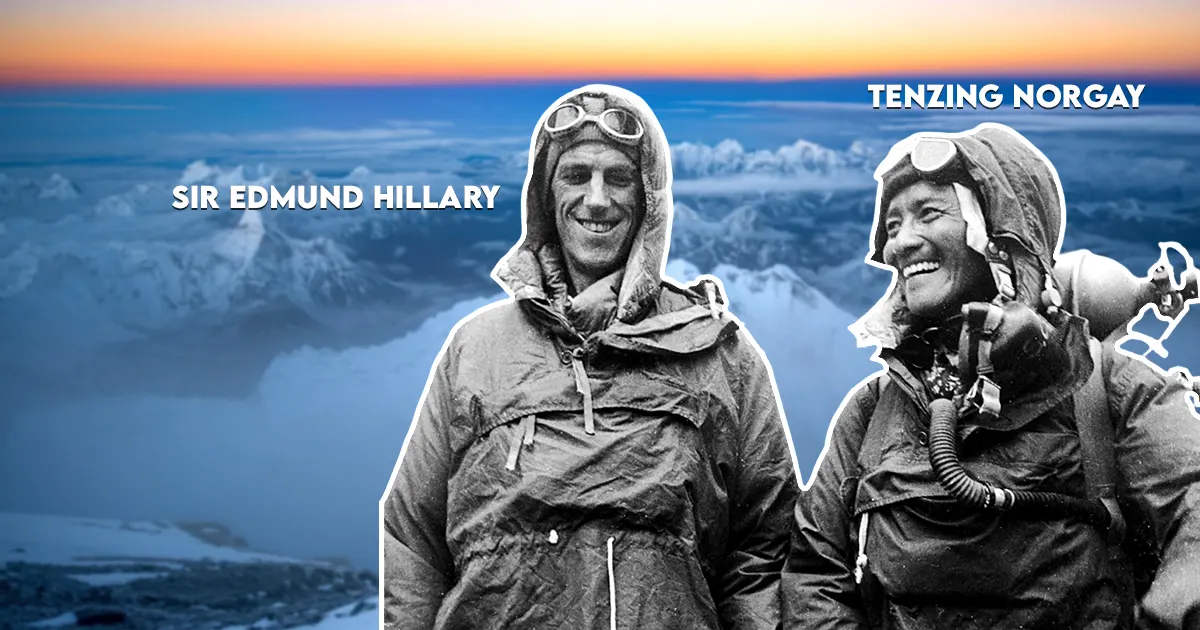
sir edmund hillary and tenzing norgay
Though dangerous, it’s still a dream of thousands of mountaineers. But what is it really like? Why is the Hillary Step so dangerous, and how has it changed over time? This Hillary Step blog will answer all of these questions.
“People do not decide to become extraordinary; they decide to accomplish extraordinary things.”
What is the Hillary Step?
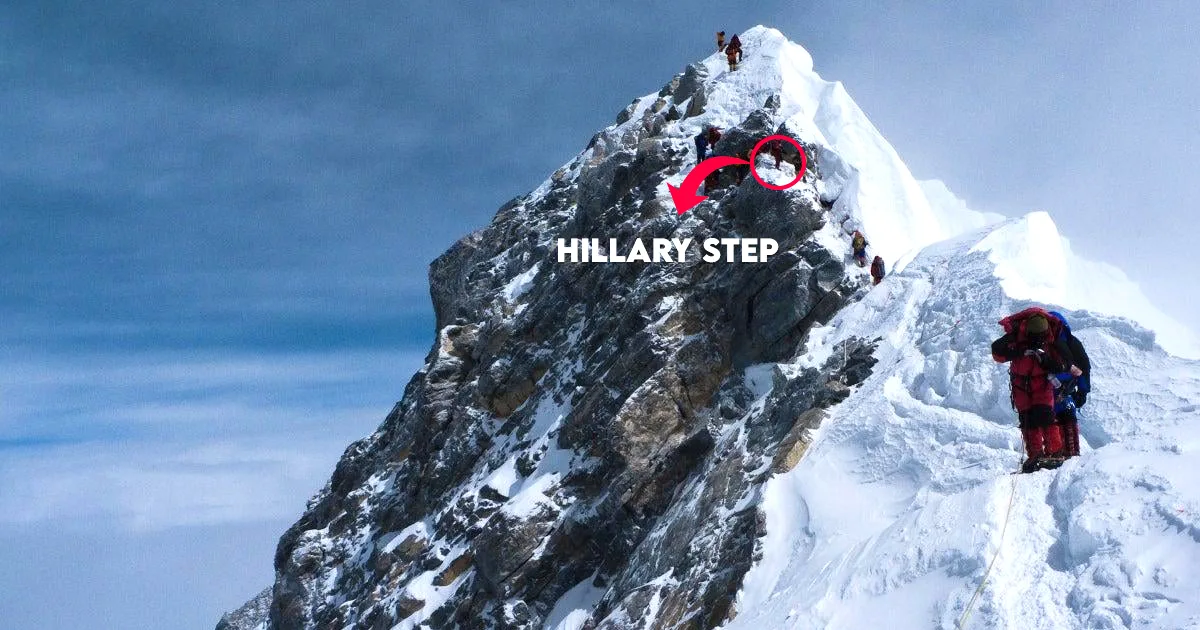
The step on Everest is a famous section of the Southeast Ridge. It is located halfway between the South Summit (8,749m) and the 8,848m summit. This Step is mostly popular due to its technical difficulty and elevation. At 8,790 meters (28,839 feet), a narrow stone 12-meter (39-foot) high wall is the last hurdle climbers have to face before reaching the top of Everest.
The borderline vertical rock, narrow lines, and full exposure of the Hillary Step at 8,790 m height give goosebumps. Remembering the legacy of Sir Edmund, every climbers have climbed through these challenging sections for decades.
To take over this section, trekkers need tens of minutes to an hour. Some climbers need 20-30 minutes or more on the exposed face. Mounatineers climb this section by supporting themselves using fixed ropes placed by Sherpa crews each spring.
Before the 2015 earthquake, it was even more difficult. It used to take one to two hours to climb from bottom to top on summit day. Especially at Class IV section, the technical difficulty was high. Once reaching here, it’s a do-or-die thing. Every second matters in this death zone. One mistake can lead to great tragedy.
Hillary steps map lies at roughly 27°59′9″N 86°55′31″E on the Nepal side, in the remote Khumbu region. Hillary carried up the steps that can’t be seen from Everest Base Camp or Advanced Base Camp. You will padd directy during the final push only. Today, Hillary Step has become a prominent section during the Everest expedition as it’s the final gate to the top.
Origin and History of the Hillary Step of Mount Everest
Coming to the origin and historical significance of Hillary Step, it goes back many decades. The name carries the legacy of the first Everest climber, Sir Edmund Hillary, along with Tenzing Norgay.
Hillary Step is one of the challenging sections during the final push. It was first climbed on May 29, 1953, by Sir Edmund Hillary and Tenzing Norgay. At first, it was a 12-meter-high steep rock wall. They climbed over the Hillary Step with the help of Tenzing. He climbed over the shoulder of Tenzing and pried himself into cracks. It was narrow and could only fit one person at a time. First, Hillary climbed and then gave a hand to Tenzing.
Likewise, in respect, this section is named after Sir Edmund Hillary.
Hillary Step Before and After: The 2015 Earthquake’s Impact
The steep vertical rock of Hillary Step, just below the summit, is popular among mountaineers. It is believed that today’s appearance of Hillary’s step is not the same as in the past. Hillary Step before and after the appearance was changed by the 2015 earthquake.
In 2015, Nepal was hit by a catastrophic 7.8-magnitude earthquake. Many suspected that Hillary’s steps had changed. It was hard to agree at first. Moreover, the Nepalese government and veteran Sherpas initially downplayed the change. Some of the Hillary Step photos created a debate. All of them were confused whether the great rock wall collapsed or only became buried under snow?
Later in 2017, Garrett Madison and Ben Jones, Everest veteran guides, shared fresh Hillary Step photos. In the picture, the giant boulder formerly known as the Hillary Step was gone. The image of Hillary Step before and after shows that there was no rock, and it was replaced by a steep snow slope.
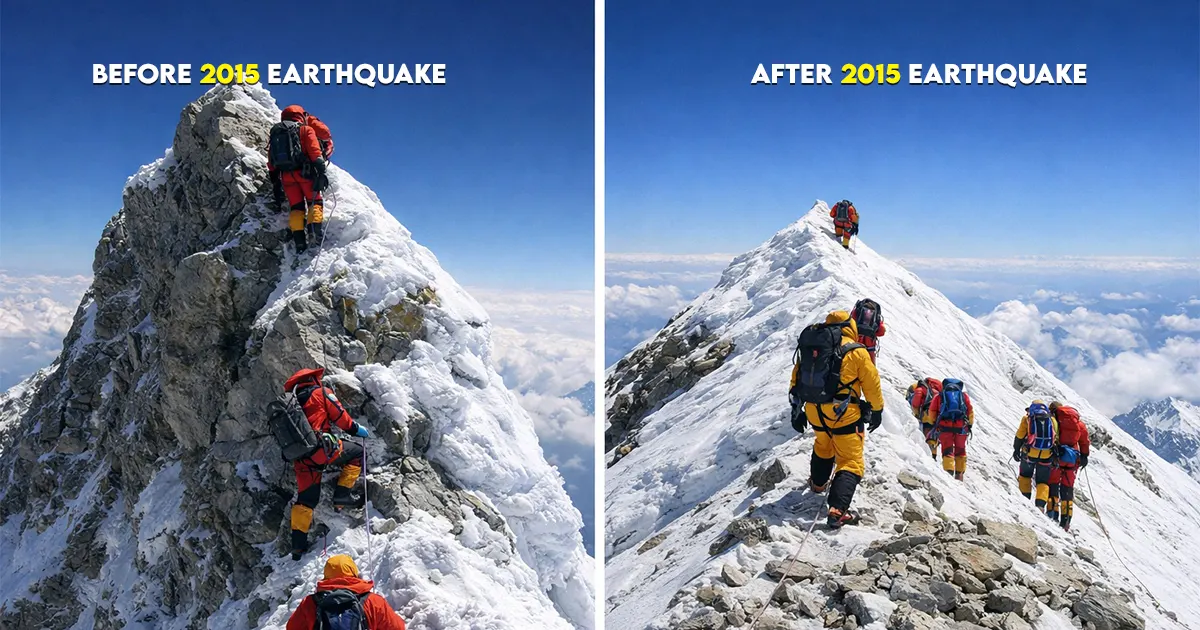
Hillary Step Before and After the 2015 Earthquake
After the 1015 earthquake, Hillary Step has become a little more achievable. Now it is completely covered by snow, which makes it easier to climb. That steep rock wall is still there, except that there are lots more snow on it, so the rock portion is not easily visible.
Hillary Step before was a 40-foot, nearly vertical wall. Afterwards, it got covered by a snow ramp. Now, it has changed into a more achievable slope as the steep rock has turned into a 30-45° snow slope. Achievable doesn’t mean easy; it’s still dangerous due to high altitude. Regardless of the change or not, Hillary Step still carries decades of legacy and challenges.
Why is the Hillary Step So Dangerous?
Elevation plays a big role in making the Hillary Step dangerous. Moreover, it’s near the highest point in the world, so it will be dangerous. Some of the major factors that make it dangerous are given below:
-
Sheer Vertical Drop-Offs:
Hillary Step is not a simple ladder. It’s a giant steep rock standing on a razor-thin ridge with staggering drops on both sides. To the west, the snow and ice plunge some 3,000 meters (nearly 10,000 feet) to the Western Cwm; to the east, about 2,400 meters (7,900 feet) down to the Kangshung face.
2. Death Zone:
Hillary Step height is 8,790 m. It falls in the Death Zone (above 8,000 m), where the oxygen level is just one-third. Spending too much time at this altitude means death. Climbing at this height brings challenges like difficulty in breathing, slow movement, and every physical movement feels hard. At the death zone, a simple walk is exhausting; climbing the steep Hillary Step is devastatingly hard.
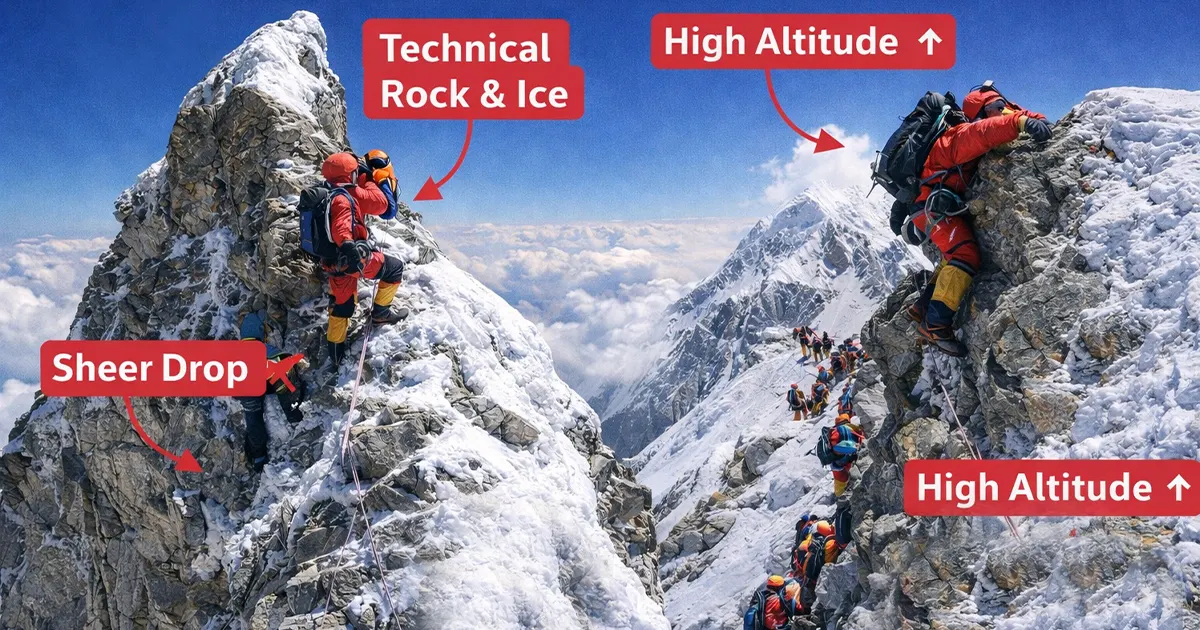
Why is Hillary’s step dangerous?
3. Severe Cold and Wind:
The temperature at the Hillary Step on Everest usually ranges from -20°C down to -35°C (-4°F to -31°F) even in peak summer. Weather are unpredictable and strong winds (over 160 km/h or 100 mph). Besides altitude sickness, other concerns include frostbite and hypothermia. Already hard to climb rock becomes more demanding. In fierce weather and height waiting in line against gusts and sudden storms is a battle for survival.
4. One-at-a-Time Bottleneck:
The path of the Hillary Step is very narrow. Only one climber can climb it at a time. Hillary was helped up the steps at first. This takes time and results in long, dangerous wait queues in the thin air. During peak climbing season, climbers have to sit for long hours waiting for their turn at 8,800m. Every seconds are valuable in the death zone. Risks like exhaustion, altitude sickness, frostbite, and even death are not uncommon.
5. Physical and Mental Exhaustion:
Another major concern is physical and mental exhaustion. To reach there, climbers have to spend many days climbing the Khumbu Icefall, Western Cwm, and Lhotse Face. By the time you reach Hillary Step, your body will already be exhausted. It also has the psychological pressure of almost reaching the peak of Everest. Fatigue and technical difficulties makes hard.
6. Unpredictable Weather Conditions:
At high elevation, the weather are unpredctable. Weather condition changes fast. As the terrain is covered with snow, fresh snow or ice could lead to dangerous or slippery conditions. Climbing just after snowfall is risky due to poor holds. Though there will be fixed lines to support the body, each hold should be probed. As the weather changes quickly, things like boulder shifts or collapsed ice, unstable rocks, or hidden crevasses create danger.
Hillary Steps Difficulty
Hillary’s step difficulty level is challenging. Climbing this steep rock wall requires technical skill. The Hillary Step is rated Class 4 in difficulty. This means it is serious technical climbing on a rope. To climb over the Hillary Steps, one must lift oneself using ice screws, crampons, and every tiny crack or ledge.
When Hillary and Tenzing first attempted, Hillary had to cramponed backwards up the crack under Tenzing’s belay. As of today, climbers have to use rock-climbing techniques, use gear like carabiners, crampons, edging on razor ridges, and fixed ropes. Even with all these equipments, to overcome the Hillary Steps it takes 20 to 40 minutes or more.
Likewise, before the 2015 earthquakes, it used take 10-20 minutes of hard climbing just to get up the 12m wall. Another main issue is the narrow path, which causes traffic during peak seasons. Each mounatineers have to climb hand over hand, kick crampons backward into ice, and inch up, supporting themselves in a fixed rope.
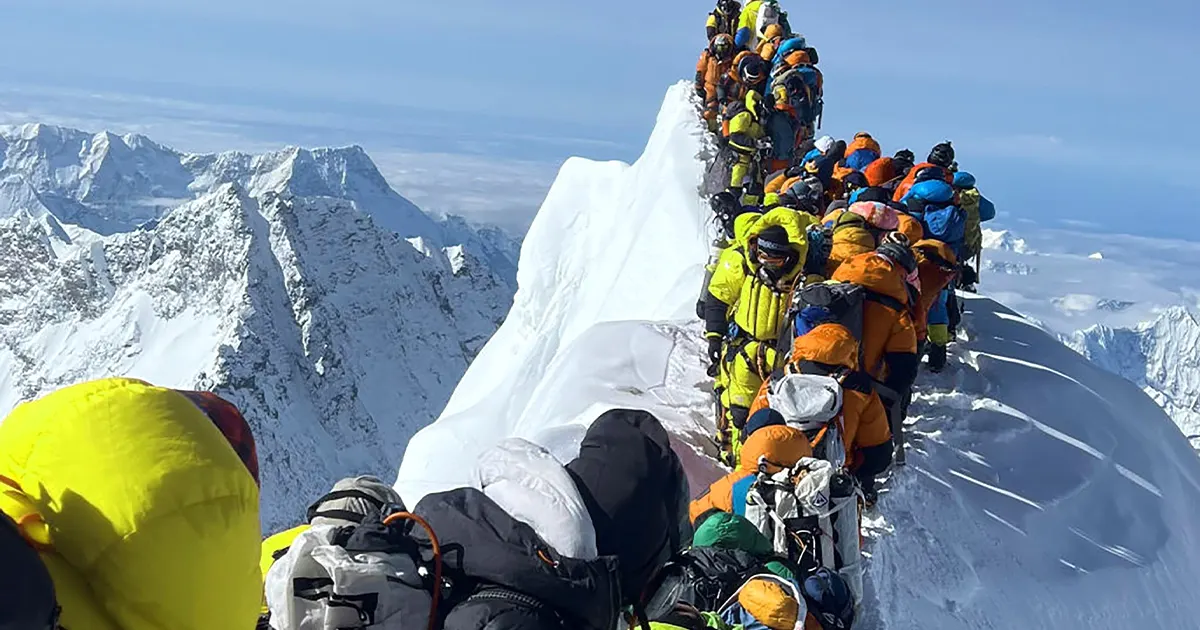
Traffic Jam in Everest
For the safety of climbers, Sherpa supports the team. The fix ropes in advance, so climbers can clip ascenders during the climb. Throughout the journey, Sherpa will closely monitor you. Technique is crucial. Staying close to the rope, feeling for rock holds, and taking it step by step is the only way to success. The fixed rope is a lifeline.
Hillary Step Dead Body
As we already know, how dangerous the Hillary Step is, it can’t be complete without talking about Everest fatalities. Today, step has become a symbol to represent the remains of past climbers.
One of the famous Hillary Step dead body names is Bruce Herrod, a South African photojournalist. His body was found hanging on the rope at the base of the Hillary Step in 1997 by Anatoli Boukreev. He successfully made it to the summit but lost on the way down two weeks after the May 1996 Mount Everest Disaster. Bruce was just 37 years old. His bright yellow clothing became part of the countless “Dead Boots” on Everest.
The latest incident was in May 2024, when two climbers, British mountaineer Daniel Paterson and Nepali guide Pastenji Sherpa, went missing during the return journey. It was reported that they collapsed at the vertical rock of Hillary Step. Rescuers searched for their bodies but could not find them. It is believed their bodies may have fallen on the Tibetan side of Everest. However, rescuing the body from that side is not possible because a flying helicopter is restricted.
Another popular fatalities of Everest is Green Boots. However, it is from the north side of Everest. There is no going back. One slip means great tragedy. At the Hillary Step and the death zone, climbers should not underestimate the situation. Weather condition changes quickly and unpredictably.
Why is the Hillary Step of Mount Everest so Famous?
Since the knowledge of the Hillary Step, its name has become famous among mountain climbers. The name was given in honour of Sir Edmund Hillary, the first person to reach the top of Mt. Everest along with Tenzing Norgay Sherpa.
However, it is not famous just because of the name. It is famous for being one of the hardest sections during the final push of Everest climbing. Though Hillary Step before and after the 2015 Earthquake has some change in appearance, challenges remains same. Hillary Steps Everest holds hundreds of memories of climbers and dreamers.
Similarly, the experience and memories spent at it remain forever. Queueing up for a turn, standing at exposed ridges, the thrill will always be engraved in climbers’ memories.
Hillary Steps Map: Where Exactly Are Hillary Steps Located?
For those dreamers dreaming of climbing the Hillary Step at least once, might wanna know its location. Hillary Step sits just below Mount Everest’s Summit on the South Col side in Sagarmatha National Park of the Khumbu region of Nepal. On the Everest map, you can find it on the Southeast Ridge line about 150 meters below the summit. Its precise coordinates are around 27.987°N, 86.925°E.
Hillary Step comes after Camp IV. The route follows from the South Col (7,900m), passing the summit of Lhotse, crossing the South Summit, and then climbers will reach the Hillary Step. The Step doesn’t come into view during the stay in South Col and the climb. It gets visible during the final push only.
In conclusion, climbing the Hillary Step is not an easy feat because it’s one of the most challenging sections during the Everest climb. It is dangerous but not impossible. With rigorous physical training, technical skills, preparation, guidance, strategy, and support, it is manageable.
Access Nepal Tours and Trekking has brought some good offers for beginner trekkers as well. Even if you are not a mountaineer but still have a dream to walk on the trails of Hilary and Tenzing, you can book our Everest Base Camp Trek package with us. This adventure will take you to the base camp of Mount Everest, the highest peak in the world.
FAQs on Hillary Steps
What exactly is the Hillary Step?
It is a steep vertical rock that sits just below the top of Everest. It is one of the challenging and final sections of Everest climbing, located at 8,790 meters (28,839 ft) in the death zone. This part is named after Sir Edmund Hillary, who first climbed it in 1953 along with Tenzing Norgay Sherpa.
What happened to the Hillary Step?
The step was a steep rock cliff, which was later altered by the 2015 Nepal earthquake. The steep rock is now covered with steep snow, making it a little less challenging. However, terrains vary season-wise due to snow and ice buildup
Is Everest easier without the Hillary Step?
Technically, yes, but practically, no. Without the Hillary Step, it eliminates the technical rock climbing section near the summit, but it doesn’t make it easy. Factors like high altitude, unstable weather conditions, harsh temperatures, physical exhaustion, and lack of oxygen make the Everest climb still difficult.
What is the hardest part of the Everest?
The hardest part of the Everest is climbing beyond the Death Zone (8,000 m+). The summit push from Camp IV is the hardest part of the Everest.
How long is Hillary Step?
The Hillary’s Step is 12 meters (about 40 feet) high and long. Though short, steepness, icy conditions, and exposure make it difficult.


Awards and Achievements
Access Nepal Tour and Treks has been recognized with TripAdvisor’s prestigious Travelers’ Choice Award for multiple consecutive years, reflecting our unwavering commitment to quality and clients’ satisfaction.











Leave Your Comment